
Fillet welds are a key part of many steel structures, machines, and buildings. They connect two surfaces at right angles or other angles, forming a triangle of weld metal. While they look simple, the minimum size of a fillet weld is a topic that needs careful attention.
Choosing the right size is important for safety, strength, and durability. If the weld is too small, it can fail; if it’s too big, it adds unnecessary cost and can even damage the base materials.
Understanding what determines the minimum size, what standards say, and how to apply this knowledge is essential for anyone involved in welding or fabrication.
This article takes you step by step through everything you need to know about minimum fillet weld size. We’ll look at the standards, the reasons behind size rules, examples from the field, and practical tips that often go unnoticed. Even if you’re new to welding, this guide will make things clear and help you avoid common mistakes.

Image by linkedin
What Is A Fillet Weld?
A fillet weld is a triangular weld that joins two surfaces at a right angle or other angle. These welds are common in T-joints, lap joints, and corner joints. Fillet welds are popular because they are easy to make, do not require edge preparation, and can be used in many positions.
The main features of a fillet weld include:
- Leg length: The distance from the root to the toe of the weld on each side of the triangle.
- Throat thickness: The shortest distance from the root to the face of the weld. This is the most critical part, as it relates directly to the weld’s strength.
Fillet welds are used in everything from bridges and buildings to cars and ships. Because they are so common, understanding their correct sizing is important for safety and quality.
Why Minimum Fillet Weld Size Matters
The size of a fillet weld affects both safety and cost. If the weld is too small, it may not hold the parts together under load. This can lead to cracks, breakage, or even structural collapse. On the other hand, making a weld too large wastes time, material, and money, and it can cause problems like distortion or weakened base metal.
Minimum fillet weld size is set by standards to ensure:
- Enough heat is applied to melt both pieces being joined.
- The weld is strong enough to handle expected loads.
- The weld has good fusion and is free from defects.
Welds that are too small can be weak because:
- They may not fuse properly with the base metal.
- They cool too quickly, leading to poor structure.
- They might not fill the gap fully, leaving cracks or holes.
Welds that are too large create other issues:
- They increase stress in the base material.
- Extra metal means more cost and longer welding time.
- They can cause distortion, especially in thin materials.
International Standards For Minimum Fillet Weld Size
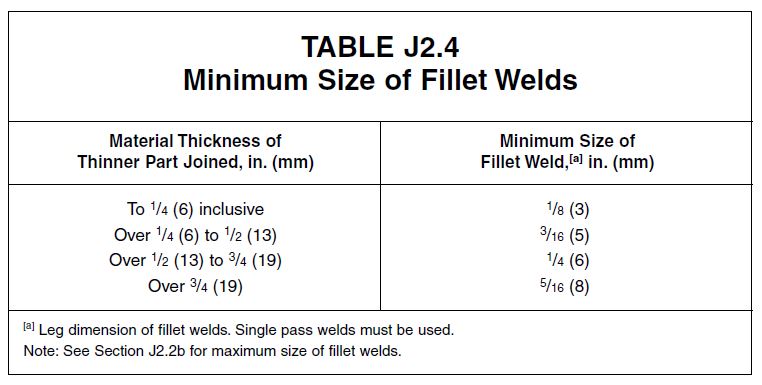
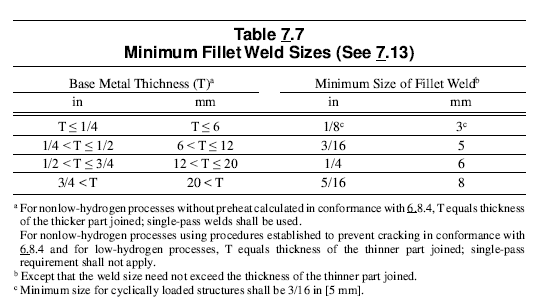
Many organizations set standards for welding, including the American Welding Society (AWS), the International Organization for Standardization (ISO), and the American Institute of Steel Construction (AISC). These standards give clear tables for minimum sizes based on factors like material thickness, type of material, and welding position.
Below is a summary of minimum fillet weld sizes for steel, based on AWS D1. 1, a widely used standard.
| Thicker Part (mm) | Minimum Fillet Weld Size (mm) |
|---|---|
| Less than 3 | Not recommended |
| 3 to < 5 | 3 |
| 5 to < 8 | 4 |
| 8 to < 10 | 5 |
| 10 and above | 6 |
These values are for carbon steel. Other materials, like stainless steel or aluminum, might have different requirements.
Key Standards And Where To Find Them
- AWS D1.1: Focuses on structural steel welding.
- ISO 2553: International standard for welding symbols and sizes.
- AISC Manual: Used in building and bridge design in the US.
Always check the latest version of the standard for your region and application.
Factors That Affect Minimum Fillet Weld Size
The minimum size of a fillet weld is not just about what looks strong. Several important factors must be considered:
Thickness Of The Thinner Part
The most common rule is: the minimum size is based on the thinner part being joined. If you weld a 10 mm plate to a 6 mm plate, the minimum weld size is set by the 6 mm plate. This ensures the weld does not overheat or weaken the thinner material.
Type Of Base Material
Different metals behave differently when welded:
- Carbon steel is easier to weld and has well-known guidelines.
- Stainless steel may require larger welds to avoid cracking.
- Aluminum often needs special care because it conducts heat quickly.
Welding Position
Welds made overhead or vertically may need to be slightly larger than flat welds to compensate for gravity and possible defects.
Service Conditions
If the weld will face vibration, dynamic loading, or harsh weather, a larger minimum size may be required for safety.
Repetitive Stress Or Fatigue
Welds in parts that move or flex a lot must be stronger, so minimum size rules can increase.
Corrosion Protection
A slightly larger weld can help seal joints and prevent water or chemicals from entering, which is useful in outdoor or marine environments.
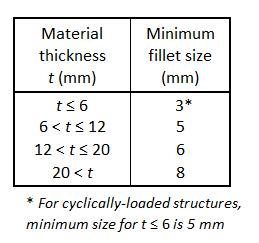
Credit: www.cisc-icca.ca
How To Calculate The Minimum Fillet Weld Size
Calculating the minimum size is straightforward if you follow the standard steps:
- Identify the thinner part’s thickness.
- Check the standard table for your material and application.
- Consider special requirements (such as service conditions, code rules, or inspection needs).
- Round up to the nearest standard weld size (sizes are usually available in 1 mm steps).
For example, if you are welding a 10 mm plate to a 7 mm plate, and the standard says 4 mm for 5 to <8 mm, use a 4 mm fillet weld.
But what if your plate is 2 mm thick? Most standards say fillet welds are not recommended for plates below 3 mm. Instead, a different joint or welding method should be used.
Minimum Fillet Weld Size: Typical Mistakes To Avoid
Even experienced welders and engineers can make mistakes with minimum size:
- Using the thicker part to set the minimum size. The rule is always to use the thinner part.
- Forgetting about joint access. If the joint is hard to reach, the weld might end up smaller than required.
- Ignoring the effect of painting or coating. These can make the weld look bigger than it is, so measure before coating.
- Not checking for distortion. Large welds on thin materials can warp or bend the metal.
- Neglecting special conditions. For example, in cold climates, welds may need to be larger to prevent cracking.
Minimum Fillet Weld Size In Practice: Real Examples
Let’s look at some practical examples that show how standards apply in real work.
Example 1: Welding A 6 Mm Plate To A 10 Mm Plate
- Thinner part: 6 mm
- Standard minimum size: 4 mm (from AWS D1.1)
- Result: Use a 4 mm fillet weld, even though the thicker plate could take a larger weld.
Example 2: Joining Two 4 Mm Plates
- Thinner part: 4 mm
- Standard minimum size: 3 mm
- Result: Use a 3 mm fillet weld.
Example 3: Fillet Weld On A 2.5 Mm Plate
- Thinner part: 2.5 mm
- Standard minimum size: Not recommended
- Result: Use a different joint (like a butt weld) or a special welding process for thin sheet metal.
These examples show why blindly using the same weld size for every job is a mistake. Always check the standard and adapt to the situation.
Minimum Fillet Weld Size For Different Materials
Not all fillet welds are made on carbon steel. Here’s how the minimum size can change with material.
| Material | Usual Minimum Size (mm) | Special Notes |
|---|---|---|
| Carbon Steel | 3-6 | Follow AWS D1.1 or AISC |
| Stainless Steel | 3-8 | Check for cracking risk |
| Aluminum | 4-10 | Needs special welding process |
| High-Strength Steels | Varies | Check manufacturer guidance |
Key insight: Beginners often miss that the “minimum size” is only a starting point. For unusual materials or important joints, consult an engineer or welding expert.
Inspection And Measuring Fillet Weld Size
Inspectors check fillet weld size to make sure it meets code and is safe. This is done using fillet weld gauges. These tools let you quickly measure the leg length and throat thickness.
Steps for measuring:
- Clean the weld area to remove spatter or slag.
- Place the gauge against the weld.
- Read the leg length.
- If the weld is not uniform, measure at several points.
Non-obvious tip: Always measure after the weld cools. Hot welds can expand, making them look larger, and then shrink as they cool.
Some welds are “intermittent,” meaning they are not continuous. For these, the size and length of each segment must be checked.
Fillet Weld Size Symbols And Drawings
Welding symbols on drawings tell the welder what size to make the fillet weld. Understanding these symbols prevents costly mistakes.
- The triangle symbol: Means a fillet weld.
- Number to the left: Shows the weld size (leg length).
- Number to the right: Shows the weld length.
- Arrows and references: Indicate where the weld is to be placed.
Example: If you see a symbol with “6” to the left of the triangle, it means a 6 mm fillet weld.
Practical tip: Always double-check the drawing. Sometimes designers make mistakes or forget to update the size when the design changes.
How Minimum Size Relates To Maximum Size
There is also such a thing as maximum fillet weld size. If the weld is too big, it can cause problems:
- Overheating and weakening the base metal.
- Distortion of thin parts.
- Unnecessary extra cost.
Some standards say the maximum fillet weld should not be more than the thickness of the thinner part minus 1. 5 mm (as a rule of thumb). But always check the standard for your job.
How To Choose The Right Fillet Weld Size
Choosing the correct fillet weld size is not just about following a table. Here are steps to get it right:
- Check the code or standard. Use the latest version, as rules can change.
- Consider the job’s importance. For critical parts, be conservative.
- Think about welding position and access. Hard-to-reach areas may need larger welds.
- Look at the service conditions. Will the part face vibration, heat, or chemicals?
- Check the drawings and symbols. Make sure the size matches the design.
Advanced Considerations: Fatigue, Impact, And Dynamic Loads
Some structures, like bridges or cranes, face repeated loading or vibration. Here, welds can fail even if they look good at first. For these jobs:
- Use larger minimum fillet weld sizes.
- Consider full penetration welds for the most critical joints.
- Check for weld toe blending (smooth transition to base metal) to reduce stress concentration.
Welds that face impact or cold weather may also need special care. Always consult an expert for these cases.
Non-obvious Insights And Practical Advice
1. The heat input matters just as much as size. If you go too fast, the weld may look big but have poor fusion. If you go too slow, you may burn through the base metal.
2. Rework is costly. If an inspector finds undersized welds, you may have to grind them out and reweld. This costs time and money.
3. Watch for cumulative effects. In large structures, a small mistake repeated many times can lead to a big problem. Always measure and check, especially when starting a new job.
4. Weld appearance is not everything. A smooth, shiny weld can still be too small or have poor fusion.
5. Training and practice are key. Using gauges, reading drawings, and understanding codes take time to master.
Credit: weldinganswers.com
Fillet Weld Size In Different Industries
Minimum fillet weld size rules can change depending on the industry:
- Construction: Follows AISC or AWS D1.1. Safety is the top concern.
- Shipbuilding: Often uses larger welds and special alloys.
- Automotive: Uses thinner materials, so weld size rules are stricter.
- Oil and Gas: Welds must be tested for cracks and corrosion resistance.
In each field, always check the relevant standard and talk to experienced welders or engineers.
When To Go Beyond The Minimum Size
Sometimes, you may want to make the weld larger than the minimum:
- If the joint will be ground or machined after welding.
- If the weld will face extreme loads or shocks.
- If there is uncertainty about material quality or fit-up.
But remember, more is not always better. Oversized welds can cause problems, as mentioned earlier.
Credit: aqcinspection.com
Wrapping Up
A correct fillet weld is more than just a line of metal. It is a carefully designed and checked part of a structure. By understanding the minimum size rules, the reasons behind them, and how to apply them in practice, you can make sure your welds are both safe and efficient.
The next time you see a simple triangle of weld metal, remember the science and care that go into making it just the right size.
Frequently Asked Questions
What Happens If A Fillet Weld Is Smaller Than The Minimum Size?
A fillet weld smaller than the minimum is likely to be weak, may not fuse properly with the base metal, and can fail under load. This is dangerous and usually does not pass inspection.
How Do I Measure The Size Of A Fillet Weld?
Use a fillet weld gauge to measure the leg length after the weld has cooled. Place the gauge against the weld and check at several points for consistency.
Are Minimum Fillet Weld Sizes Different For Aluminum And Stainless Steel?
Yes. Aluminum and stainless steel often need larger minimum sizes because of their different welding properties. Always check the standard for your material.
Can I Make A Fillet Weld Larger Than The Minimum?
You can, but it’s not always a good idea. Larger welds add cost and may cause distortion or stress in the base metal. Follow the maximum size limits in the standard.
Where Can I Find Official Fillet Weld Size Standards?
The most widely used is AWS D1.1 for structural steel. You can find more details at the American Welding Society website.


