
Understanding what is throat thickness in welding is critical for ensuring the structural integrity of fillet welds. Throat thickness defines the shortest distance from the weld root to the face of the weld, directly determining the weld’s load-carrying capacity.
Incorrect throat sizing can lead to under-strength welds, premature failure, excessive distortion, and costly rework. In practice, matching throat thickness to design specifications affects amperage settings, penetration depth, and arc stability, making it a key factor in both safety and efficiency.
I’ll discuss the concept of throat thickness, explains how it impacts real-world welding performance, and provides the technical clarity needed to measure, calculate, and optimize welds for stronger, more reliable joints.
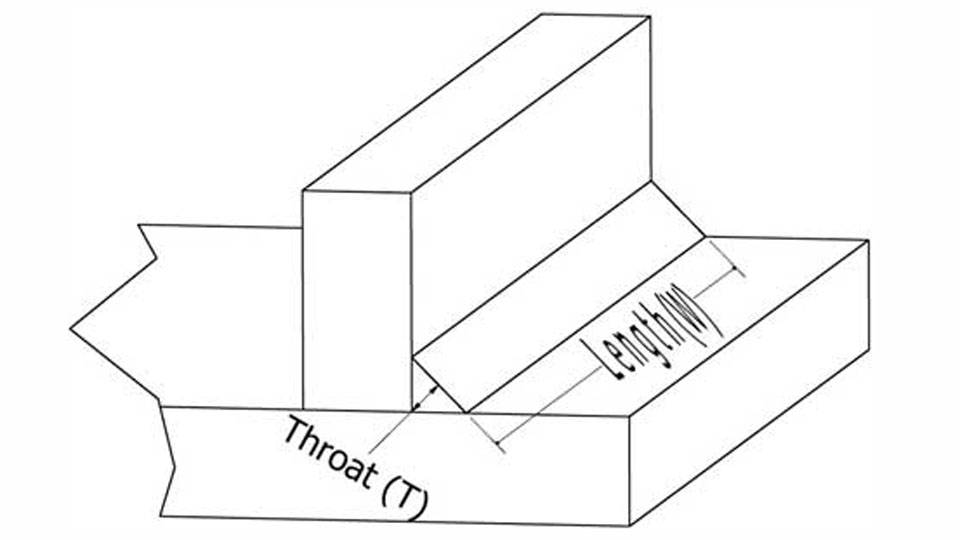
Image by mtm-inc
Defining Throat Thickness
Throat thickness, often called the effective throat or leg throat, measures the depth of the weld metal in a fillet weld. It runs from the deepest point where the base metals meet—the root—to the outer surface of the weld bead. In a standard fillet weld, this forms a right triangle, with the throat as the height.
To visualize, consider two plates joined at a 90-degree angle. The weld fills the corner, and the throat thickness is the perpendicular line from the root to the hypotenuse of that triangle. For convex welds, it’s the distance to the tangent point on the curve; for concave, it’s to the lowest point on the face.
This measurement differs from leg length, which is the distance along each base metal from the root to the toe. While leg length is easier to see on the surface, throat thickness reveals the actual penetration and fusion depth, making it a better indicator of joint integrity.
In codes like AWS D1.1 for structural steel, throat thickness must meet minimum requirements based on material thickness and load type. For example, in a 1/4-inch fillet weld on mild steel, the throat might need to be at least 0.177 inches to handle shear stress effectively.
Why Throat Thickness Matters in Weld Design
Throat thickness directly influences the shear strength of a fillet weld. The formula for shear strength is stress = load / (throat thickness × weld length). A thicker throat distributes stress better, reducing the risk of failure under load.
In practical terms, for a hobbyist building a trailer frame, insufficient throat thickness might cause joints to shear during towing. Professionals in U.S. shops often calculate it to comply with ASME or API standards, ensuring welds hold in pressure vessels or pipelines.
Overly thick throats waste filler material and increase heat input, potentially causing distortion in thin sheets. Balancing it optimizes cost and performance. For instance, in T-joints on 1/2-inch plate, aim for a throat of 0.35 inches to achieve full strength without excess buildup.
This dimension also affects fatigue resistance. In cyclic loading, like in machinery parts, a consistent throat minimizes stress concentrations at the root.
Measuring Throat Thickness Accurately
Accurate measurement starts with proper tools. Use a fillet weld gauge, which has notches for checking throat and leg sizes. Position the gauge so one arm rests on the base metal and the other touches the weld face perpendicularly.
For non-destructive testing, ultrasonic methods can assess throat depth internally, useful for thick sections where visual inspection falls short. Calibrate the device to the material’s acoustic properties—steel typically uses a velocity of 5,900 m/s.
In the shop, after welding, section a test piece if needed. Cut perpendicular to the weld, polish the cross-section, and measure with calipers. This destructive method confirms actual throat versus theoretical.
Common pitfalls include measuring at an angle, which inflates readings. Always align perpendicular to the hypotenuse. For multi-pass welds, measure the cumulative throat after all layers.
| Weld Type | Recommended Tool | Accuracy Level |
|---|---|---|
| Single-pass fillet | Fillet gauge | ±0.01 inch |
| Multi-pass T-joint | Ultrasonic tester | ±0.005 inch |
| Destructive sample | Digital calipers | ±0.001 inch |
Factors Influencing Throat Thickness
Several variables control achievable throat thickness. Joint preparation is key—bevel angles affect penetration. A 45-degree bevel on each plate in a V-groove allows deeper throat without excessive filler.
Electrode choice impacts it too. For SMAW, E7018 rods provide good penetration at 100-150 amps for 1/8-inch diameter, yielding throats up to 0.25 inches in one pass on mild steel.
Polarity matters: DCEP (reverse polarity) in GMAW enhances penetration, increasing throat by 20-30% compared to DCEN. Travel speed also plays a role—slower speeds (8-12 ipm) build thicker throats but risk burn-through on thin materials.
Material compatibility influences outcomes. Welding aluminum requires higher amperage (200-250 amps for 3/16-inch wire) to achieve similar throats as steel due to its higher thermal conductivity.
Arc stability is crucial. Voltage fluctuations can lead to inconsistent throats; maintain 18-22 volts in FCAW for steady deposition.
In overhead positions, gravity pulls molten metal down, reducing throat—compensate with smaller electrodes and lower amps.
Calculating Throat Thickness for Strength
To calculate required throat thickness, use the equation: throat = (load / (0.707 × allowable stress × length)). The 0.707 factor comes from the geometry of a 45-degree fillet, where throat = leg / √2.
For example, in a lap joint carrying 10,000 lbs shear over 6 inches, with allowable stress of 21,000 psi (for E70 electrodes), throat = 10,000 / (0.707 × 21,000 × 6) ≈ 0.113 inches.
Software like WeldCalc or manual charts from AWS help verify. Input joint type, material, and load to get minimum throat.
In practice, add a safety factor of 1.5-2.0 for dynamic loads. For static, stick closer to calculated values to avoid over-welding.
This ensures welds are neither under- nor over-designed, saving time and materials in fabrication shops.
Common Applications and Examples
In automotive fabrication, throat thickness ensures chassis welds hold under vibration. A 0.2-inch throat on frame rails provides adequate strength for off-road vehicles.
For structural steel in buildings, codes mandate minimum throats based on beam size—e.g., 5/16-inch for W12 beams.
DIY projects like gates benefit from 0.15-0.2 inch throats on angle iron, preventing sagging over time.
In pipe welding, effective throat in fillet welds around branches must account for pressure, often requiring 1.414 times the pipe wall thickness.
One insight from shop experience: In high-humidity environments, preheating base metals to 150°F can improve fusion, consistently achieving designed throats without porosity.
Throat Thickness in Different Welding Processes
SMAW typically yields throats of 0.1-0.3 inches per pass, depending on rod size. Use 6010 for root passes in deep joints to maximize initial throat.
GMAW offers better control, with short-circuit mode for thin sheets (throats under 0.15 inches) and spray for thicker (up to 0.4 inches).
TIG welding excels in precision, allowing throats as fine as 0.05 inches on aluminum, but slower deposition rates suit detailed work.
FCAW, with its slag, protects the weld pool for outdoor use, maintaining throats in windy conditions.
Each process demands adjusted parameters: For GMAW on carbon steel, 25-30 cfh gas flow ensures clean throats without oxidation.
Ensuring Consistent Throat Thickness
Consistency requires calibrated equipment. Check welder output weekly—amperage drifts can vary throat by 10-15%.
Joint fit-up is essential; gaps over 1/16 inch reduce effective throat, necessitating bridging techniques.
Post-weld inspection with dyes or magnets detects root defects affecting throat integrity.
Training tip: Practice on scrap with varying angles to master control, as 60-degree joints need larger throats than 90-degree for equivalent strength.
Conclusion
Mastering throat thickness equips welders to create joints that reliably transfer loads and resist failure modes like shear or fatigue. By focusing on accurate measurement, process-specific parameters, and design calculations, you ensure every weld contributes to the overall durability of the fabrication.
This understanding prevents common issues such as under-penetration in critical assemblies, allowing for efficient material use and compliance with industry standards.
For an advanced insight, consider how throat thickness interacts with heat-affected zone properties in high-strength low-alloy steels.
Preheating to 300°F and using low-hydrogen electrodes can minimize HAZ cracking while optimizing throat for maximum tensile strength, often exceeding 70 ksi in properly executed welds. This approach elevates weld performance in demanding applications like heavy equipment repair.
FAQ
How Does Throat Thickness Differ from Weld Size?
Weld size often refers to leg length, visible on the surface, while throat thickness measures the internal depth perpendicular to the face. Throat provides a truer strength metric, as size alone doesn’t account for convexity or concavity affecting load distribution.
What Tools Are Best for Measuring Throat in Field Conditions?
In the field, a pocket fillet gauge offers quick, non-destructive checks with accuracy to 1/32 inch. For precise work, pair it with a digital protractor to ensure perpendicular measurement, avoiding errors from uneven surfaces.
Can Throat Thickness Be Adjusted Post-Weld?
Post-weld grinding can reduce excess throat in convex welds, but increasing it requires re-welding. Always aim for correct thickness initially, as grinding weakens the joint if it removes too much fusion zone material.
How Does Material Thickness Impact Required Throat?
Thicker base metals demand proportionally larger throats to avoid stress concentrations. For 1-inch plate, target 0.7 times the thickness for full-strength fillets, adjusting for yield strength—e.g., 50 ksi steel needs less than 100 ksi alloys.
What Role Does Welding Position Play in Achieving Throat Thickness?
Flat positions allow easier buildup for thicker throats, while vertical or overhead require stringer beads and lower heat to prevent sagging, often limiting throat to 80% of flat-position capabilities without supports.


