
I was inspecting a corner joint on a steel frame when I noticed the weld didn’t look quite right—too thin in spots and uneven along the edge. That’s when it hit me how crucial knowing how to calculate throat thickness of fillet weld really is.
Getting this measurement right isn’t just about passing inspection; it affects the strength, durability, and safety of the entire structure.
I’ll show you step by step how to determine fillet weld throat thickness accurately, with tips I’ve picked up over years in the workshop that make the math simple and practical.
Fillet Weld Basics Every Welder Should Know
A fillet weld is that triangular bead you lay in the corner where two pieces of metal meet at a right angle—think T-joints, lap joints, or corner assemblies. It’s one of the most common welds you’ll run into, especially in structural work or repairs.
How does it work? The weld fuses the two base metals together with filler material, creating a strong bond without needing full penetration like a groove weld. You heat the joint with your arc, melt the electrode, and deposit metal to form the fillet.
But here’s where experience kicks in: the shape and size aren’t random. They’re dictated by the load the joint will bear, the material thickness, and the welding process you’re using, like SMAW (stick welding), which is my go-to for outdoor jobs.
Use a fillet weld when you need quick, reliable strength without overcomplicating the setup. It’s ideal for non-critical structural elements, like attaching brackets to beams or sealing corners on tanks. Why? Because it’s forgiving on fit-up and doesn’t require as much prep as other welds.
In practice, though, I’ve seen guys overuse them on high-stress applications, leading to failures. The key is matching the weld to the job—calculate the required size first to avoid under- or over-welding.
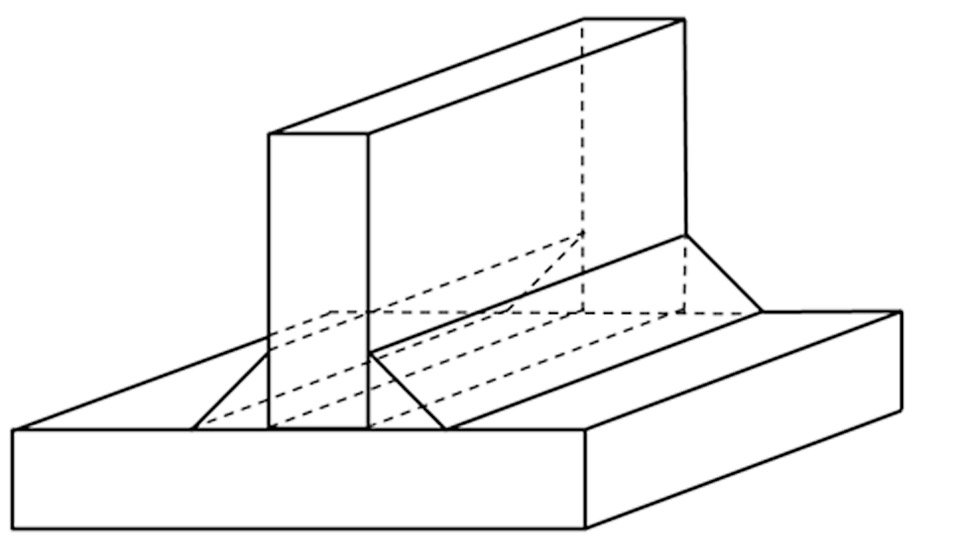
Image dlubal
From the shop floor: Always clean your joint thoroughly before starting. Mill scale, rust, or oil can cause porosity, weakening the throat. I once had a batch of trailer hitches come back because I skipped a thorough wire brushing—lesson learned, and it cost me a weekend of rework.
Why Throat Thickness Matters in Your Welds
Throat thickness is the shortest distance from the root of the weld (where the two metals meet) to the face of the fillet, measured perpendicular to the root. It’s essentially the “effective” size of your weld that carries the load.
Think of it this way: In a fillet weld, the legs are the visible sides along the base metals, but the throat is what determines shear strength. For equal-legged fillets, the throat is about 70% of the leg length (thanks to that 45-degree angle). If your design calls for a 1/4-inch leg, the throat might be around 0.177 inches—but we’ll get into the math soon.
When do you focus on it? Always in load-bearing joints, like machinery frames or vehicle repairs. Underestimate the throat, and your weld might shear off under stress; overestimate, and you’re wasting rod and risking distortion from excess heat.
Safety-wise, it’s crucial—I’ve welded pressure vessels where improper throat led to leaks, and in structural steel, it prevents collapses.
Practical tip: In the field, use a fillet weld gauge to check throat after cooling. It’s faster than calculating every time and catches issues before they become problems. Common mistake? Assuming a bigger weld is always better. Nope—extra metal can cause cracking from uneven cooling.
Step-by-Step: How to Calculate Throat Thickness
Calculating throat thickness isn’t complicated, but it requires knowing your joint and materials. Here’s how I do it in the shop, step by step.
First, identify your fillet type. For a standard equal-legged fillet (both legs the same length), the formula is straightforward: Throat thickness (t) = Leg length (z) × cos(45°) or z / √2, which is approximately z × 0.707.
Step 1: Measure or specify the leg length. This comes from engineering drawings or load calculations. For example, on mild steel plates under shear stress, you might need a 5/16-inch leg.
Step 2: Apply the formula. If z = 0.3125 inches, t = 0.3125 × 0.707 ≈ 0.221 inches.
Step 3: Adjust for unequal legs. If one leg is longer, use t = (shorter leg + longer leg) / (2 × √2), but better yet, draw it out or use software for precision.
Step 4: Factor in convexity. Real welds aren’t perfectly flat; a slight convex face reduces effective throat, so aim for minimal convexity.
For concave fillets (which are weaker), the throat is measured to the lowest point on the face.
In practice, I always verify with a test piece. Weld a sample, section it with a cutoff wheel, and measure directly with calipers. It’s eye-opening how arc voltage affects the actual throat—higher voltage flattens it out.
Common pitfall: Ignoring material thickness. On thin sheets (under 1/8 inch), you can’t achieve a thick throat without burn-through. Scale down accordingly.
Choosing the Right Welding Rod for Optimal Throat
The rod you pick directly influences how well you can build that calculated throat. In SMAW, electrodes like E6010 or E7018 are staples in US shops for their versatility.
What are they? E6010 is a cellulose-coated rod for deep penetration, great for root passes in fillets. E7018 is low-hydrogen for cleaner welds on structural steel.
How it works: The coating fluxes out impurities, stabilizes the arc, and adds alloys to the weld pool, affecting bead shape and throat depth.
Use E6010 when you need aggressive dig on dirty metal, like outdoor repairs. Switch to E7018 for code work where ductility matters.
Why? The right rod ensures proper fusion without slag inclusions that undercut throat strength.
Shop tip: Store rods in a dry oven—moisture ruins low-hydrogen types, leading to hydrogen cracking. I’ve lost count of how many bad welds stemmed from damp rods.
Mistake to avoid: Using the wrong polarity. DCEN for E6010 gives deeper penetration, building throat faster, but switch to DCEP for E7018 to avoid spatter.
For fillet welds, match rod diameter to throat needs—smaller rods for precise control on thin material.
Amperage Settings to Achieve Desired Throat Thickness
Amperage is your throttle for building throat. Too low, and you get shallow penetration; too high, and you risk undercut or burn-through.
Ranges vary by rod size and process. For a 1/8-inch E7018 rod, I run 90-140 amps on mild steel, adjusting up for thicker plates.
How it works: Higher amps melt more rod, depositing filler quicker for thicker throats, but increase heat input, which can warp thin sections.
When to use what: Start low on test pieces—say 100 amps for a 3/16-inch fillet—and creep up until the bead wets nicely without sagging.
Why it matters: Proper amps ensure full fusion to the root, maximizing throat effectiveness.
Practical advice: On US machines like Lincoln or Miller inverters, use the digital readout for consistency. In my shop, I mark settings on a chart for repeat jobs.
Fix for bad welds: If throat is undersized from low amps, grind out and reweld. For excess, dress it down with a grinder to avoid stress risers.
Common error: Ignoring electrode angle. Hold at 45 degrees to the joint for even leg distribution, ensuring balanced throat.
| Rod Diameter | Typical Amperage Range (E7018 on Mild Steel) | Best For Throat Thickness |
|---|---|---|
| 3/32 inch | 70-100 amps | Up to 1/8 inch |
| 1/8 inch | 90-140 amps | 1/8 to 1/4 inch |
| 5/32 inch | 120-180 amps | 1/4 to 3/8 inch |
| 3/16 inch | 150-220 amps | Over 3/8 inch |
This table’s saved me time on jobs—adjust 10-20% lower for vertical positions to prevent slag run.
Joint Preparation Tips for Better Throat Control
Prep work sets the stage for your throat calculation to pay off. A clean, properly fitted joint allows better penetration and accurate sizing.
What is it? Beveling edges, grinding surfaces, and ensuring tight fit-up.
How: For fillets on plates over 1/4 inch, bevel one side at 30 degrees to open the root for deeper throat.
When: Always on rusty or painted metal; skip on clean, thin stock to avoid distortion.
Why: Poor prep leads to incomplete fusion, reducing effective throat by 20-30%.
Tip: Use a flap disc for beveling—it’s faster and leaves a smoother surface than a grinding wheel. In fabrication, I clamp joints to prevent gaps that force oversized welds.
Mistake: Over-beveling, which requires more filler and risks warping. Test fit dry first.
For material handling: Preheat thicker steels (over 1 inch) to 200°F to slow cooling and prevent cracks that compromise throat.
Material Compatibility and Filler Metal Choices
Matching filler to base metal is non-negotiable for throat integrity. Mild steel? Stick with E70 series rods for matching tensile strength.
How it works: The filler alloys with the base, creating a homogeneous weld zone.
Use matching fillers for carbon steels; go undermatching for dissimilar metals to avoid brittleness.
Why: Mismatch causes galvanic corrosion or weak throats in corrosive environments, like marine repairs.
Shop anecdote: I once used E308 on mild steel by mistake—weld looked fine, but it cracked under load. Always double-check rod labels.
Pros of compatible fillers: Better ductility, less rework. Cons: Higher cost for specialty rods, but worth it for critical jobs.
Suggest: For aluminum fillets (using TIG), use 4043 filler for its flow; on stainless, 308L to minimize carbide precipitation.
Common Mistakes in Fillet Welding and How to Fix Them
Even pros slip up. Undercut—those grooves along the toe—eats into throat thickness.
What happens: High travel speed or amps cause it.
Fix: Slow down, weave slightly, and dress with a grinder if minor.
Another: Lack of fusion from cold laps. Increase amps or preheat.
Porosity from dirty rods weakens the throat—bake them out.
In my experience, beginners rush the puddle control, leading to convex beads that overstate throat. Practice on scrap to flatten it.
For distortion: Tack weld alternately and use backstepping to build throat evenly.
Advanced Techniques for Precise Throat in Challenging Jobs
On vertical fillets, gravity pulls the puddle, thinning throat. Use uphill technique with lower amps.
For overhead, short arc and small rods prevent sagging.
In multi-pass fillets for thick throats, calculate layers: First pass for root, subsequent for build-up.
Tip: On US code jobs (AWS D1.1), measure throat with ultrasonic testing for hidden defects.
I’ve used weaving on wide joints to distribute heat, achieving uniform throat without hot spots.
Safety Considerations When Building Throat Thickness
Never skimp on PPE—fumes from high-amp runs are brutal. Use a respirator in confined spaces.
Arc flash risks rise with bigger rods; wear rated gear.
Post-weld, let cool naturally to avoid quenching cracks in the throat.
Electrical safety: Ground properly on US 220V machines to prevent shocks.
From the shop: I once got a nasty burn from hot slag—always knock it off before inspecting throat.
Final Thoughts
The throat thickness calculation transforms your welds from guesswork to reliable craftsmanship. You’ve got the formulas, settings, and fixes now to tackle any fillet job with confidence, saving time and materials while boosting safety.
Whether you’re fixing farm gear or building custom rigs, this knowledge equips you to spot issues early and deliver pro-level results.
Always document your calculations and settings in a job log—it’ll sharpen your skills over time and make quoting repeats a breeze.
What if my calculated throat doesn’t match the actual weld?
Double-check your leg measurements and formula. If off, adjust amps or rod size on a test piece. Often, it’s due to inconsistent travel speed—practice maintaining a steady 10-12 inches per minute.
How does material type affect throat calculation?
On stainless or alloys, factor in higher strength— you might need a smaller throat for the same load. Use matching fillers and preheat to avoid dilution issues that weaken the effective throat.
Can I use the same amperage for all rod sizes?
No way—scale it with diameter. A 1/8-inch rod at 120 amps might work, but jump to 5/32 and you’ll need 150+ to melt properly without sticking. Test on scrap to dial in.
What’s the biggest mistake with fillet weld throats?
Overwelding for “safety.” It adds weight, heat, and cost without benefit. Stick to calculated sizes—engineered properly, a precise throat is stronger than a sloppy big one.
How do I check throat thickness without cutting the weld?
Use a fillet gauge for the legs, then estimate throat at 0.707 times the smaller leg. For accuracy, non-destructive tests like dye penetrant reveal root issues affecting throat.


