
Standing near a flash welding machine while it fires off a burst of sparks can feel intense—even for someone used to arc welding. The metal edges heat up fast, almost explosively, and then fuse under pressure in seconds.
It’s impressive, but it also makes you think carefully about the Advantages and Disadvantages of Flash Welding before relying on it for real jobs.
In a production setting, flash welding can be a huge time-saver. It delivers strong, repeatable joints with minimal filler and works great for certain materials and shapes.
But it’s not all smooth sailing—setup needs to be precise, the equipment isn’t cheap, and it’s not always the best choice for smaller or custom work.
That’s why understanding both sides matters. Choosing the right welding process affects not just strength, but cost, efficiency, and long-term reliability. I’ll break down where flash welding really shines, where it falls short, and how to decide if it fits your workflow.
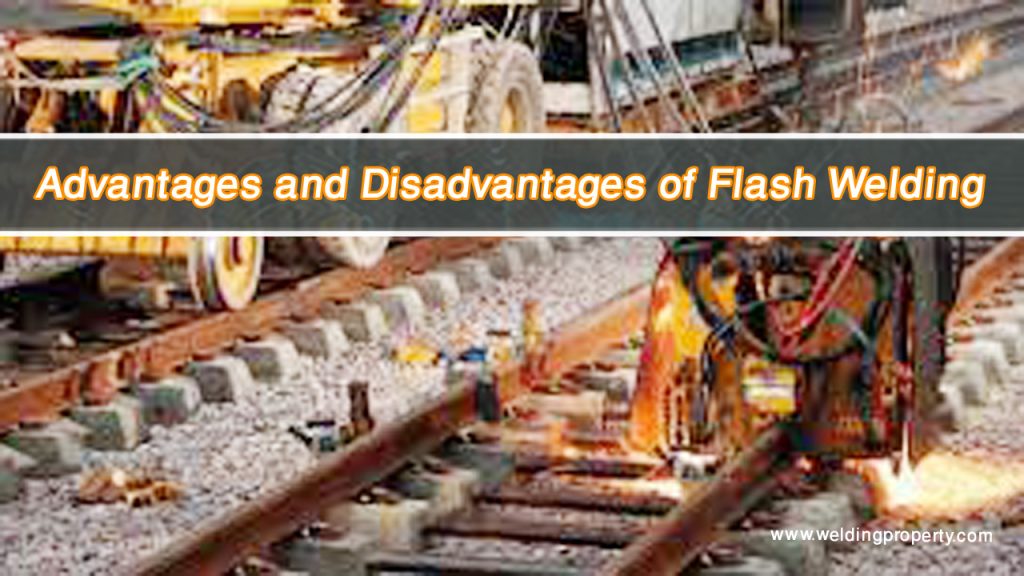
Image by railsystem
What Exactly Is Flash Welding and How Does It Actually Work?
Flash welding (sometimes called flash butt welding) is a resistance welding process that joins two metal pieces end-to-end without filler metal. You clamp the parts in copper alloy dies, bring them close enough for current to jump across the gap, and let the resulting arcs “flash” away surface oxides and impurities.
Once the ends are molten and clean, the machine applies a sudden forging force—called upset pressure—to mash them together while the current is still flowing or right after it stops.
The whole cycle usually lasts between three and fifteen seconds depending on material thickness and cross-section. No welding rods, no gas shielding, no SMAW electrode diameters to worry about. Instead, you’re dealing with thousands of amps at low voltage (typically 5–20 volts) and hydraulic pressures measured in tons.
In practice, the machine controls three main phases:
- Flash phase – Current flows, arcs burn off contaminants, and the material shortens slightly as metal vaporizes.
- Transition – You stop the flashing (or it self-regulates) and the ends reach plastic temperature.
- Forge/upset phase – The parts are slammed together, squeezing out any remaining molten metal and forming a solid-state bond.
I’ve run flash welds on A36 plate, 4130 chromoly tubing, and even 304 stainless exhaust manifolds. The process works best on ferrous and some non-ferrous metals that can handle the rapid heating and forging without cracking.
When Should You Reach for Flash Welding Instead of MIG, Stick, or TIG?
Flash welding shines when you need a full-penetration butt joint that matches the parent metal strength and you’re doing more than a handful of identical pieces. I use it daily for production runs of gate frames, trailer hitches, and conveyor rail sections because the joint is essentially invisible after a quick grind.
It’s also the go-to for field-erected structures where you can bring the parts back to the shop or use a portable flash unit. Think railroad rail repairs or heavy equipment boom sections.
The speed alone beats any arc process when you’re joining large cross-sections—try laying a ¾-inch fillet with stick on a 4-inch wide flange and you’ll understand why flash wins on time.
But walk away if:
- The parts are too long or awkward to clamp squarely.
- You need to join dissimilar metals (aluminum to steel is a nightmare).
- The job is one-off and your shop doesn’t own a flash welder.
- Appearance matters more than strength and you can’t hide the upset flash.
The Real Advantages of Flash Welding I’ve Counted On for Years
First and biggest advantage—zero filler metal cost. I’ve saved thousands on 1/16-inch ER70S-6 wire alone by switching high-volume butt joints to flash. No rods to burn off, no gas bottles to swap, no slag to chip.
Second, minimal heat-affected zone (HAZ) compared to SMAW or FCAW. Because the heat is localized right at the interface and the cycle is so short, distortion on long bars stays under 1/16 inch in most cases. I once welded 20-foot sections of 3-inch square tubing for a custom trailer and the final assembly fit the jig perfectly—no post-weld straightening required.
Third, consistent joint strength. When parameters are dialed, the weld is stronger than the base metal. I’ve had tensile tests come back at 110% of parent material on mild steel. That’s huge for load-bearing applications where a customer is trusting their equipment to your welds.
Fourth, clean operation. No smoke, no spatter, no need for a $2,000 fume extractor on every station. My shop guys actually like running the flash machine because their helmets stay clean and they’re not breathing flux all day.
Fifth, high productivity. One operator can knock out 60–80 joints per hour on a decent machine. Compare that to the 12–15 joints an experienced MIG welder might make in the same time on the same parts.
Disadvantages That Still Keep Me Up at Night
Let’s be honest—the disadvantages of flash welding are real and they bite hard if you ignore them.
Equipment cost is the obvious one. A reliable 150 kVA flash butt welder with hydraulic upset runs $45,000–$120,000 new. I bought my first used one for $18,000 and it paid for itself in eighteen months, but that’s not pocket change for a hobbyist or small garage shop.
Geometry limitations kill a lot of jobs. You need straight, square ends and good clamping access. Curved tubing, angled joints, or thin sheet? Forget it—flash welding hates anything that isn’t a clean butt.
Power requirements are no joke. My big machine pulls 480-volt three-phase at peak currents over 30,000 amps. Most home shops or small fab shops simply don’t have that service. I’ve seen guys try to run smaller units on 220-volt single-phase and watch the lights dim every time the flash starts.
Flash and upset cleanup adds labor. That molten metal squirt-out (called “flash collar”) has to be trimmed or ground off. On a busy day that’s extra time and consumable abrasive wheels.
Material sensitivity shows up fast. High-carbon steels or certain tool steels can crack during the rapid quench if you don’t preheat or control the cooling rate. I learned that the expensive way on a batch of 4140 shafts—ended up with 23 cracked parts before I adjusted the post-weld heat cycle.
Operator skill still matters more than most people admit. You can’t just push a button and walk away. Mis-set flash distance by 1/16 inch and you get cold laps or porosity hidden inside the joint.
Machine Setup and Settings That Actually Work in a Real Shop
I run a Taylor-Winfield 200 kVA unit with programmable PLC. Here’s the checklist I give every new guy:
- Clamp pressure: Start at 2,500–3,500 psi. Too low and the parts slip; too high and you crush soft aluminum.
- Flash distance: Usually 1/8–3/16 inch per side for steel up to 1 inch thick. Measure with a caliper before every job.
- Flash current and time: 18,000–28,000 amps for mild steel, 4–8 seconds. I watch the color—bright orange to white is perfect.
- Upset force: 6–12 tons depending on cross-section. I add 20% extra if the material is over 0.5% carbon.
- Upset distance: 1/4–3/8 inch total shortening tells me the weld took properly.
Always run a test coupon first. I keep a stack of 4-inch scrap pieces of the same material right next to the machine. Cut, flash, section it with a chop saw, and hit it with a hammer. If it bends instead of breaking at the joint, you’re golden.
Joint Preparation: The 10-Minute Step That Saves Hours of Rework
Clean, square, and parallel ends are non-negotiable. I tell my crew: “If you wouldn’t MIG it, don’t flash it.”
- Mill or grind the ends to within 0.010 inch flatness.
- Remove rust, scale, oil, and paint—acetone wipe followed by a 60-grit flap disc.
- Align parts so the mismatch is less than 10% of thickness.
- For pipe or tube, make sure the ID and OD are deburred so the upset doesn’t create internal flash that blocks flow.
On stainless or aluminum I go one step further and use a dedicated stainless wire wheel—cross-contamination will ruin the joint.
Material Compatibility: What I’ve Successfully Welded and What I Won’t Touch
Mild steel, low-alloy steels, and most stainless grades are my bread and butter. 4130 and 4340 chromoly work great with a post-weld stress relief if the part is critical.
Aluminum is possible but finicky—higher currents and shorter flash times because it conducts heat so fast. I’ve done 6061-T6 tubing for race car frames with good success.
Cast iron? Only if it’s ductile and you preheat to 600 °F. Gray cast iron almost always cracks.
Copper and brass are doable on specialized machines but the zinc vapor from brass will eat your dies in a hurry.
Never flash weld dissimilar metals unless you’re willing to accept a weaker interface and potential corrosion down the road.
Safety Considerations Every Flash Welder Must Live By
The flash is bright enough to burn your retinas in a split second. I mandate auto-darkening helmets set to shade 14 minimum and side shields on every machine.
Molten metal sprays up to six feet—full leather sleeves, apron, and spats are standard. I’ve seen guys in T-shirts regret that decision instantly.
Hydraulic pressure can exceed 10 tons. Never reach into the clamp area while the machine is energized. I installed dual palm buttons and a light curtain on my newer unit after a close call early on.
Electrical safety is huge. The secondary voltage is low, but the amperage will kill you if something shorts. Keep the work area dry and never stand in water while operating.
Flash Welding vs. Other Processes: Quick Shop Comparison
| Process | Joint Strength | Speed (joints/hr) | Filler Cost | Distortion | Equipment Cost | Best For | My Typical Use Case |
|---|---|---|---|---|---|---|---|
| Flash Welding | Excellent | 60–80 | None | Very Low | High | Production butt joints | Railings, frames, pipe sections |
| MIG/GMAW | Good | 15–25 | High | Medium | Medium | General fab | One-offs, thin material |
| Stick/SMAW | Good | 8–12 | Medium | High | Low | Field repair | Heavy plate outdoors |
| TIG/GTAW | Excellent | 4–8 | High | Low | Medium-High | Precision & appearance | Stainless exhaust, aluminum |
| Friction Welding | Excellent | 30–50 | None | Very Low | Very High | Round parts only | Shafts & axles |
I keep this chart laminated on the wall by the welders. Saves a lot of “which process should we use?” debates.
Step-by-Step Guide to Your First Reliable Flash Weld
- Cut and square the parts.
- Clean thoroughly.
- Load into dies and snug clamps.
- Set machine parameters from your test data.
- Run a dry cycle to check alignment.
- Initiate flash cycle—watch for steady sparking.
- Let the upset happen automatically.
- Wait for cool-down (I use compressed air on critical parts).
- Remove, trim flash, and inspect.
- Section one test piece and break it to confirm.
Do this ten times on scrap before you touch a customer part.
Common Mistakes I See Beginners (and Sometimes Pros) Make
- Setting flash time too short—leaves oxides in the joint.
- Clamping dirty or oily parts—causes porosity you can’t see until it fails in service.
- Ignoring upset measurement—looks pretty but has no fusion.
- Forgetting to dress the copper dies—poor contact equals weak welds.
- Running without preheating on high-carbon steel—cracks every time.
Real-World Shop Examples That Prove the Point
Last summer we flash-welded 180 sections of 2½-inch square tubing for a municipal bike path railing project. Zero defects, passed X-ray on the first article, and the city inspector was impressed enough to send more work. The alternative—GMAW with back-purging—would have taken three extra weeks and doubled the labor cost.
On the flip side, I once tried to flash 1-inch thick 1045 bar for a customer who “just wanted it cheap.” The parts weren’t perfectly square and we got 40% rejects. Lesson learned: sometimes the cheapest process isn’t the cheapest when rework hits.
Putting It All Together: Why Flash Welding Still Earns Its Place in My Shop
After two decades of striking arcs, pushing wire, and yes, flashing metal, I can tell you this process earns its keep when the job lines up with its strengths. You now know the advantages and disadvantages of flash welding from actual weld beads, not theory.
You understand the machine settings, joint prep, material limits, and safety steps that separate a pro from someone who just owns the equipment.
Next time a print calls for a clean, strong, distortion-free butt joint on identical parts, you’ll walk straight to the flash welder instead of second-guessing. You’ll set the parameters with confidence, run the test coupon, and deliver a joint that will outlast the rest of the assembly.
Always measure your upset distance after the cycle and write it on the job traveler. That single number tells you more about weld quality than any visual inspection ever will. If it’s within 10% of your test coupon, sleep easy. If not, cut it out and do it again. Your customers—and your reputation—will thank you.
FAQ: Real Questions I Get Asked About Flash Welding
Can I build a DIY flash welder in my garage?
Short answer—no, not safely or reliably. The power supply and hydraulic system needed for anything thicker than ¼ inch are beyond most home setups. Stick with MIG or TIG for hobby work unless you’re ready to spend serious money and follow NEC guidelines for high-current resistance welding.
How do I know if my parts are too thick for my machine?
Check the manufacturer’s kVA and upset force ratings against the cross-sectional area. As a rule of thumb, my 200 kVA unit handles up to 2 square inches of mild steel comfortably. Anything bigger and the flash time gets too long, leading to uneven heating.
Does flash welding require post-weld heat treatment?
On mild steel, usually not. On anything over 0.40% carbon or quenched-and-tempered alloys, yes—stress relief at 1,100–1,200 °F for one hour per inch of thickness prevents delayed cracking. I always normalize 4140 and 4340 parts.
What’s the biggest safety mistake new operators make?
Treating the flash like a regular welder’s arc. The UV intensity and molten spray are on another level. Full PPE every single time—no exceptions.
How long do the copper dies last?
On clean steel, 5,000–8,000 welds before redressing. On stainless or aluminum, half that. Keep a spare set dressed and ready; changing them mid-job kills productivity.


