Getting a smooth, stable bead with 7018 isn’t always as simple as striking an arc and going. I’ve seen plenty of welds go wrong just because the machine settings were a little off—either the rod starts sticking, the puddle gets too fluid, or the bead ends up looking cold and weak. That’s exactly why understanding the Best Setting for 7018 Welding Rod matters more than most beginners realize.
In real stick welding work, 7018 is known for producing strong, clean, low-hydrogen welds—but only when the voltage (or amperage) and technique are properly matched to the material thickness and position.
Even small adjustments can completely change arc stability and penetration quality, especially on structural steel jobs where consistency is everything.
That’s why this topic is so important. Dialing in the right settings doesn’t just make welding easier—it directly impacts strength, appearance, and safety.
I’ll walk through practical settings, real-world adjustments, and simple tips from shop experience so you can run 7018 rods with confidence and get dependable results every time.
What Is A 7018 Welding Rod?
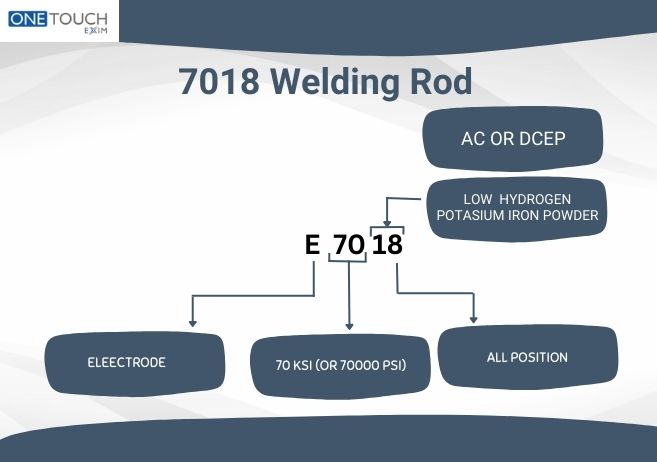
Before adjusting settings, it helps to know exactly what a 7018 rod is. The numbers tell a lot:
70 = 70,000 psi tensile strength. This means the weld can withstand a lot of pulling force before breaking. For construction, bridges, and heavy repairs, this strength is needed.
1 = All positions (flat, vertical, overhead, horizontal). You can use the rod in any position, so it’s flexible for different jobs. For example, if you need to weld a pipe standing up, or a plate lying flat, the 7018 rod can do both.
8 = Low-hydrogen, iron powder coating. The coating helps prevent weld defects caused by moisture and hydrogen, which can lead to cracking. Low hydrogen is especially important for structural steel.
This rod is famous for making strong, clean welds. It works well on structural steel, repair jobs, and critical projects like bridges. It’s also less prone to cracking, which is why many welding codes require it.
Extra detail: The iron powder in the coating also increases deposition rate. This means you lay down more weld metal with every pass, making the process efficient for big jobs.
Why Settings Matter For 7018 Rods
You can run a 7018 rod on many machines, but only the right settings give you:
Smooth, stable arc: The arc should sound like a gentle buzz, not a harsh crackle. This helps you control the weld puddle.
Minimal spatter: Less spatter means less cleaning later and a neater weld. Too much spatter can cover the weld and make it harder to inspect.
Deep penetration: The weld must go deep into the base metal for strength. Poor penetration can make the joint weak and unsafe.
Attractive bead appearance: A good weld bead looks uniform, not lumpy or uneven. This is important not just for looks, but also for inspection and strength.
Strong welds: The right settings make sure your weld is not just pretty, but also tough and reliable.
Wrong settings can cause problems like sticking, porosity (holes), undercutting, or weak welds. For example, running too low an amperage makes the rod stick and creates a weak joint. Too high and you’ll blow through the metal or create excessive spatter.
Extra insight: Sometimes, welders overlook the effect of machine age. Older machines may deliver less stable power, so check your welder performance, especially if you notice unusual arc behavior.
Key Factors Affecting 7018 Settings
Let’s break down the main variables:
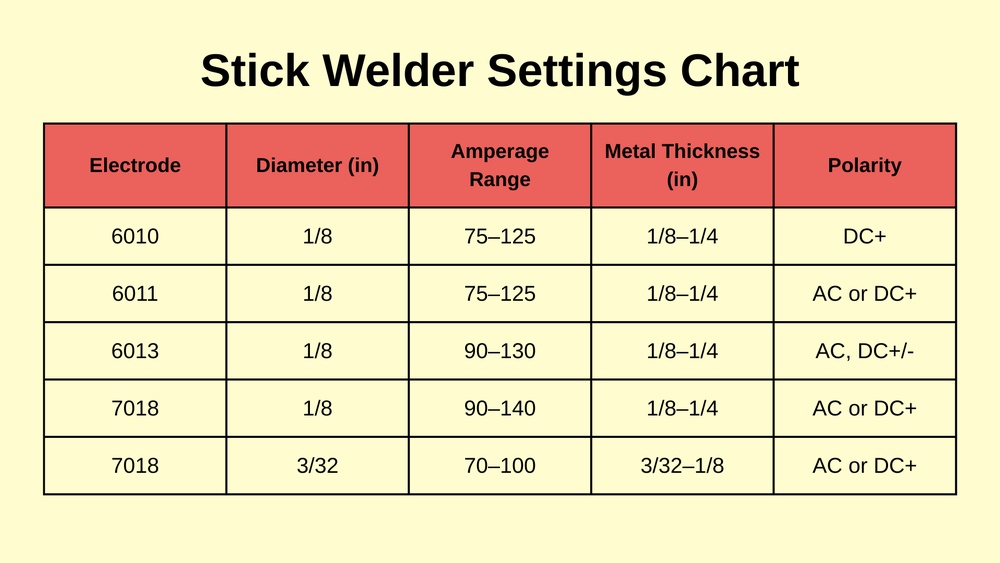
Rod Diameter: 7018 rods come in sizes like 3/32″, 1/8″, 5/32″, and 3/16″. The diameter affects how much current you need and how thick the weld bead will be.
Material Thickness: Thicker steel needs more heat. If you use too little heat, the weld won’t penetrate.
Welding Position: Overhead, vertical, flat, or horizontal affects your control. For example, overhead welds need lower amperage to avoid dripping.
Welder Type: Some machines deliver power differently. Inverter welders often have more stable arc and can handle a wider range of settings.
Polarity: AC or DCEP (DC Electrode Positive) makes a difference. Polarity affects penetration and arc stability.
Understanding these factors is crucial before you start adjusting your settings.
Extra explanation: Sometimes, the type of joint (butt, lap, fillet) also affects settings. For fillet welds, you may need a slight weave technique, while butt joints often need a straight pass.
Recommended Amperage Settings For 7018 Rods
The most important setting for 7018 rods is amperage. Here are the typical ranges for each common diameter:
| Rod Diameter | Amperage Range (Flat/Horizontal) | Amperage Range (Vertical/Overhead) |
|---|---|---|
| 3/32″ (2.4mm) | 70–105A | 65–90A |
| 1/8″ (3.2mm) | 110–165A | 100–135A |
| 5/32″ (4.0mm) | 150–220A | 135–180A |
| 3/16″ (4.8mm) | 210–305A | 180–250A |
Tip: Start at the lower end if you’re new or working with thin steel. If your arc is unstable or the rod sticks, slowly increase amperage.
Example: If you’re welding a 1/4″ plate with a 1/8″ rod, try 120A. If the rod sticks or the bead looks cold, move up to 130A. If the puddle is too fluid and you see burn-through, drop back to 115A.
Extra detail: Amperage can also be affected by cable length and connections. If your cables are very long, you may lose voltage, so your actual amperage at the rod tip may be less. Always check your connections for tightness.
How To Choose The Right Polarity
The 7018 rod works best with DCEP (Direct Current Electrode Positive). This provides deeper penetration and stable arc. However, if you only have an AC machine, 7018 rods can still work, but you may notice more spatter and a slightly less smooth arc.
- DCEP (DC+): Best for 7018, smoother arc, strong welds.
- AC: Acceptable if you don’t have DC. Use the same amperage settings as DC.
Common mistake: Using DCEN (Direct Current Electrode Negative) by accident. This gives poor results—always check your cables and machine setting.
Extra explanation: Some 7018 rods are made specifically for AC machines, called “7018AC.” If you have trouble with arc stability on AC, try these rods—they help with easier arc starts and reduce spatter.
Setting Voltage And Arc Force
Most stick welders do not let you set voltage directly; it’s controlled by amperage. But some advanced machines let you adjust arc force (also called dig or arc control).
Arc Force: Set around 30–40% if adjustable. This helps keep the arc stable, especially for vertical or overhead welds.
Voltage: For manual stick welders, voltage is typically self-regulating, but expect about 22–28 volts during 7018 welding.
Don’t confuse arc force with amperage—they are not the same. Arc force is about arc stability when the rod is close to the metal.
Extra tip: Too much arc force can cause a harsh arc and excessive spatter, while too little may cause sticking. Adjust slowly, and listen for a steady buzz.

Credit: fsmdirect.com
Choosing The Right Rod Diameter For Your Project
Picking the right 7018 rod diameter is important:
- 3/32″ (2.4mm): Best for thin steel (1/8″–1/4″), light fabrication, small repairs.
- 1/8″ (3.2mm): Most popular size; good for 1/4″–1/2″ steel.
- 5/32″ (4.0mm): Heavy fabrication, thick steel (over 1/2″).
- 3/16″ (4.8mm): Industrial, very thick steel.
Don’t use a large rod on thin metal—you’ll blow holes. For heavy work, a small rod won’t penetrate enough.
Non-obvious insight: The length of the rod also matters—shorter rods give you better control in tight spaces or for vertical/overhead work.
Extra example: For pipe welding in a cramped area, a short 3/32″ rod lets you maneuver without hitting the walls. For long, straight welds on plate, a full-length rod is more efficient.
Effect Of Material Thickness
Your base metal’s thickness changes everything:
- Thin steel (<1/8″):Use 3/32″ rod, 70–85A, low travel speed.
- Medium steel (1/8″–1/4″): Use 1/8″ rod, 110–130A.
- Thick steel (1/4″–1/2″): Use 1/8″ or 5/32″ rods, higher amperage.
Example: If you try to weld 1/16″ steel with a 5/32″ rod, you’ll burn through. Match rod size and amperage carefully.
Extra tip: For thick steel, consider multipass welding. Make one weld pass, let it cool, then add another layer. This ensures deep penetration and strength.
Credit: onetouchexim.com
Welding Position Adjustments
7018 rods work in all positions, but your settings change:
- Flat/Horizontal: Use higher end of amperage range, faster travel speed.
- Vertical/Overhead: Drop amperage by 10–20%. Move slower, use shorter arc.
Pro tip: Use a “whip and pause” technique for vertical welding. Move the rod up, pause, then move up again. This keeps the puddle from sagging.
Extra detail: For overhead welding, keep the puddle small and the rod angle close to perpendicular. Too much heat or a long arc can cause the molten metal to drip. Practice on scrap before tackling your real project.
Machine Type: Ac Vs Dc Welders
Most professionals prefer DC welders for 7018 rods. They offer smoother arcs and easier starts. But many hobby welders have AC-only machines.
- DC: Best for 7018, less spatter, easier control.
- AC: Works with 7018, but requires more skill. Watch your arc length to avoid sticking.
Some AC machines have a “high open circuit voltage” option—use it if available for easier arc starts with 7018 rods.
Extra insight: If your AC machine struggles to start the arc, try slightly “scratching” the rod tip on the steel before lifting. This can help initiate the arc, especially with older machines.
How To Store And Prep 7018 Rods
One thing that sets 7018 rods apart is their low-hydrogen coating. It’s designed to keep moisture out, which prevents weld cracks. But if the rod absorbs moisture, you can get porosity, weak welds, or cracking.
- Store rods in a rod oven at 250–300°F (120–150°C).
- If exposed to air for over 4 hours, re-bake at 650°F (340°C) for 1–2 hours.
- Never weld with damp rods.
Non-obvious insight: Even new rods from a sealed can may need drying if your shop is humid.
Extra tip: If you don’t have a rod oven, keep rods in a sealed, airtight container with a moisture-absorbing packet. This is not as good as an oven, but better than nothing.
Common Problems And How To Fix Them
Even with the right settings, mistakes happen. Here’s how to solve the most common issues:
- Rod sticks to workpiece: Amperage too low or arc too short. Increase amps, lengthen arc.
- Porosity (holes): Rod is damp or metal is dirty. Dry rods and clean base metal.
- Undercutting: Travel speed too fast or amps too high. Slow down, lower amps.
- Excessive spatter: Amps too high or arc too long. Lower amps, shorten arc.
- Weak weld bead: Amps too low, rod too small. Use correct rod size and amperage.
Extra explanation: Sometimes, porosity is caused by drafts blowing across your weld or by oil inside the steel. Shield your welding area and make sure the steel is clean.
Real-world Welding Examples
Let’s look at two practical examples to show how these settings work:
Example 1: Welding 1/4″ Plate In Flat Position
- Rod: 1/8″ 7018
- Amperage: 120A
- Polarity: DCEP
- Travel Speed: Steady, not too fast
- Technique: Slight weave for wider bead
Result: Strong, smooth weld with deep penetration.
Extra detail: If the bead looks narrow, try a wider weave. If the puddle is sluggish, increase amperage slightly.
Example 2: Welding 3/8″ Plate Vertical Up
- Rod: 1/8″ 7018
- Amperage: 110A (lower end)
- Polarity: DCEP
- Travel Speed: Whip and pause up the joint
- Arc Length: Short, controlled
Result: Clean, well-formed bead with no sagging.
Extra tip: For vertical up, pause just enough for the puddle to freeze before moving up. Practice makes perfect.
Pro Tips For Better Results
- Keep arc short: A long arc causes spatter and weakens the weld.
- Angle the rod: 10–15° push angle is best for flat welding.
- Pause at edges: Avoid undercut by pausing briefly at the edge of each weave.
- Clean everything: Dirt, rust, or paint cause porosity.
- Don’t rush: Let the puddle cool slightly between passes for thick steel.
Extra insight: For multipass welds, use a wire brush after each pass to clean slag and improve fusion.
Quick Reference For 7018 Settings
A handy summary for each rod size and its best use:
| Rod Diameter | Material Thickness | Amperage Range | Position |
|---|---|---|---|
| 3/32″ | 1/8″ – 1/4″ | 70–105A | All |
| 1/8″ | 1/4″ – 1/2″ | 110–165A | All |
| 5/32″ | 1/2″ + | 150–220A | Flat, horizontal preferred |
| 3/16″ | 3/4″ + | 210–305A | Flat, horizontal only |
Extra tip: For very thick steel, consider preheating the base metal to reduce cracking risk. Preheat is usually needed for steel over 1″ thick.
7018 Vs Other Popular Rods
How Does 7018 Compare With Other Common Rods?
| Rod Type | Main Use | Polarity | Coating | Skill Level |
|---|---|---|---|---|
| 7018 | Structural, heavy steel | DCEP/AC | Low-hydrogen | Intermediate |
| 6010 | Pipelines, root passes | DCEP | Cellulosic | Advanced |
| 6011 | Dirty/rusty steel | AC/DCEP | Cellulosic | Beginner |
| 6013 | Thin steel, sheet metal | AC/DC | Rutile | Beginner |
Extra explanation: 6010 and 6011 are more aggressive, good for dirty or rusty steel, but require more skill to handle their fast arc. 7018 is smoother, but needs clean metal and proper storage.
Mistakes Beginners Make With 7018 Rods
- Not drying rods: Even a bit of moisture can ruin your weld.
- Wrong polarity: Accidentally using DCEN causes weak welds.
- Too long arc: This is common—keep the arc tight.
- Not adjusting for position: Using flat settings for overhead welds leads to drips.
- Rushing travel speed: Going too fast makes a narrow, weak bead.
Extra detail: Beginners often forget to chip off slag after each pass. 7018’s slag is easy to remove but must be cleaned to avoid defects in multipass welds.
Essential Safety Tips
- Wear proper PPE: Gloves, helmet, long sleeves.
- Ventilation: 7018 rods produce fumes—work in a well-ventilated area.
- Rod disposal: Don’t leave hot rods on the ground.
- Eye protection: 7018’s arc is bright—use a shade 10–12 helmet.
Extra tip: If welding indoors, use a fume extractor. Manganese fumes from welding can be hazardous over time.
How To Practice For Consistent Results
- Start with scrap steel of similar thickness to your project.
- Try different amperage settings and record the results.
- Practice different positions: Flat, vertical, overhead.
- Inspect your welds: Look for smooth bead, no holes, good tie-in.
- Ask an experienced welder to check your work or compare to code standards.
Non-obvious insight: The “sound” of a good 7018 arc is a steady, soft “buzz”, not a harsh crackle.
Extra tip: Take photos of your welds and compare them over time. Tracking progress helps you see improvement and spot mistakes.
Advanced Tips For Professionals
- For code work, always keep a log of rod batches and storage temperature.
- For multipass welds, let each pass cool before adding the next.
- Use a slight weave for wider joints, but don’t overdo it.
- For critical jobs, X-ray or bend-test your welds to ensure strength.
Extra detail: For welding on thick plates, preheat to 200–400°F before welding to reduce risk of hydrogen cracking. Use a temperature stick to check preheat.
When To Use 7018 And When Not To
7018 rods are ideal for:
- Bridges, buildings, critical structures
- Repairing heavy equipment
- Any job where weld strength matters
They are NOT the best choice for:
- Dirty, rusty, or oily metal (use 6011 instead)
- Thin sheet metal (use 6013 or MIG)
- Projects where rod storage is not possible (like outdoor field repairs)
Extra example: If working outdoors in humid conditions, and you can’t keep rods dry, switch to 6010 or 6011 for better reliability.
Final Thoughts
Welding is a skill built over time, but the right 7018 settings take you further, faster. Keep practicing, stay safe, and remember: every good weld starts with good preparation and attention to detail.
Frequently Asked Questions
What Is The Best Amperage For A 1/8″ 7018 Rod?
The best amperage for a 1/8″ 7018 rod is usually 110–135 amps for most flat and horizontal welds. For vertical or overhead, drop to 100–120 amps. Always adjust slightly for your welder and steel thickness.
Extra tip: If your machine is an inverter, you may find you can run a bit lower amperage and still get good results.
Can I Use 7018 Rods On An Ac Welder?
Yes, 7018 rods can be used on an AC welder, but you may notice more spatter and a less smooth arc compared to DC. Some rods are labeled “7018AC” for even better AC performance.
Why Do My 7018 Rods Keep Sticking?
This happens when amperage is too low or your arc is too short. Increase your amperage a bit and try to keep the rod a tiny distance from the steel, not pressed against it.
Extra detail: Sometimes, a dirty rod tip can cause sticking. Always chip off slag and keep the tip clean.
How Should I Store 7018 Rods?
Store 7018 rods in a rod oven at 250–300°F (120–150°C). If exposed to air for more than 4 hours, rebake at 650°F (340°C) for 1–2 hours to remove moisture.
What’s The Difference Between 7018 And 6013 Rods?
7018 rods are low-hydrogen, give stronger welds, and are used for structural steel. 6013 rods are easier for beginners, work on thin or clean steel, and don’t require special storage.