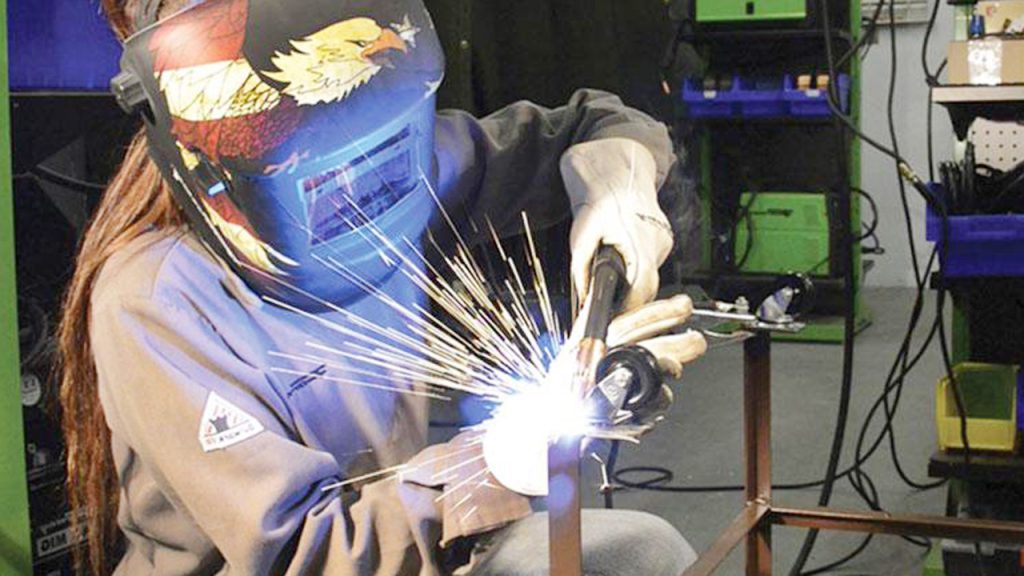
You’re on a job site with ¼-inch mild steel beams and need 7018 beads that hold under load, but your transformer arc welder trips the breaker after 15 minutes at 140 amps or the arc wanders when voltage sags.
Switch to an inverter and the same electrode runs smoother with adjustable arc force that prevents sticking, while the machine draws 40 percent less input current and keeps welding at 60 percent duty cycle.
This Arc Welder vs Inverter Welder choice decides whether you finish the shift without downtime, burn through extra electricity, or haul 150 pounds of iron across the shop floor.
The difference lies in how each power source converts electricity, controls the arc, and survives daily use—numbers that directly affect penetration, spatter, and your bottom line.

Image by machineomatic4026, YT
Power Source Technology: How Electricity Becomes Weld Current
Traditional transformer arc welders step down 240 V line power through a massive 60 Hz iron core. Primary windings induce current in secondary windings with fewer turns, delivering high amperage at low voltage. Output is typically AC unless a rectifier bridge converts it to DC.
The heavy core stores magnetic energy but generates significant heat from resistance and hysteresis losses. A 225-amp transformer model often weighs 180–250 pounds and requires a dedicated 50-amp circuit because efficiency hovers around 60 percent.
Inverter welders first rectify incoming AC to DC, then switch it at 20,000–100,000 Hz through IGBT transistors before a tiny high-frequency transformer steps it down. The final rectifier and choke produce smooth DC—or true AC for aluminum TIG.
The high switching frequency shrinks the transformer core to a fraction of the size, cuts heat losses, and lets microcontrollers adjust output 1,000 times per second. Result: a 200-amp inverter weighs 20–40 pounds, runs on a standard 20-amp 120 V outlet for many tasks, and reaches 85–93 percent efficiency.
Efficiency and Operating Costs: What Shows Up on Your Power Bill
Every amp delivered to the arc costs money. A transformer welder converting 240 V at 50 amps input might deliver only 200 amps output after losses—roughly 50–60 percent efficient. Run it eight hours at 150 amps and you consume 12–15 kWh more per day than an inverter doing identical work. Over a year that adds hundreds of dollars in electricity alone.
Inverters draw far less line current for the same weld amperage. A modern 200-amp inverter at full load pulls 25–30 amps on 240 V versus 45–55 amps for a transformer. The savings compound when you weld thinner material or use pulsed modes that reduce average heat input by 20–30 percent without sacrificing penetration.
For a hobbyist running 10 hours weekly or a mobile repair tech burning 40 hours, the lower draw also means smaller generators or extension cords and fewer tripped breakers.
Portability and Workflow: Weight That Changes How You Set Up Jobs
Transformer arc welders sit in one corner because moving them requires a forklift or two people. Long leads create voltage drop—every 50 feet of 2/0 cable can lose 3–5 volts, flattening the arc and forcing higher machine settings. You adapt your workspace around the machine instead of the other way around.
Inverter welders fit in a truck bed or roll across the floor on casters. The short, lightweight leads maintain full voltage at the stinger, giving consistent arc force even 100 feet from the power drop.
On a farm repair or structural retrofit you carry the unit to the work, not the work to the unit. That single change cuts setup time by 30–50 percent and reduces fatigue from dragging heavy cables.
Arc Characteristics and Electrode Performance: Stability That Affects Bead Quality
Transformer output at 60 Hz produces a slightly rippled arc. On 6010 or 6011 electrodes the aggressive dig helps on dirty metal, but 7018 rods can stick easily without perfect technique. Open-circuit voltage (OCV) stays high, yet the arc softens under load and voltage fluctuations cause inconsistent penetration.
Inverter welders deliver near-perfect DC with adjustable arc force (also called dig). Set arc force at 30–40 percent for 7018 on flat plate and the puddle stays fluid without sticking; crank it to 70–80 percent for vertical-up 6010 and the arc digs like a 300-amp transformer.
Hot-start automatically boosts current for 0.5–1 second on arc initiation, eliminating cold starts that ruin the first inch of bead. Anti-stick circuitry drops voltage if the electrode freezes, preventing a blown fuse or rod stub.
Real amperage examples for ¼-inch mild steel:
- 3/32-inch 6010/6011: 70–110 A (inverter arc force 50 % for crisp keyhole)
- 1/8-inch 7018: 100–130 A (inverter hot start 120 % for 0.8 s)
- 5/32-inch 7018: 130–180 A (transformer often limited by duty cycle)
Inverters let you dial exact values in 1-amp increments with digital readouts; transformers use coarse taps that force you to compromise between too hot and too cold.
Duty Cycle in Shop and Field Conditions
Duty cycle ratings tell you how long the machine can weld before thermal protection kicks in. A typical transformer rated 20 % at 200 amps means 2 minutes on, 8 minutes off—real-world use on thick plate forces frequent pauses. Portable transformers drop even lower because the massive core retains heat.
Inverter models commonly achieve 60 % at 200 amps or 100 % at 150 amps thanks to smaller components and forced-air cooling. In practice this means continuous root passes on pipe or multiple ¼-inch fillet welds without cooldown.
One fabricator reported cutting daily welding time by 25 % simply because the inverter stayed online instead of cycling every 10 minutes.
| Machine Type | Output Amps | Rated Duty Cycle | Real-World Continuous Time (approx.) |
|---|---|---|---|
| Transformer (classic 225 A) | 200 A | 20–30 % | 2–3 minutes per 10-minute cycle |
| Inverter (mid-range 200 A) | 200 A | 60 % | 6 minutes per 10-minute cycle |
| High-end Inverter | 200 A | 100 % at 150 A | Unlimited at moderate settings |
Versatility Beyond Stick: Multi-Process Capability
A dedicated transformer arc welder does SMAW and little else. Adding MIG or TIG requires separate machines or bulky add-ons. Inverter platforms integrate all three processes in one chassis.
One unit handles flux-cored wire for outdoor steel, AC TIG for aluminum, and DC stick for repairs—switching takes 30 seconds via quick-connect torches.
Pulse functions on inverters reduce heat input on thin sheet by 40 percent while maintaining travel speed, something transformers cannot replicate.
Durability, Maintenance, and Long-Term Reliability
Transformers win on raw toughness. No circuit boards, no fans to clog, and 50-year-old units still run in shops worldwide. Repair involves rewinding coils or replacing a rectifier diode—jobs any competent electrician can handle.
Inverters pack IGBTs, capacitors, and control boards that dislike extreme dust, moisture, or voltage spikes. Modern units include sealed electronics and surge protection, yet field failures still occur more often than with transformers. Warranty periods run 3–5 years versus the “lifetime” feel of a buzz-box.
For a stationary shop that rarely moves the machine, a transformer may outlast two inverters. For mobile or home use where portability matters more than 30-year service life, inverters deliver lower total ownership cost.
Upfront Cost vs Lifetime Value
Entry-level transformer arc welders start around $400–600 for 180–225 amps. Inverters with comparable output begin at $300–500 but add multi-process capability and digital controls.
Over five years the inverter saves on electricity, reduces consumable waste through better arc control, and avoids buying separate machines. The break-even point arrives within 12–18 months for anyone welding more than 10 hours weekly.
Generator Compatibility and Field Performance
Generators produce “dirty” power with voltage fluctuations. Transformers tolerate it better because their large inductive mass smooths ripples. Many older inverters tripped or produced erratic arcs on small generators until manufacturers added active power factor correction and wide input voltage tolerance (90–275 V).
Current mid-range inverters run reliably on 5–8 kW clean-output generators; always verify “generator-ready” labeling and avoid cheap non-inverter generators with the cheapest inverters.
Final Thoughts
Choose a transformer arc welder when the machine stays bolted to the floor, you weld heavy plate all day in a dusty shop, and you value bulletproof simplicity over features. Choose an inverter welder when you need to move the machine, weld multiple processes, control heat precisely, or keep operating costs low.
The technical edge in efficiency, arc stability, and duty cycle makes inverters the default for 80 percent of today’s DIY, hobby, and light-to-medium professional work.
One advanced insight separates the pros: inverters with true pulse or waveform control let you weld ⅛-inch aluminum with AC balance set to 70 % EN and 120 Hz frequency—producing a narrow, penetrating bead with minimal distortion that a transformer sine-wave arc simply cannot match.
Match the power source to the actual demands of your next 100 welds and the difference appears in every bead you lay down.