
The sparks were flying, the pipe was hot, and I had already burned through more filler rod than I planned. What looked like a simple pipe joint quickly turned into a guessing game—how many electrodes do I actually need, and how much wire should I prepare before starting the next pass? Situations like that are exactly why a Pipe Welding Consumable Calculator can be a game changer in the workshop.
In real pipe welding—whether it’s Stick on a thick carbon steel line or TIG on stainless—running out of consumables halfway through a weld isn’t just annoying. It wastes time, increases costs, and can even affect weld quality if you start rushing or switching materials mid-job.
After spending years welding pipes in tight positions and awkward angles, I learned that planning consumables properly saves more headaches than any fancy trick with the torch. Knowing how much filler metal, electrodes, or shielding gas you’ll need keeps the workflow smooth and the welds consistent.
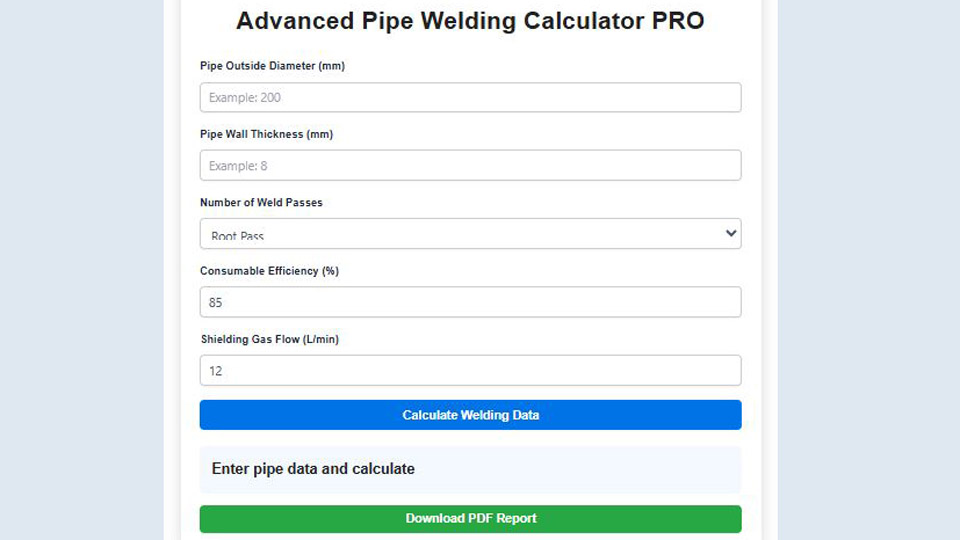
I’ll show you how a Pipe Welding Consumable Calculator works, why welders rely on it in real projects, and how you can quickly estimate the materials needed before striking your first arc.
What Exactly is a Pipe Welding Consumable Calculator?
A pipe welding consumable calculator is essentially a method—sometimes a simple formula, other times a quick sketch on the back of your glove—to estimate the amount of electrodes, filler wire, or flux you’ll burn through on a pipe job. It’s based on the weld joint’s geometry, the pipe’s size, and the welding process you’re using.
It works by breaking down the weld into measurable parts: the cross-sectional area of the joint, the length of the weld (like the circumference for a girth weld), and factors like deposition efficiency, which tells you how much of the consumable actually ends up in the weld versus slag or spatter.
For instance, in SMAW (stick welding), you might only get about 55-60% efficiency because of stub ends and coating waste.
Use it when you’re bidding on a project, prepping for a long run of pipe fittings, or even just stocking up for a DIY repair in your garage. Why bother? Because inaccurate estimates lead to material waste, which hits your wallet hard—especially with electrode prices fluctuating.
Plus, running out mid-weld can cause rushed work, leading to poor penetration or cracks that require grinding out and redoing.
In my shop, I once underestimated for a 12-inch schedule 40 carbon steel pipe run. We were using 7018 rods, and I figured low on the V-groove filler. Ended up with distortion from uneven heating because we had to stretch the rods we had. Lesson learned: always factor in a 10-15% buffer for unexpected passes or touch-ups.
Why Accurate Consumable Calculations Matter in Pipe Welding
Getting your consumables right isn’t just about counting rods—it’s about the integrity of your welds. Overestimating means you’re hauling extra weight and spending unnecessary cash; underestimating forces stops and starts that can introduce defects like lack of fusion.
This calculation shines in high-stakes scenarios, like pressure vessel repairs or oilfield pipelines, where safety is non-negotiable. Wrong amounts can lead to incomplete fills, increasing the risk of leaks or failures under pressure.
Apply it before you strike an arc: measure your pipe diameter, joint type (butt, fillet for branches), and material thickness. Then plug into a formula to get your needs. It’s especially crucial for processes like TIG, where filler rod burn-off is slower but more precise.
One pro tip from years on the floor: always consider the pipe’s schedule. Thicker walls mean more volume to fill, so a schedule 80 pipe will chew through twice the consumables of a schedule 40 on the same diameter. I’ve seen new guys ignore this and end up with underfilled grooves that fail inspection.
Breaking Down Welding Processes for Pipe Work
Pipe welding isn’t one-size-fits-all, and your consumable needs shift with the process. SMAW is my go-to for fieldwork because it’s portable and forgiving on rusty pipes, but it guzzles electrodes faster than MIG.
SMAW works by melting a coated rod that provides both filler and shielding. You’ll use it for root passes on pipes where access is tight. Deposition rates are lower, so calculate higher consumption—around 1-2 lbs per hour depending on rod size.
Go for SMAW when welding carbon steel pipes outdoors; it’s wind-resistant and doesn’t need gas tanks. But indoors or for stainless, switch to GTAW (TIG) for cleaner welds with less spatter.
Practical advice: For a 6-inch pipe butt weld in SMAW, start with a 1/8-inch 6010 for the root to get good penetration, then fill with 7018. Misjudge the switch, and you’ll have slag inclusions—grind them out with a flap disc before continuing to avoid porosity.
In one fab job for irrigation lines, we mixed processes: SMAW for roots, MIG for fills. Cut consumable waste by 20% because MIG’s higher efficiency (95%) meant less wire overall.
SMAW vs. Other Processes: Pros and Cons for Consumable Efficiency
SMAW pros: Versatile for positions, low setup cost. Cons: Higher waste from stubs, slower speed means more rods per joint.
MIG pros: Faster deposition, less cleanup. Cons: Needs clean surfaces, gas shielding can be pricey in bulk.
TIG pros: Precise control, minimal distortion. Cons: Slow, so consumables last longer but jobs take more time.
Here’s a quick comparison table for a standard 4-inch pipe girth weld:
| Process | Typical Consumable | Deposition Efficiency | Estimated Consumption per Weld (lbs) | Best For |
|---|---|---|---|---|
| SMAW | 7018 Rods | 55-60% | 0.8-1.2 | Field repairs |
| MIG | ER70S-6 Wire | 90-95% | 0.4-0.6 | Shop fab |
| TIG | ER70S-2 Rod | 95-100% | 0.3-0.5 | Stainless pipes |
Adjust based on your machine—US brands like Lincoln or Miller handle these well with consistent arcs.
Choosing the Right Electrode Diameter for Pipe Welding
Electrode size matters big time in pipe work. Too thin, and you’ll lack penetration; too thick, and you’ll fight burn-through on thinner walls.
Diameters range from 1/16-inch for delicate roots to 3/16-inch for heavy fills. For pipes, 1/8-inch is the sweet spot for most carbon steel jobs.
It affects amperage and burn rate: smaller diameters run hotter relative to size, melting faster for quicker roots.
Pick based on joint thickness—under 1/4-inch walls? Go 3/32-inch. Over? Step up to 5/32-inch.
Shop tip: Store rods in a heated oven to keep moisture out. I’ve had batches go bad from humidity, leading to hydrogen cracking in high-strength pipes. Always bake low-hydrogen rods like 7018 at 250°F before use.
Common mistake: Using the same diameter throughout. For a multi-pass weld, start small for the root, go bigger for caps to build reinforcement without excess heat.
Amperage Ranges: Setting Your Machine for Optimal Consumable Use
Amperage is the dial that controls how fast your consumables melt. Too low, and you get poor fusion; too high, and rods burn off unevenly, wasting material.
For SMAW on pipes, aim for 70-140 amps on 1/8-inch 6010 rods for roots—gets deep penetration without blow-through.
How it ties to consumables: Higher amps mean faster deposition but more spatter loss, so your calculator must account for that.
Use when pipe material varies—mild steel takes lower amps than alloyed stuff to avoid distortion.
From experience: On a 8-inch API 5L pipe, I ran 120 amps on 7018 fills. Dropped to 100 for the cap to control bead shape. Overamping once caused warping that needed straightening—extra time and rods.
Recommended Amperage by Electrode and Pipe Thickness
Tailor to your US welder like a Miller Dynasty for TIG or Lincoln Idealarc for stick.
| Electrode | Diameter (inch) | Pipe Thickness (inch) | Amperage Range (DC+) | Notes |
|---|---|---|---|---|
| 6010 | 1/8 | 1/8-1/4 | 75-125 | Root passes, good dig |
| 7018 | 1/8 | 1/4-1/2 | 90-140 | Fills, low hydrogen |
| 7018 | 5/32 | 1/2+ | 120-180 | Heavy walls, higher heat |
| ER70S-6 (MIG) | 0.035 | All | 150-250 | Wire feed speed 300-400 ipm |
Test on scrap pipe first—adjust 10% based on your machine’s output.
Joint Preparation: The Foundation for Accurate Consumable Estimates
Joint prep is where many calculations go wrong. A sloppy bevel means more filler to fill gaps, inflating your consumable needs.
For pipe butts, aim for a 37.5-degree single-V groove with a 1/16-inch root face. This minimizes volume while ensuring penetration.
Prep with a grinder or plasma cutter—clean edges prevent contamination that wastes rods on rework.
Do this for all pipe welds, especially in corrosive environments like water lines, to avoid undercuts.
Tip: Use a pipe beveling tool for consistency. In my shop, switching to one cut prep time by half and reduced filler use by 15% on repetitive jobs.
Mistake to avoid: Skipping back-gouging on thick pipes. Leaves inclusions, forcing extra passes—I’ve ground out miles of bad roots because of it.
Step-by-Step Guide to Calculating Consumables for a Pipe Weld
Let’s get hands-on. Here’s how I calculate for a typical girth weld on carbon steel pipe.
First, measure the pipe: Diameter (D) in inches, wall thickness (T), joint type (e.g., single-V butt).
Calculate circumference: L = π × D (for full girth).
Determine cross-sectional area (A). For single-V: A ≈ (T² × tan(θ/2)) + root opening area, where θ is groove angle (usually 60°).
More precisely: Area of V = (T × tan(θ/2) × T)/2 × 2 (for both sides) + cap reinforcement.
From shop formulas, weld metal volume V = A × L.
Then weight W = V × density (0.283 lb/in³ for steel).
Consumable needed C = W / efficiency (e.g., /0.55 for SMAW).
Example: 6-inch pipe (D=6.625″), T=0.28″ (sch 40), 60° V, 1/16″ root gap.
Circumference L ≈ 20.8″.
V-groove area A ≈ 0.5 × T² × (1/tan(30°)) wait, better: Using standard: A = T² / (2 × tan(30°)) for triangles + rectangle.
Simplified: A = (T × (2 × T × tan(30°) + gap)) / 2 + cap (say 0.1 in²).
Rough: For 1/4″ T, A ≈ 0.15 in².
V = 0.15 × 20.8 ≈ 3.12 in³.
W = 3.12 × 0.283 ≈ 0.88 lbs weld metal.
For SMAW: C = 0.88 / 0.55 ≈ 1.6 lbs rods.
That means about 20-25 1/8-inch 7018 rods, depending on length (14″ standard, ~0.07 lb each).
Step 1: Sketch the joint.
Step 2: Calc area using geometry.
Step 3: Multiply by length.
Step 4: Apply density and efficiency.
Step 5: Add 10% for losses.
I used this on a refinery job—saved us from ordering an extra case.
Formulas for Different Joint Types in Pipe Welding
Butt joint (single-V): A = (T² × tan(β)) + (gap × T), where β = groove angle/2.
Fillet for branch: A = 0.5 × leg².
Double-V for thick pipes: Double the single-V minus overlap.
Include reinforcement: Add 0.5 × cap width × height.
Density: Always 7.85 g/cm³ or 0.283 lb/in³.
Efficiency varies: TIG near 100%, FCAW 90%.
Material Compatibility: Matching Consumables to Pipe Alloys
Pipes come in carbon, stainless, alloy—your consumables must match to avoid cracks or corrosion.
For A106 carbon: Use E7018 or ER70S-6.
Stainless 304: ER308L filler.
Mismatch? Brittle welds. I once used carbon rods on low-alloy pipe—cracked under test pressure. Fix: Grind out, requalify.
Check specs: AWS classifications ensure compatibility.
Tip: For dissimilar metals, like carbon to stainless, use 309L to bridge properties.
Safety Considerations When Handling Pipe Welding Consumables
Consumables aren’t just metal—they’re hazards if mishandled. Fumes from coatings can cause respiratory issues, so vent your shop.
Wear PPE: Gloves for hot stubs, respirators for confined pipes.
Store properly: Dry, upright to prevent damage.
Why? Wet rods pop and spatter, wasting material and risking burns.
In a tight pipe crawl space, I skipped a respirator once—coughed for days. Now, always calculate extra time for safety breaks.
Common pro mistake: Rushing without grounding properly—arc flashes ruin days and consumables.
Common Mistakes and Fixes in Pipe Welding Consumable Use
Beginners often forget to include cap reinforcement in calcs—underfills the joint.
Fix: Add 20% to area for convex beads.
Pros might ignore position: Overhead welding burns more due to gravity—up efficiency deduction to 50%.
Anecdote: On a vertical pipe rack, we miscalculated for uphill—ran short. Solution: Pre-weave practice beads to gauge burn rate.
Another: Wrong polarity. DCEP for most rods, but switch messes melt rate.
Test fix: Run a coupon weld, weigh before/after to calibrate your personal efficiency.
Advanced Tips for Multi-Pass Pipe Welds
For thick pipes, multi-pass means layered calcs: Root pass low consumable, fills higher.
Estimate per pass: Root 20%, hot 30%, fill 30%, cap 20%.
Use weaves for wider beads—covers more with less rod.
In shop, I stringer for roots, weave for caps—balances heat, reduces distortion.
For long runs: Batch calc total length, divide by rod output (e.g., 7018 1/8″ yields ~1 ft weld per rod at 120A).
Integrating Consumable Calcs into Your Daily Workflow
Make it habit: Before cutting pipe, calc consumables.
Use apps or spreadsheets if tech-savvy, but paper works fine.
For hobbyists: Start small—calc for a fence post repair.
Pros: Bid accurately—include consumable costs at $5-10/lb.
Saved my business on a contract: Accurate calcs undercut competitors without skimping quality.
Wrapping Up
Nailing your pipe welding consumable calculations turns chaotic jobs into smooth operations. You’ve got the formulas, tips, and real fixes to avoid the pitfalls I’ve stumbled through. Now you’re set to tackle that next pipeline with confidence, knowing your supplies won’t let you down.
Always weigh your leftover rods after a job—track your actual efficiency to refine future calcs and cut waste even more.
How Much Electrode Do I Need for a 6-Inch Pipe Girth Weld?
For a schedule 40 carbon steel pipe with a single-V butt, you’ll need about 1.5-2 lbs of 7018 rods for a full circumference. Factor in 55% efficiency and add 10% buffer. Use 1/8-inch for roots at 100A, 5/32 for fills at 140A.
What’s the Best Amperage for 1/8-Inch 6010 on Thin Pipe?
Run 75-110 amps DC+ for 1/8-3/16 inch walls to get penetration without burn-through. Whip technique helps control puddle—test on scrap to avoid holes.
Why Do My Welds Crack When Using Wrong Filler Metal?
Mismatch causes differing expansion rates. Stick to matching AWS specs, like E7018 for A53 pipe. Preheat to 200°F if needed to relieve stress.
How Does Joint Prep Affect Consumable Consumption?
Poor preps increase gaps, needing 20-30% more filler. Bevel cleanly to 30-37 degrees, land 1/16 inch—saves rods and strengthens the weld.
Can I Use the Same Calc for Stainless Pipe Welding?
Yes, but adjust density (0.29 lb/in³) and efficiency. Use ER308 for 304 pipes, lower amps (80-120) to prevent carbide precipitation. Always purge for TIG roots.


