
Welding symbols can be more intimidating than striking an arc, especially when a simple-looking drawing decides how an entire joint is welded. I’ve seen solid welds rejected and parts sent back just because a symbol was misunderstood or overlooked.
Learning the standard symbols for welding is essential if you want your welds to match design intent, pass inspection, and avoid costly rework. These symbols aren’t just lines and arrows—they’re instructions that affect strength, size, and quality.
After years of working from blueprints and shop drawings, I’ve learned how to read welding symbols the right way, without guessing. In this guide, I’ll break them down in plain language and show you how to interpret them confidently, step by step, so you can weld exactly what the drawing calls for.

Image by mech619
What Are Standard Symbols for Welding and Why Do They Matter?
Standard symbols for welding are like shorthand notes on engineering drawings, packing in details about weld type, size, location, and finishing into compact graphics. They’re based on AWS A2.4, the go-to standard in the US for everything from shop welds to field repairs. Without them, blueprints would be novels, bloated with text that no one has time to read mid-project.
In my experience, these symbols matter because they bridge the gap between design and execution. Picture this: you’re on a construction site welding I-beams for a bridge. A simple arrow and reference line tell you to make a fillet weld on the arrow side, saving you from assuming the wrong joint prep.
They promote safety by specifying processes that match materials—like avoiding high-heat methods on thin aluminum to prevent warping. Material compatibility shines here too; symbols might note a specific filler rod for stainless steel, ensuring corrosion resistance in humid environments.
Why use them? For weld integrity, they dictate penetration depth to handle loads without cracking. Cost efficiency comes from precise specs—no over-welding that burns through filler or under-welding that requires fixes. I’ve saved countless hours by quickly decoding a symbol instead of radioing the engineer.
For students or new trainees, they’re your roadmap to professional-level work. Start by familiarizing yourself with the basic structure: every symbol has a reference line as its foundation, an arrow pointing to the joint, and optional tails for extras.
The Basic Structure of a Welding Symbol
At the heart is the reference line—a straight horizontal bar that holds everything together. It’s where you attach the weld symbol itself, which shows the cross-section shape of the weld you need to create.
The arrow connects to one end of this line and points directly to the joint on the drawing. That’s crucial: the side the arrow touches is the “arrow side,” and welds specified below the reference line go there. Anything above the line is for the “other side.” I’ve messed this up early on, welding on the wrong face and having to grind it out—lesson learned: always trace the arrow first.
Then there’s the tail, curving off the reference line’s other end. It’s optional but gold for details like the welding process—say, SMAW for stick welding—or electrode type. No tail? No worries; it means keep it simple. Dimensions pop up around the symbol: size to the left, length to the right, angles or depths in specific spots.
How does this work in practice? Grab a blueprint, spot the arrow, note the side, read the symbol for type (like a triangle for fillet), and check numbers for specs. When to use it? Every time you see a joint marked—it’s your instruction manual. Pro tip: If the arrow bends, it highlights which piece needs beveling, saving prep time on the wrong part.
How to Read Welding Symbols on Blueprints
Reading welding symbols on blueprints is a skill that pays off big time, especially in fast-paced US shops where codes like ASME demand accuracy. Start by scanning the drawing for the reference line—it’s your anchor. Follow the arrow to pinpoint the exact joint location.
Next, interpret the weld symbol attached to the line. If it’s below, weld the arrow side; above, the far side. Both? Duplicate symbols on each. Numbers guide you: a “1/4” left of a fillet triangle means quarter-inch leg size. Angles, like “60°” for a V-groove, tell you how to prep edges.
In real life, I always double-check for supplementary marks. A circle at the arrow-reference junction means weld all around the part—handy for pipes but watch for overheating. A flag signals a field weld, so prep for on-site conditions like wind affecting your arc.
Common mistake: Ignoring the tail’s process note, like using MIG instead of TIG on aluminum, leading to porosity. Fix it by cross-referencing your machine settings— for TIG, amp up to 150-200A on 1/8-inch stock. Practical tip: Practice on scrap; draw a symbol, weld it, then inspect. This builds intuition for integrity checks.
Common Types of Weld Symbols and Their Meanings
Diving into specific types, let’s cover the ones you’ll see most in US fabrication. Each has a unique shape representing the weld’s profile.
Fillet Weld Symbols
The fillet weld symbol is a right triangle, mimicking the triangular bead you lay in corners or laps. It’s for joining pieces at right angles, like T-joints or laps, fusing the base metals without full penetration.
How it works: Size (leg length) goes left of the triangle—equal legs need one number, uneven get two (like 1/4 x 3/8). Length to the right; no number means full joint. For intermittent, dashes show length-pitch, like 2-4 for 2-inch welds every 4 inches center-to-center.
Use it when strength isn’t max but efficiency is—think frames or brackets. Why? It’s quick and uses less filler. In my shop, I rely on fillets for 80% of work. Tip: On mild steel, set your MIG at 18-20V, 150-200 IPM wire speed for clean 1/4-inch legs. Mistake: Uneven legs from poor angle—fix by holding torch at 45°.
Groove Weld Symbols
Groove symbols vary by prep: square (straight lines), V (V shape), bevel (half-V), U (U curve), J (J hook). They’re for butt or edge joints needing deep penetration.
Prep the edges per symbol—angle inside the V, root opening in parentheses. Depth left, effective throat in parens if beyond prep. Works by filling the groove with passes for full fusion.
When to use: High-stress applications like beams or pressure vessels for max integrity. Pro: Strong under load; con: More prep time.
Anecdote: On a tank build, a missed 45° bevel led to root defects—always use a protractor. Settings: For SMAW on 1/2-inch plate, 6010 rod at 120-150A for root, 7018 at 140-180A for fills.
Plug and Slot Weld Symbols
Plug is a circle, slot a rectangle—both for filling holes in overlapping plates.
Diameter/width left, pitch right, depth if partial. Number of plugs in parens. How: Drill hole, fill with weld metal fusing layers.
Use for shear strength in laps without edge access. Tip: Countersink for flush; mistake: Overfilling causes distortion—control heat with 100-120A on stick. Pro: Hidden strength; con: Hole prep adds steps.
Spot and Seam Weld Symbols
Spot is a circle (no side significance), seam two parallel lines. Spot fuses points, seam a continuous line via resistance or arc.
Numbers: Diameter left, pitch right, count in parens. For spot, use on thin sheets like auto panels.
Practical: In resistance welding, set pressure at 500-1000 psi. Mistake: Uneven spacing weakens—use templates. Why? Fast for mass production.

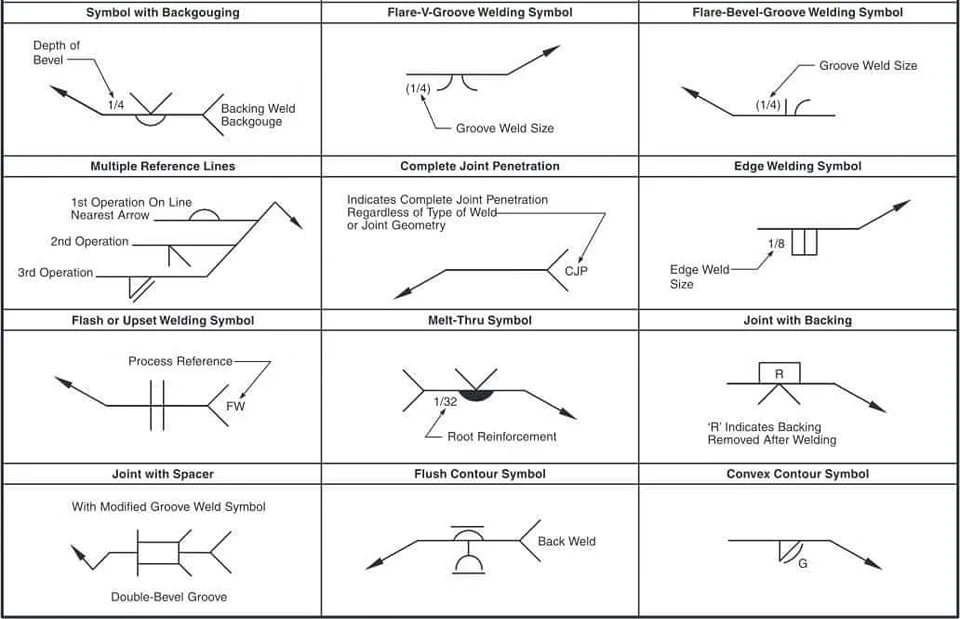
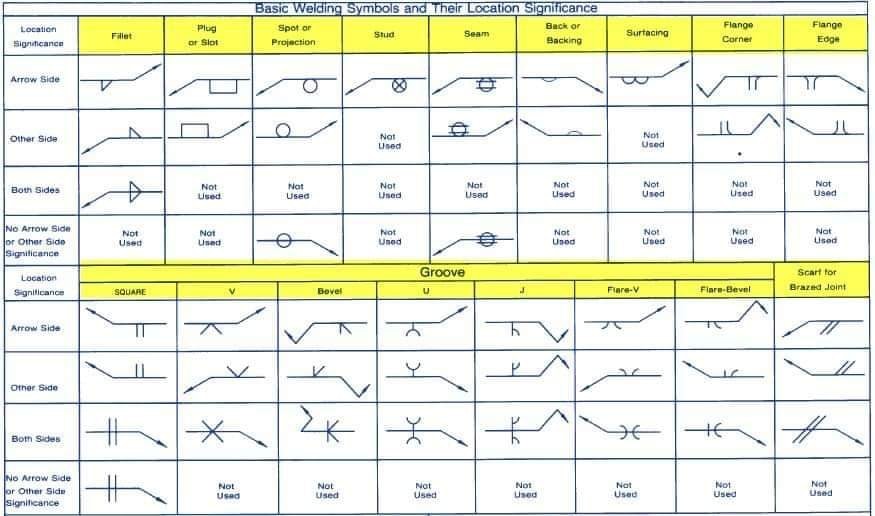
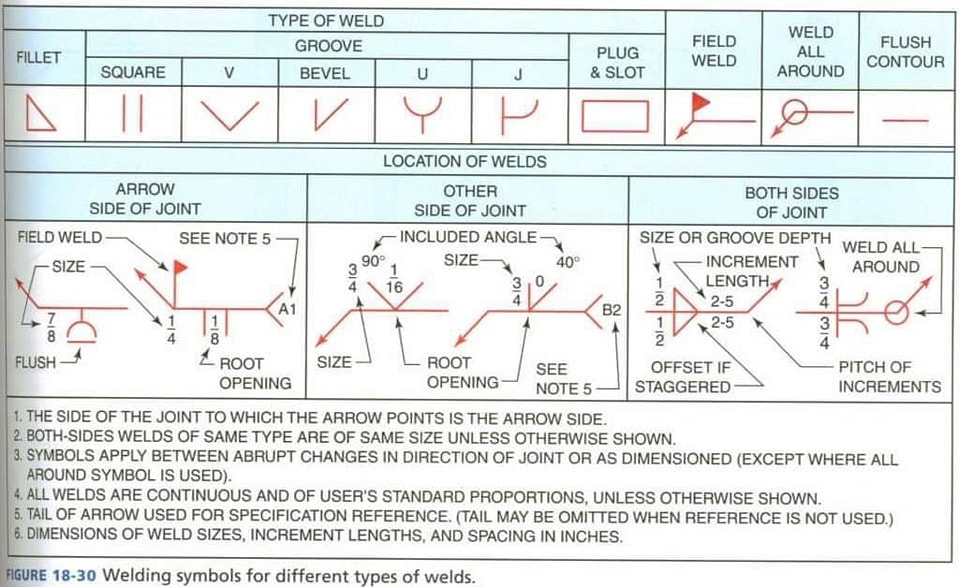
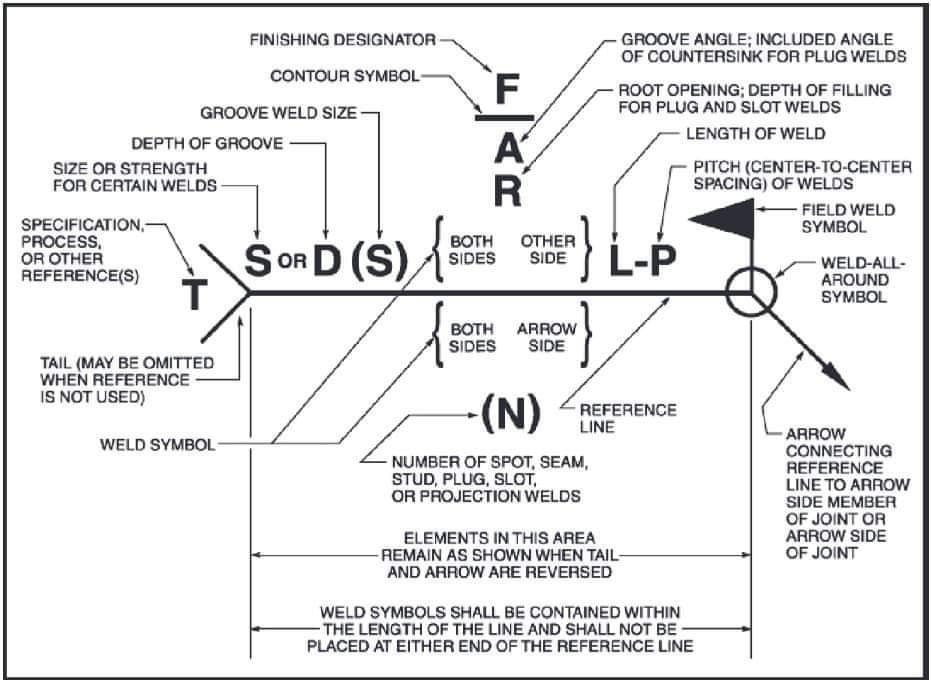
Image by mech619
Supplementary Symbols in Welding
These add-ons refine your welds. The weld-all-around circle means encircle the joint—great for tubes but watch warpage.
Field weld flag: For site work, prep portable gear. Melt-through half-circle: Ensures root reinforcement from one side.
Backing bar rectangle: Supports root; “R” if removable post-weld. Contour lines: Straight for flat, curved for convex/concave. Finishing letters: G for grind, M for machine.
I’ve used melt-through on single-sided grooves to skip back-gouging, saving time. Tip: Grind contours at low RPM to avoid gouges.
Step-by-Step Guide to Interpreting a Welding Symbol
Let’s walk through this hands-on. Step 1: Locate the reference line on your blueprint—it’s horizontal, with an arrow at one end.
Step 2: Trace the arrow to the joint. Note if it bends—that side needs prepping.
Step 3: Identify the weld symbol. Triangle? Fillet. V? Groove. Check position: Below line = arrow side.
Step 4: Read dimensions. Left for size/depth, right for length/pitch, inside for angles.
Step 5: Scan for supplements. Circle? All-around. Flag? Field.
Step 6: Check tail for process/filler. MIG? Set voltage 18-22V for steel.
Step 7: Prep materials—clean edges, bevel if needed.
Step 8: Weld per specs, inspect for defects like undercut.
Common pitfall: Skipping supplements leads to incomplete welds. Fix: Always circle-check.
Comparison of Common Weld Types
Here’s a quick table to compare key welds:
| Weld Type | Symbol Shape | Best For | Pros | Cons | Typical Settings (Mild Steel) |
|---|---|---|---|---|---|
| Fillet | Triangle | Laps, Ts | Quick, low filler | Limited strength | MIG: 18V, 150 IPM |
| V-Groove | V | Butts | Deep penetration | High prep time | SMAW: 140A, 7018 rod |
| Plug | Circle | Overlaps | Hidden joints | Drilling required | Stick: 100A, partial fill |
| Spot | Circle | Sheets | Fast assembly | Point strength | Resistance: 800 psi |
This helps choose based on project—fillet for speed, groove for durability.
Practical Tips for Joint Preparation and Filler Compatibility
Joint prep is half the battle. For grooves, bevel edges to the specified angle—use a grinder for 30-45° on plate over 1/4-inch.
Cleanliness: Wire brush or solvent wipe to remove rust; skips lead to slag inclusions. Filler match: For carbon steel, ER70S-6 on MIG; 308L for stainless.
Machine settings vary: TIG on aluminum? 120-150A AC, pure argon. Mistake: Wrong polarity—DCEN for TIG root passes.
Anecdote: On a custom gate, mismatched filler caused cracks—always check AWS classifications.
Safety Considerations When Using Welding Symbols
Symbols imply safety too. Field flags mean outdoor hazards—secure ground, watch weather.
Penetration specs prevent weak spots failing under load. Always PPE: Helmet, gloves, respirator for fumes.
Tip: For high-amp grooves, use ventilation to avoid zinc fumes on galvanized.
Advanced Applications in US Welding Codes
In US codes like AWS D1.1 for structural, symbols ensure compliance. For pipelines, note root openings for X-ray quality.
I’ve applied these on certified jobs—melt-through for one-sided access in tanks. Tip: Log settings for repeatability.
Common Mistakes When Reading Welding Symbols and How to Avoid Them
Big one: Confusing sides—weld arrow side only if below line. Avoid by labeling “near/far” mentally.
Overlooking intermittents: Misread pitch as gap, weakening chains. Measure center-to-center.
Ignoring tails: Wrong process on exotic metals. Always read fully.
Fix: Practice decoding 10 symbols daily; use apps for quizzes.
Personal Anecdotes from the Workshop
Back in ’05, I botched a flare-bevel on a trailer hitch—misread the flare as standard bevel, leading to poor fit-up. Ground it out, re-prepped, and it held for years. Lesson: Double-check shapes.
Another time, an all-around on exhaust pipes overheated the thin wall—pulsed MIG next time for control.
These stories remind me: Symbols guide, but experience refines.
Pros and Cons of Different Weld Symbols in Practice
Fillet: Pro—versatile; con—surface only.
Groove: Pro—strong; con—labor-intensive.
Plug: Pro—secure laps; con—destructive to inspect.
Balance based on application—fillets for hobby, grooves for pro.
Machine Settings and Techniques for Key Welds
For fillet on 1/4-inch steel: Stick 6013 at 90-110A, drag technique.
V-groove: Multi-pass, root with 6010 at 100A, weave fills.
Tip: Preheat thick stock to 200°F for crack prevention.
Conclusion
You’ve now got the tools to decode standard symbols for welding like a seasoned pro—from basic structures to advanced supplements. You’re better prepared to tackle blueprints with confidence, choosing the right weld type for safety, strength, and savings.
Whether fabricating in your garage or on a job site, these insights mean fewer mistakes and stronger results. Always keep a laminated AWS chart in your toolbox—it’s saved my hide more times than I can count.
What Do the Basic Elements of a Welding Symbol Mean?
The reference line is your base, arrow points to the joint side, tail adds details like process. Master these for quick reads.
How Can I Tell If a Weld Is Arrow Side or Other Side?
Look at symbol position: Below the line means arrow side (near you), above is other side. Both? Symbols on each.
What’s the Difference Between Fillet and Groove Weld Symbols?
Fillet is a triangle for angular joints with surface fusion; groove varies (V, U) for deep penetration in butts.
When Should I Use a Weld-All-Around Symbol?
For full encirclement, like on pipes or cylinders—ensures no weak spots but manage heat to avoid distortion.
What Are Common Mistakes in Interpreting Dimensions on Symbols?
Misreading left (size) vs. right (length), or ignoring angles. Always measure precisely for integrity.


