Ultrasonic joining depends heavily on machine capability, so understanding Ultrasonic Welding Equipment is essential for achieving consistent bond strength and repeatable production results.
Ultrasonic welding equipment converts electrical energy into high-frequency mechanical vibration, then delivers that vibration through a transducer, booster, and horn to create localized frictional heat at the joint.
Equipment selection directly affects amplitude control, weld cycle stability, energy delivery, and part consistency; undersized power supplies, poorly matched horns, or incorrect frequency ranges can cause weak bonding, surface damage, excessive flash, or rejected parts during inspection.
In real manufacturing environments, proper equipment configuration determines whether the process runs efficiently or produces costly downtime and tooling wear.
I’ll explain the core components of ultrasonic welding systems, how each part influences weld performance, and what technical factors matter most when setting up reliable ultrasonic joining operations.

Image by flipkart
Principles of Ultrasonic Welding
Ultrasonic welding operates by converting electrical energy into mechanical vibrations that induce intermolecular friction at the joint interface.
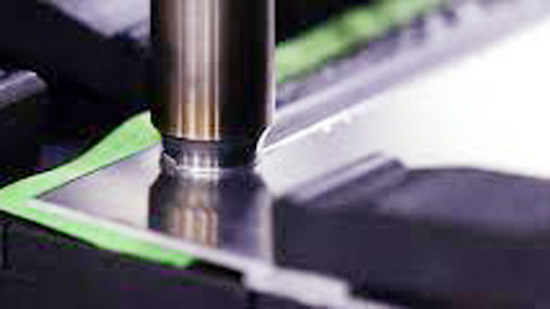
The equipment delivers vibrations through a sonotrode to workpieces clamped under pressure, causing localized melting in thermoplastics or oxide dispersion in metals. Weld formation occurs in milliseconds, with cycle times often under 1 second, minimizing heat-affected zones.
Key process variables include frequency, amplitude, pressure, and time. Frequencies range from 15 kHz for larger parts to 70 kHz for delicate assemblies, with 20 kHz and 35 kHz being common in industrial units. Amplitude, measured in microns, typically spans 10 µm to 120 µm, adjusted via boosters to optimize energy delivery.
Pressure application, via pneumatic or electric presses, ranges from 100 N to 3000 N depending on material thickness and joint geometry.
Material compatibility is essential: thermoplastics like ABS, polycarbonate, and polypropylene weld effectively due to their viscoelastic properties, while semicrystalline polymers such as nylon require higher amplitudes for sufficient melt flow.
For metals, aluminum, copper, and nickel foils or wires up to 0.5 mm thick join reliably, with shear forces dispersing surface contaminants.
Key Components of Ultrasonic Welding Equipment
Ultrasonic welding systems comprise a generator, transducer stack, press, and support tooling, each engineered for resonance and energy efficiency.
Generator
The generator supplies high-frequency electrical signals, converting single-phase mains power (110V or 220V AC) to match the stack’s resonant frequency. Output power varies from 400 W to 4800 W, with microprocessor control enabling parameter adjustments like weld time (0.1 s to 5 s), energy (Joules), and hold time.
Advanced models feature proportional valve control for consistent pressure and monitoring of up to five weld conditions, including power draw and collapse distance.
Transducer (Converter)
Piezoelectric ceramics within the transducer convert electrical input to axial mechanical vibrations. Composed of lead zirconate titanate discs sandwiched between titanium blocks, it produces peak-to-peak displacements of 15 µm to 20 µm at resonances of 20 kHz or 40 kHz. Thermal management is critical, as temperatures exceeding 45°C reduce efficiency; humidity below 48% prevents arcing.
Booster
This mechanical amplifier modifies vibration amplitude by a factor of 0.5 to 3, typically constructed from titanium or aluminum for fatigue resistance.
Length equals half the ultrasonic wavelength in the material (approximately 125 mm at 20 kHz in titanium), ensuring resonance. It clamps the stack and mounts to the press, with designs incorporating axial slots to minimize transverse vibrations.
Horn (Sonotrode)
The horn transfers amplified vibrations to the workpiece, with tip amplitudes reaching 30 µm to 120 µm. Materials include titanium for durability or aluminum for prototyping, often with carbide coatings to resist wear. Horn geometry—cylindrical, stepped, or exponential—optimizes gain; for example, a stepped horn provides 2:1 amplification.
Tip profiles match joint contours, such as flat for sheet welding or knurled for metal foils, directing energy to interfaces with minimal loss.
Press and Fixtures
Pneumatic or servo-electric presses apply forces up to 3000 N, with stroke lengths of 50 mm to 100 mm and approach speeds adjustable via flow controls (0.1 m/s to 1 m/s). Fixtures, or anvils, are machined from hardened steel or aluminum to support parts, preventing slippage and ensuring vibration focus.
Custom nesting accommodates complex geometries, with alignment tolerances under 0.05 mm for repeatable welds.
| Component | Typical Specifications | Function |
|---|---|---|
| Generator | 400-4800 W, 15-70 kHz, AC 110/220V | Power conversion and cycle control |
| Transducer | 15-20 µm displacement, piezoelectric | Electrical to mechanical conversion |
| Booster | 0.5-3 gain, titanium/aluminum | Amplitude modification |
| Horn | 30-120 µm amplitude, profiled tip | Energy application to joint |
| Press | 100-3000 N force, pneumatic/electric | Pressure and alignment |
Types of Ultrasonic Welding Machines
Equipment varies by scale and automation, suited to workshop needs from prototyping to production.
Handheld Units
Portable welders, such as 28 kHz 500 W models, feature ergonomic pistols with integrated transducers for spot welding. Force application is manual (up to 50 N), ideal for thin films like polyester or Tyvek. Specifications include 110V operation and weld times of 0.2 s, with applications in repair work or small assemblies.
Benchtop Systems
Standard machines like 20 kHz 3000 N units offer pneumatic drives and digital controls for medium-volume fabrication. Footprints measure 500 mm x 600 mm, with power up to 1600 W.
They support multi-sonotrode setups for simultaneous welds, achieving deposition rates equivalent to 10 mm/s travel speed in plastics.
Automated Systems
Integrated lines incorporate robotic arms or shuttles for high-throughput, with 4200 W 20 kHz welders handling multi-lamination in batteries. Cycle times drop to 0.3 s, with air pressure requirements of 0.4-0.6 MPa. These systems monitor weld collapse to 0.01 mm precision, ensuring consistency in automotive or medical production.
Technical Specifications and Parameters
Core specifications define performance: frequency influences penetration, with lower values (15 kHz) suited to thick materials (up to 5 mm) and higher (70 kHz) for precision (under 0.1 mm). Power correlates to joint area; 900 W suffices for 50 mm² plastics, while 4200 W handles metal stacks.
Amplitude control affects melt pool size—higher values (75 µm) enhance flow in semicrystallines, but risk flash. Pressure optimizes at 0.2-0.5 MPa for thermoplastics to avoid deformation. Weld energy, in Joules, is preset (e.g., 50-200 J) or time-based, with hold times (0.5-2 s) allowing solidification under load.
Monitoring includes peak power, frequency shift (indicating resonance drift), and distance collapse, flagging defects like under-weld (insufficient energy) or over-weld (excess flash). Environmental limits: operation below 45°C, humidity under 48%.
| Parameter | Range | Impact |
|---|---|---|
| Frequency | 15-70 kHz | Penetration depth and precision |
| Power | 400-4800 W | Joint size capability |
| Amplitude | 10-120 µm | Melt flow control |
| Force | 50-3000 N | Interface contact |
| Weld Time | 0.1-5 s | Cycle efficiency |
Applications in Industry
Ultrasonic equipment excels in sectors demanding clean, rapid joins.
In automotive, it welds instrument panels and wire harnesses, achieving hermetic seals in ABS with 20 kHz systems. Battery production uses 20 kHz 4200 W machines for aluminum-copper tabs, dispersing oxides for conductivities above 90% of parent material.
Medical applications include IV catheters and filters, where 35 kHz welders ensure biocompatibility in polycarbonate, with joint strengths exceeding 10 MPa.
Packaging employs 30 kHz units for pouch seals in polyethylene laminates, providing leak-proof bonds at 15 mm/s speeds.
Electronics fabrication joins capacitors and flash drives with 40 kHz precision, minimizing distortion in delicate circuits.
Hygiene products like diapers laminate nonwovens at 35 kHz, preserving softness while bonding at 745 N force.
Advantages and Limitations
Advantages include low energy use (0.5-2 kWh per 1000 welds), no consumables, and fast cycles reducing labor. Joints exhibit high strength (80-95% of base material) with minimal defects, suitable for dissimilar materials.
Limitations: restricted to thin parts (under 5 mm for plastics, 0.5 mm for metals); requires precise joint design (energy directors for plastics); horn wear in high-volume use necessitates titanium. Not viable for thermosets or thick sections due to vibration attenuation.
Selection Criteria for Ultrasonic Welding Equipment
Evaluate based on material, volume, and precision. For thermoplastics, select 20-35 kHz with 900-3000 W for general use; metals demand 20 kHz high-power (over 2000 W) for oxide disruption.
Consider press type: pneumatic for cost (under $5000), servo for accuracy (±0.01 mm). Generator features like amplitude stepping (ramping from 30% to 100%) prevent stringing in melts.
Budget: handheld units at $800-2000; benchtop $5000-15000; automated over $20000. Ensure U.S. compliance with ANSI standards for test specimens.
Factor maintenance: titanium components extend life to 10^6 cycles versus aluminum’s 10^5.
Operation and Best Practices
Setup involves calibrating force with load cells (accuracy ±5 N) and tuning stack resonance (±30 Hz). Position parts with 0.05 mm alignment, using energy directors (60° triangular, 0.2-0.5 mm height) for focused melting.
Initiate weld: apply pressure, trigger ultrasound, monitor collapse (target 0.1-0.3 mm for plastics). Optimize parameters iteratively—increase amplitude for poor flow, reduce time for flash.
For metals, ensure clean surfaces; use knurled horns for grip. Travel speed equivalents: 5-20 mm/s based on power.
Safety: use enclosures for noise (over 85 dB at 20 kHz), gloves for vibration.
Maintenance and Troubleshooting
Inspect horns for wear (pitting reduces amplitude 10-20%); resurface or replace every 5000 hours. Clean transducers with isopropyl, avoiding impacts.
Common issues: inconsistent welds from resonance drift—retune generator; weak joints from low pressure—increase to 0.3 MPa; flash from excess energy—shorten time to 0.5 s.
Monitor metrics: power draw spikes indicate contamination; frequency shifts signal wear.
Annual calibration ensures force and amplitude accuracy.
Final Thoughts
Ultrasonic welding equipment delivers reliable performance through precise control of vibrational energy, enabling efficient joins in demanding applications.
Systems with integrated monitoring maintain weld quality across cycles, supporting scalability from hobbyist to professional use.
In metal welding, optimizing booster gain to 2.5 can enhance shear strength by 15% in aluminum foils, provided horn temperature remains below 50°C to prevent detuning.
FAQs
What frequency should I choose for ultrasonic welding equipment?
Select 20 kHz for thicker thermoplastics (2-5 mm) or metals requiring deep penetration; opt for 35-40 kHz for thin films or precision electronics to minimize marking.
How does power rating affect ultrasonic welding performance?
Higher power (over 2000 W) supports larger joints or stiffer materials, increasing deposition efficiency; lower ratings (400-900 W) suit small-scale spot welds but limit cycle speed.
What materials are incompatible with ultrasonic welding?
Thermosets like epoxy and thick metals over 1 mm attenuate vibrations excessively; avoid porous or highly filled composites that scatter energy.
How do I calibrate force in ultrasonic welding machines?
Use a load cell under the anvil to measure applied pressure; adjust regulator to match specifications, verifying ±5% accuracy across the range.
What is the typical lifespan of a sonotrode in ultrasonic equipment?
Titanium sonotrodes last 500,000-1,000,000 cycles with proper maintenance; aluminum variants wear faster at 100,000 cycles, especially in abrasive applications.