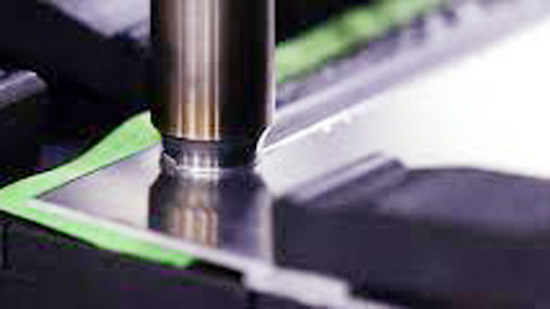
Metal parts clamped tight, high-frequency vibrations humming through the machine, and a tiny tool pressing them together—that tool is the sonotrode, the heart of ultrasonic welding.
I’ve worked on small plastic assemblies and metal welds, and getting the sonotrode setup right makes all the difference between a strong bond and a weak, inconsistent weld.
A sonotrode transfers ultrasonic energy from the welder to the workpieces, creating heat at the interface that fuses the materials. Its shape, material, and pressure aren’t just technical details—they directly affect weld quality, consistency, and even production speed.
Let me break down exactly what a sonotrode does and how to use it effectively so your ultrasonic welds come out clean and reliable every time.

Image by assemblymag
What Exactly Is a Sonotrode?
Think of the sonotrode as the specialized tool that channels ultrasonic energy into your workpiece. In the welding stack, it sits at the bottom: the converter (transducer) turns electrical energy into mechanical vibration, the booster adjusts the amplitude, and the sonotrode focuses and applies that vibration right where the weld needs to happen.
It’s not just any metal piece. A sonotrode is precision-tuned to resonate at the machine’s frequency—usually 20 kHz, 30 kHz, or 40 kHz. It acts like a half-wavelength resonator, vibrating lengthwise with standing waves so the tip moves exactly as needed while the mounting area stays relatively still.
The shape of the sonotrode matches your part. A simple flat-faced horn might work for flat joints, while a contoured or multi-tip design suits complex automotive parts or multiple weld points at once. The face often includes knurling, texturing, or specific geometry to grip the plastic and direct energy.
In my experience, the sonotrode is where most of the magic—and most of the problems—happen. Get the design right, and you get consistent, strong welds. Get it wrong, and you’ll chase defects all day.
How Does a Sonotrode Work in Ultrasonic Welding?
The process starts when the generator sends high-frequency electrical signals to the converter. Piezoelectric crystals inside expand and contract rapidly, creating mechanical vibrations at ultrasonic frequencies—too high for human ears to hear.
These vibrations travel through the booster, which amplifies or reduces the amplitude depending on the ratio (common ones are 1:1, 1:1.5, or 1:2). Then they reach the sonotrode.
When the sonotrode presses against the top part with controlled force, the rapid back-and-forth motion (typically 10–50 microns of amplitude) creates intense friction at the joint interface.
This friction generates localized heat that melts the plastic only where you want it—usually at an energy director, a small triangular ridge molded into one of the parts.
The materials flow together under pressure, and once the vibrations stop, the joint solidifies under hold pressure. The whole cycle often takes less than a second for small parts.
What I love about this on the shop floor is the control. You adjust weld time, trigger force, weld force, amplitude, and hold time to dial in perfect results. Unlike hot-plate or vibration welding, there’s no big heat-affected zone, so you avoid warping on thin or delicate parts.
Key Components of the Ultrasonic Welding Stack
You can’t talk about the sonotrode without understanding the full stack—it all works together.
- Converter (Transducer): Converts electricity into vibration. This is the heart that generates the ultrasonics.
- Booster: Modifies amplitude and provides a mounting point. It also acts as a mechanical transformer.
- Sonotrode: Delivers the energy to the part. Its design and tuning are critical.
- Fixture (Anvil): Holds the bottom part rigidly so energy focuses at the joint instead of vibrating the whole assembly.
On many machines I’ve used, the stack gets tuned as a unit. If you swap sonotrodes, you often need to retune or verify frequency. Shops that run high production keep spare tuned stacks ready to minimize downtime.
Types of Sonotrodes: Matching the Tool to the Job
Not all sonotrodes are the same. The right choice depends on part geometry, material, and production volume.
Common types include:
- Cylindrical or round sonotrodes: Great for spot welds or circular joints. Simple and effective for prototypes.
- Block or rectangular sonotrodes: Ideal for longer straight welds or larger flat areas.
- Contoured or custom sonotrodes: Machined to match complex part surfaces—common in automotive and medical work.
- Multi-tip or composite sonotrodes: One carrier block with multiple individual tips for welding several points simultaneously.
- Knife or cutting sonotrodes: For cut-and-seal applications on films or fabrics.
- Torsional sonotrodes: Newer designs that deliver twisting motion for delicate membranes or films.
I once built fixtures for a client making plastic filter housings. A standard block horn left uneven welds on the curved sections. Switching to a contoured titanium sonotrode with proper FEA tuning solved it immediately and boosted output.
Sonotrode Materials: Titanium, Aluminum, or Steel?
Material choice affects cost, durability, and performance more than most beginners realize.
Titanium is the gold standard for production work. It offers excellent fatigue strength, low acoustic damping, and high wear resistance. It costs more upfront but lasts longer in high-volume runs. I recommend titanium when you’re running thousands of parts per shift.
Aluminum works well for prototyping or lower-volume jobs. It’s lighter, cheaper, and machines easily, but it wears faster—especially on abrasive plastics or with high amplitudes. Many shops hard-anodize aluminum horns to improve surface hardness.
Steel (often hardened or tool steel) shines in applications needing high hardness or when the sonotrode must resist heavy abrasion, like in some metal ultrasonic welding or punching. It has higher acoustic impedance, so it’s less common for plastics unless amplitude is low.
In practice, I start most new jobs with aluminum for testing, then move to titanium once parameters are locked in. Always verify the sonotrode is tuned after material changes—resonance shifts slightly with density and stiffness.
Here’s a quick comparison:
| Material | Pros | Cons | Best Applications |
|---|---|---|---|
| Titanium | High durability, low damping, long life | Higher cost, harder to machine | High-volume production, abrasive plastics |
| Aluminum | Low cost, lightweight, easy to modify | Faster wear, lower fatigue strength | Prototyping, low to medium volume |
| Steel | Very hard, good for wear resistance | Higher damping, heavier | Metal welding, cutting, punching |
When and Why to Use Ultrasonic Welding with a Sonotrode
Ultrasonic welding shines when you need speed, cleanliness, and repeatability.
Common shop scenarios where I reach for it:
- Assembling plastic enclosures, housings, and medical devices
- Automotive interior components (dashboards, door panels, air ducts)
- Packaging—sealing films, blister packs, or filters
- Electronics—welding battery cases or connector housings
- Consumer products—toy parts, appliance components
- Thin metal sheet or wire bonding in specialized fabrication
Why it beats other methods: No consumables, very low energy use compared to hot-plate welding, minimal flash or visible marks, and excellent hermetic seals when done right. Cycle times drop dramatically—often 0.5 to 2 seconds per weld.
The limitation? Parts must be thermoplastic (or compatible thin metals), fit well, and have a suitable joint design. It’s not great for very thick sections or highly dissimilar materials without special setups.
Step-by-Step: Setting Up and Running a Successful Weld
Here’s the practical sequence I follow in the shop:
Design or check the joint — Include an energy director (triangular ridge) on one part. Aim for 0.3–0.6 mm high for most applications. Make sure parts fit with minimal gap.
Clean the parts — Remove mold release, dust, or oils. Even small contamination kills weld strength.
Choose and install the sonotrode — Match shape to the part. Torque the stack correctly and verify frequency on the generator.
Set up the fixture — The bottom part must be supported rigidly. Use custom nests made from aluminum or 3D-printed materials for prototypes.
Dial in parameters — Start conservative: medium pressure, short weld time, appropriate amplitude. Run test welds and adjust. Monitor power draw—spikes often indicate problems.
Run the cycle — Trigger force brings the sonotrode down, ultrasonics activate when pressure is reached, then hold time allows cooling under pressure.
Inspect — Look for even melt flow, no cracks in the part, and good shear or peel strength.
I always keep a log of successful parameters for each material and part family. It saves hours when a job repeats months later.
Joint Design and Part Preparation Tips from the Shop Floor
Poor joint design causes more failed ultrasonic welds than anything else.
Key rules:
- Keep the joint close to the sonotrode (near-field welding is easier and more reliable than far-field).
- Use an energy director to concentrate energy.
- Allow for some vertical collapse (typically 0.2–0.5 mm) so parts can move together as material melts.
- Design in shear or scarf joints for stronger bonds when needed.
- Account for material shrinkage and tolerances—ultrasonic welding is unforgiving of loose fits.
For glass-filled nylons or other stiff materials, you may need higher amplitude or special joint geometry. Always prototype with actual production material, not just virgin resin.
Troubleshooting Common Sonotrode and Weld Problems
Even experienced operators run into issues. Here are the ones I see most:
- Weak or no weld → Check part fit, energy director presence, amplitude too low, or dirty surfaces. Also verify the stack is tuned.
- Over-welding or burning → Reduce time or amplitude. Parts may be too thin for the chosen frequency.
- Cracks in the part → Amplitude too high or poor support in the fixture. Try a lower frequency if available.
- Uneven welds → Sonotrode not flat to the part or fixture flexing. Check for wear or damage on the horn face.
- Sonotrode cracking → Fatigue from improper tuning, over-tightening, or running detuned. The classic test: spray with foaming cleaner and run a short burst—bubbles or discoloration show cracks.
When a horn starts drawing higher power in free air, it’s time to inspect or replace it. I’ve saved many jobs by catching this early.
Maintaining Your Sonotrode for Maximum Life
Treat your sonotrodes well and they’ll return the favor.
Daily: Wipe the face clean. Avoid dropping or banging them.
Weekly: Check for cracks, especially at stress points or mounting holes. Measure frequency if your generator allows.
Monthly: Deep clean threads and mating surfaces. Inspect the full stack for fretting or wear.
When storing spares, keep them in padded cases and avoid temperature swings.
In high-production shops, I recommend having at least one spare tuned sonotrode per active setup. Rebuilding or retuning worn horns is often cheaper than buying new ones—many specialists offer this service.
Comparing Ultrasonic Welding to Other Plastic Joining Methods
Ultrasonic isn’t always the answer, but it wins in many scenarios.
Versus adhesives: Faster, no curing time, cleaner, stronger in many cases.
Versus hot-plate welding: Less heat distortion, faster cycles, better for small parts.
Versus vibration welding: Simpler tooling, lower cost for smaller assemblies, less flash.
Versus mechanical fasteners: Permanent, aesthetic, no holes or hardware.
Downsides: Requires precise part design and good molding tolerances. Not ideal for very large parts or certain high-temperature engineering plastics without special equipment.
Safety Considerations in the Shop
Ultrasonic welding is generally safe, but respect the equipment.
The high-frequency vibration can cause fatigue in your hands if you hold parts manually—always use fixtures. Noise levels at 20 kHz are usually low, but some machines produce audible harmonics, so ear protection is smart during long runs.
Keep hands clear during the cycle. The downward force combined with vibration can pinch or mark skin. Follow lockout procedures when changing sonotrodes.
In medical or food-contact applications, ensure the sonotrode material and process meet cleanliness standards.
Wrapping It Up: Why Mastering the Sonotrode Matters
Once you understand how the sonotrode fits into the bigger ultrasonic system, you start seeing opportunities everywhere—in prototype work, repair jobs, and full production runs. You’ll make cleaner parts faster, reduce scrap, and tackle projects that used to require outsourcing.
The biggest takeaway from years on the floor? Success comes from good part design, proper tuning, and paying attention to the little details like surface cleanliness and fixture rigidity. Get those right, and the sonotrode will deliver consistent, professional results every time.
When starting a new job, spend the first hour making bad welds on purpose. Push parameters to the edge so you understand the failure modes. That knowledge saves far more time than playing it safe from the start.
FAQ
How do I know if my sonotrode is properly tuned?
Run a frequency scan on your generator or use a separate frequency meter. It should sit very close to the machine’s target frequency with low power draw in free air. If power is high or the frequency has drifted more than a few hundred Hz, it needs retuning or replacement.
Can ultrasonic welding work on metal parts?
Yes, but it’s more specialized—often for thin sheets, foils, or wire bonding. The process relies on frictional deformation rather than melting, so joint designs and amplitudes differ. Most standard plastic welders aren’t set up for metals, so check equipment specs.
What causes sonotrodes to crack or fail prematurely?
Improper tuning, over-torquing during installation, running at the wrong frequency, or excessive amplitude for the material. Thermal cycling and fatigue from high-volume use also play a role. Regular inspection catches most issues early.
How often should I replace or service a sonotrode?
It depends on usage. In light prototyping, one might last years. In 24/7 production with filled plastics, you might change every few months or after 100,000–500,000 cycles. Monitor power draw and inspect visually—don’t wait for complete failure.
What’s the difference between near-field and far-field welding?
Near-field means the joint is close to the sonotrode contact surface (usually under 6 mm). It’s easier and more reliable. Far-field welding transmits energy through thicker material to a distant joint—harder to control and often requires higher power or different frequencies.