If you’ve ever struggled with leaky HVAC copper lines, you know how frustrating and costly it can be. Learning how to braze HVAC copper lines without leaks not only saves you money on repairs but also keeps your system running efficiently.
The process may sound intimidating, but with the right tools, a clean surface, and a few proven techniques, you can achieve strong, leak-free joints.
Homeowners and DIY enthusiasts often ask: Why do leaks happen after brazing, and how can I prevent them? The answer lies in careful cleaning, correct heat application, and using quality materials. Mastering this skill not only extends the life of your HVAC system but also gives you peace of mind knowing you’ve done the job right the first time.
Why Brazing HVAC Copper Lines Matters
Brazing isn’t just about joining two pieces of copper—it’s about creating a durable, leak-proof joint that can handle the intense pressures and temperature swings of HVAC systems. Think 300–600 psi for refrigerants like R-410A and temperatures up to 250°F.
A weak joint can lead to system inefficiencies, compressor damage, or even environmental harm from leaking refrigerants. I once rushed a job on a split AC unit, skipped proper cleaning, and ended up with a pinhole leak that cost me a full day to fix.
That taught me: precision and patience are non-negotiable. Brazing ensures your joints meet industry standards, resist vibration, and last for years, whether you’re working on residential ACs, commercial coolers, or industrial chillers.
What Is Brazing and How Does It Differ from Soldering?
Brazing is a metal-joining process where you heat copper pipes and fittings to a high temperature—above 840°F but below copper’s melting point of 1,984°F—and flow a filler metal into the joint via capillary action. Unlike welding, which melts the base metal, brazing keeps the copper intact, creating a strong, metallurgical bond.
Soldering, on the other hand, uses lower temperatures (below 840°F) and weaker filler metals, making it suitable for low-pressure plumbing but not for HVAC’s high-pressure refrigerant lines.
I tried soldering a refrigerant line once, thinking it’d hold, but it failed under 400 psi. Brazing’s higher heat and stronger fillers, like BCuP-5 or 15% silver alloys, are the go-to for HVAC work.
Key Differences Between Brazing and Soldering
| Aspect | Brazing | Soldering |
|---|---|---|
| Temperature | 1,100–1,500°F | Below 840°F |
| Filler Metal | Copper-phosphorus (BCuP-5), silver alloys | Tin-silver alloys (Stay Brite 8) |
| Strength | High (handles 300–600 psi) | Low (suitable for 100–150 psi) |
| Applications | HVAC, refrigeration, high-pressure lines | Potable water lines, low-pressure systems |
| Flux Requirement | Often self-fluxing (BCuP-5) | Requires acidic flux |
When to Choose Brazing
Use brazing for HVAC systems, refrigeration lines, or any application where joints face high pressure, temperature, or vibration. It’s the standard for residential split ACs, commercial chillers, or DIY cooling projects. Soldering might tempt you because it’s easier and cheaper, but it’s a gamble for refrigerant lines. Stick with brazing to avoid leaks and ensure longevity.
Tools and Materials You’ll Need
Before firing up the torch, gather your gear. I keep a dedicated toolbox for brazing jobs to stay organized—trust me, stopping mid-job to hunt for a wire brush is a pain. Here’s what you need:
- Oxy-acetylene torch: Provides precise heat control for pipes ¾-inch and larger. For smaller lines (½-inch or less), a propane torch can work.
- Brazing rods: I use BCuP-5 (copper-phosphorus, self-fluxing) for copper-to-copper joints or Harris Stay-Silv 15 (15% silver alloy) for critical jobs.
- Flux: Borax-based paste for silver alloy rods or copper-to-steel joints. Skip it with BCuP-5 on copper-to-copper.
- Pipe cutter: Ensures clean, square cuts. I learned the hard way—hacksaws leave uneven edges that weaken joints.
- Deburring tool: Smooths pipe ends to prevent turbulence or weak brazes.
- Wire brush or emery cloth: For cleaning copper to a shiny finish.
- Nitrogen purge kit: Hoses, fittings, and a flowmeter (2–4 CFH) to prevent oxidation inside the pipe.
- Safety gear: Welding gloves, shade 5–6 goggles, fire-resistant jacket, and a leather apron.
- Extras: Fire extinguisher, fire blanket, leak detection solution, vacuum pump, and pressure gauge.
Pro tip: Invest in quality rods like Harris or Lucas-Milhaupt. Cheap rods can lead to inconsistent flow and weak joints.
Safety First: Protecting Yourself and Your Workspace
Brazing involves open flames, high heat, and fumes, so safety is non-negotiable. I got a flash burn in my eyes once from skipping goggles—don’t make that mistake. Here’s how I stay safe:
Wear protective gear: Shade 5–6 goggles protect your eyes from bright light, and welding gloves shield your hands from sparks.
Ventilate the area: Flux fumes are harsh. I work in an open garage or use a fan to keep air moving.
Keep a fire extinguisher nearby: Sparks can ignite materials. I’ve never needed it, but it’s peace of mind.
Secure gas tanks: Chain oxygen and acetylene tanks to a cart to prevent tipping. A falling tank is a disaster waiting to happen.
Check for leaks: Use soapy water to test torch and nitrogen connections before lighting up.
Cover flammables: Use a fire-resistant blanket to protect insulation or wood near the joint.
Follow EPA rules: Never braze a line with refrigerant inside—it can explode or release toxic gases. Always recover refrigerant first.
One time, a spark caught a rag on fire because I didn’t clear my workspace. Now, I double-check everything before starting.
Step-by-Step Guide to Brazing HVAC Copper Lines
Here’s my process, refined from years of HVAC repairs. Follow these steps for clean, leak-free joints every time.
Step 1: Prepare the Copper
Cleanliness is everything. Dirt, grease, or oxidation blocks filler flow and causes leaks. I sand pipe ends with emery cloth until they shine, then use a fitting brush to clean the fitting’s interior. I once rushed prep on a ½-inch line, and the filler wouldn’t flow—leaked in days.
Cut pipes with a pipe cutter for a square edge, then deburr with a reaming tool to avoid turbulence. Ensure the pipe fits snugly into the fitting—gaps over 0.005 inches weaken joints.
Step 2: Set Up the Nitrogen Purge
Nitrogen displaces oxygen inside the pipe, preventing scale that can clog compressors or valves. I set the flow to 2–4 cubic feet per hour (CFH) using a quality flowmeter. Too little nitrogen won’t prevent oxidation; too much creates back-pressure and pinholes.
Connect the nitrogen kit to the system, let it flow, and check for steady pressure. I learned this the hard way when I skipped purging and ended up with black scale inside a chiller line.
Step 3: Apply Flux (If Needed)
For copper-to-copper joints with BCuP-5 rods, you can skip flux—it’s self-fluxing. For silver alloy rods or copper-to-steel joints, apply a thin layer of borax-based flux with a brush. Don’t glob it on—excess flux can corrode copper or contaminate the system. I keep my flux fresh in a sealed container to avoid clumping.
Step 4: Assemble the Joint
Slide the pipe into the fitting, ensuring it seats fully. Use clamps or pliers to hold pieces if needed. I’ve found that a snug fit is critical—too loose, and the filler won’t flow properly. For tight spaces, a heat-resistant mat or firebrick protects your workspace.
Step 5: Heat the Joint
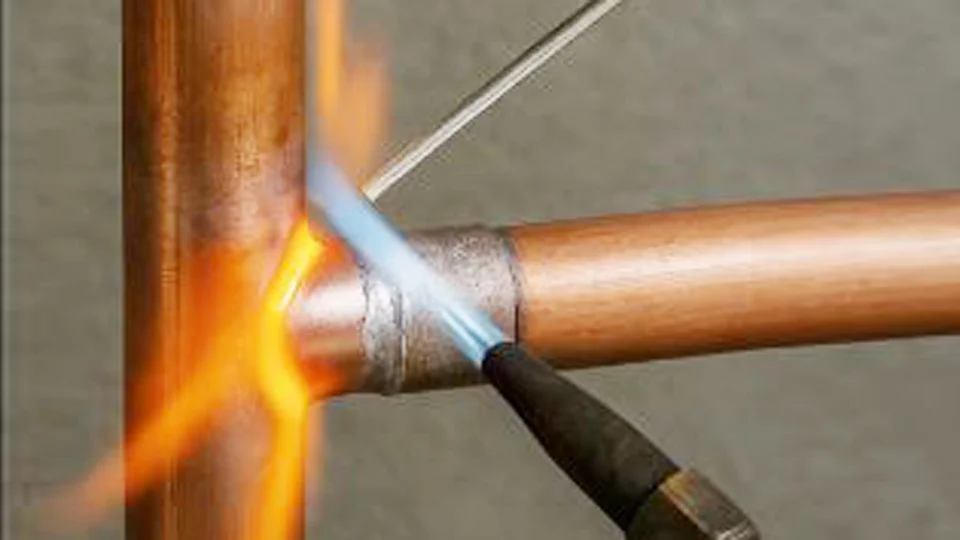
Light your oxy-acetylene torch and adjust to a neutral flame (equal oxygen and acetylene, with a clear white inner cone). Start heating the pipe first, as it takes longer to reach brazing temperature due to copper’s high thermal conductivity.
Move the flame to the fitting’s hub, keeping it in constant motion to avoid overheating. Aim for a dull cherry-red color (1,100–1,200°F). If the copper glows bright red or white, it’s too hot, and you risk warping or burning the flux.
Step 6: Apply the Filler Rod
Once the joint is hot enough, touch the brazing rod to the seam. The heat from the joint—not the flame—should melt the rod. Let the filler flow into the gap via capillary action. I made the mistake early on of heating the rod directly, which caused uneven flow and a messy joint.
Feed the rod steadily until a clean, silver fillet forms around the joint. For BCuP-5, you’ll need about 1–2 inches of rod per joint, depending on pipe size.
Step 7: Cool and Clean
Let the joint cool naturally for 10–15 minutes. Quenching with water can stress or crack the joint—I ruined a suction line that way once. Once cool, brush off flux residue with a wire brush or wipe with a damp rag to prevent corrosion. Inspect for a shiny, even fillet with no gaps or voids. A good braze looks like a clean silver ring.
Step 8: Test for Leaks
Testing is critical for HVAC systems. Pressurize the system with nitrogen (100–400 psi, depending on the system) and brush on a soap solution to check for bubbles. I also use an electronic leak detector for extra assurance.
For refrigerant lines, pull a vacuum to below 500 microns with a vacuum pump to remove moisture. I caught a pinhole leak this way on a chiller line, fixing it before charging the system.
Choosing the Right Brazing Rod
Picking the right rod is crucial for leak-free joints. Here’s what I use and why:
BCuP-5 (Copper-Phosphorus, 15% Silver): My go-to for copper-to-copper joints. It’s self-fluxing, cost-effective, and handles 300–600 psi. Melts at 1,200–1,500°F.
Harris Stay-Silv 15 (15% Silver Alloy): Ideal for critical jobs or copper-to-steel joints. Flows smoothly but requires flux. More expensive but worth it for high-pressure systems.
BAg Series (Silver-Based Alloys): For dissimilar metals like copper to stainless steel. Use with borax-based flux for strong, ductile joints.
I avoid cheap rods—they often have inconsistent flow and lead to weak brazes. Stick with trusted brands like Harris or Lucas-Milhaupt for reliable results.
Rod Comparison Table
| Rod Type | Best For | Flux Needed? | Melting Point | Cost |
|---|---|---|---|---|
| BCuP-5 | Copper-to-copper HVAC joints | No | 1,200–1,500°F | Moderate |
| Harris Stay-Silv 15 | Critical HVAC, copper-to-steel | Yes | 1,200–1,300°F | High |
| BAg Series | Dissimilar metals, high strength | Yes | 1,100–1,400°F | Very High |
Common Mistakes and How to Fix Them
I’ve made plenty of mistakes over the years—here’s how to avoid them:
Mistake: Poor cleaning. Dirt or grease blocks filler flow.
Fix: Spend extra time sanding pipes and fittings until they shine. Use a degreaser like acetone for stubborn grime.
Mistake: Overheating the joint. Too much heat warps copper or burns flux.
Fix: Keep the flame moving and watch for a dull red glow. Use a smaller torch tip for better control.
Mistake: Skipping nitrogen purge. Oxidation inside the pipe clogs compressors.
Fix: Always purge with 2–4 CFH of nitrogen during brazing.
Mistake: Using soldering for HVAC. Low-temperature alloys fail under refrigerant pressure.
Fix: Stick to brazing with high-strength fillers like BCuP-5.
Mistake: Rushing cooling. Quenching with water cracks joints.
Fix: Let joints cool naturally for 10–15 minutes.
Practice on scrap copper to perfect your technique. I still do this before big jobs to test my setup and filler flow.
Machine Settings and Joint Prep Tips
Torch Settings: For oxy-acetylene, set acetylene to 5–7 psi and oxygen to 10–15 psi for a neutral flame. For propane, use a swirl-tip torch for even heating.
Joint Gap: Aim for 0.002–0.005 inches for capillary action. Too tight, and filler won’t flow; too loose, and the joint weakens.
Heat Control: Heat the pipe first, then the fitting. Copper conducts heat fast, so keep the flame moving to avoid hot spots.
Nitrogen Flow: Set to 2–4 CFH. Check with a flowmeter for accuracy.
Cleanliness: Use a stainless steel wire brush for fittings and emery cloth for pipes. Degrease with acetone if pipes are oily.
I keep a small torch tip for ½-inch lines and a larger one for ¾-inch and up. It’s all about matching heat to pipe size.
Real-World Applications
Brazing HVAC copper lines is critical across various settings:
- Residential HVAC: Joining line sets for split AC units or heat pumps in homes.
- Commercial Refrigeration: Installing copper lines for walk-in coolers or supermarket systems.
- Industrial Systems: Brazing high-pressure lines for ammonia-based chillers in factories or data centers.
- DIY Projects: Building custom cooling systems for workshops or repairing portable AC units.
- HVAC Training: Students practicing for certifications like NATE or EPA Section 608.
I once brazed a chiller line for a data center—high stakes, tight deadline. Proper prep and nitrogen purging saved the day, delivering a leak-free system that’s still running strong.
Conclusion
Brazing HVAC copper lines without leaks is a skill that blends precision, patience, and the right tools. From cleaning pipes to a mirror shine to purging with nitrogen and choosing the perfect brazing rod, every step matters.
Whether you’re a DIYer saving on repair costs, a hobbyist experimenting with cooling systems, a student learning the trade, or a pro meeting ASME codes, you’re now equipped to create strong, leak-proof joints that stand the test of time. My biggest takeaway? Never skip prep or testing—it’s the difference between a joint that holds and one that fails.
Practice on scrap copper with your exact setup before tackling a live job. It builds confidence and catches issues early. Grab your torch, stay safe, and braze with pride—you’ve got this!
FAQ
Can I use a propane torch for brazing HVAC copper lines?
Yes, for small pipes (½-inch or less), a propane torch with a swirl tip works fine for copper-to-copper joints. For larger pipes or faster heating, I prefer an oxy-acetylene torch for better control and higher heat (1,800°F minimum). Keep the flame moving and aim for a dull red glow to avoid overheating.
Do I need flux when brazing copper-to-copper HVAC lines?
Not always. Copper-phosphorus rods like BCuP-5 are self-fluxing for copper-to-copper joints, so you can skip flux. For copper-to-steel or critical jobs, I apply borax-based flux to prevent oxidation and ensure smooth filler flow. Always clean flux residue afterward to avoid corrosion.
How do I test for leaks after brazing?
Pressurize the system with nitrogen (100–400 psi, depending on the system) and brush on a soap solution to check for bubbles. For refrigerant lines, pull a vacuum to below 500 microns with a vacuum pump to remove moisture. I also use an electronic leak detector for extra assurance.
What’s the best brazing rod for HVAC copper lines?
For most HVAC jobs, I use BCuP-5 (copper-phosphorus, 15% silver) because it’s self-fluxing, cost-effective, and handles 300–600 psi. For critical or dissimilar metal joints, Harris Stay-Silv 15 (15% silver alloy) flows smoother but requires flux. Choose based on pressure and budget.
Why is nitrogen purging important when brazing HVAC lines?
Nitrogen displaces oxygen inside the pipe, preventing scale that can clog compressors or valves. I set the flow to 2–4 CFH to keep lines clean and ensure strong, leak-free joints. Skipping this step can lead to system failures or costly repairs down the line.