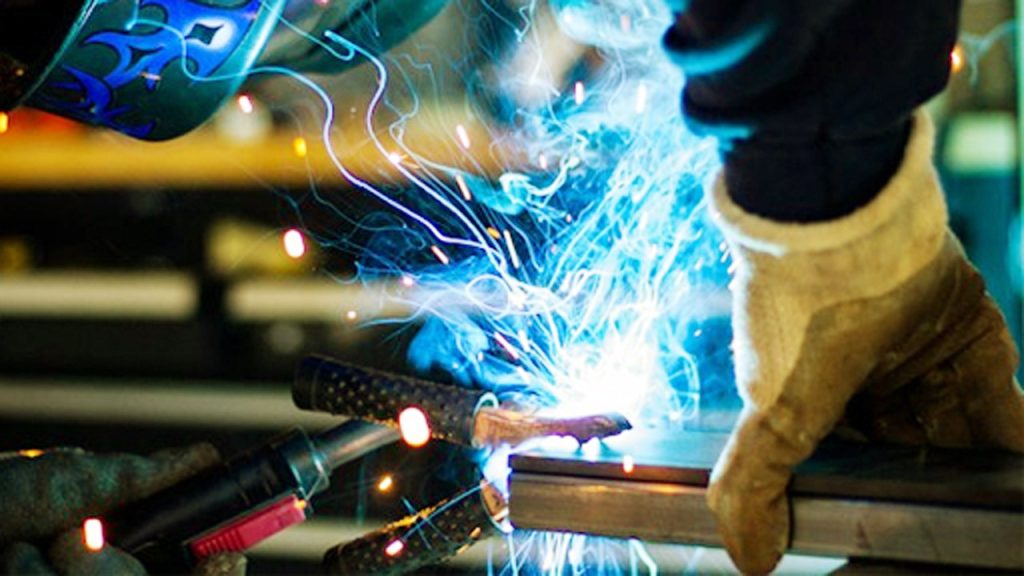
Arc blow can make you feel like the weld has a mind of its own—arc wandering, puddle pushing off to one side, and beads refusing to stay where you aim them. I’ve fought it on heavy plate and pipe joints, especially with DC stick welding, thinking my technique was the problem.
Learning how to prevent arc blow in welding came from paying attention to what the current and setup were actually doing to the arc.
Left unchecked, arc blow leads to lack of fusion, undercut, and ugly welds that won’t pass inspection. I’ve seen good welders struggle simply because the ground was in the wrong place or the joint setup worked against them. Small changes in polarity, lead placement, and weld sequence made a big difference for me.
If you’ve ever chased an arc that won’t stay put, you’re not alone. Let me show you the practical, field-proven ways to control arc blow and keep your weld puddle exactly where it belongs—step by step.
Image by I See You Don’t Know Shit About Welding
What Exactly Is Arc Blow and Why Does It Ruin Your Welds?
Arc blow is essentially a deflection of the welding arc caused by unbalanced magnetic forces around your workpiece. It shows up most in DC welding because the direct current creates a steady magnetic field that interacts with residual magnetism in the metal or even the Earth’s magnetic pull.
I’ve seen it turn a straightforward SMAW job into a nightmare, where the arc stretches sideways, blowing spatter across the shop floor.
How does it work? When you strike an arc, the current flow generates a magnetic field. If that field isn’t symmetric—say, because your ground clamp is too far from the weld zone or the metal has leftover magnetism from previous machining—the arc gets pushed or pulled. This is amplified in corners, edges, or large plates where the magnetic lines concentrate.
You’ll want to watch for it on jobs involving ferromagnetic materials like steel or iron, especially in thicker sections over 1/4 inch. Why use prevention strategies here? Because unchecked arc blow leads to incomplete fusion, porosity, and weak joints that fail under load.
In my experience, it’s a top culprit for rework in fabrication shops, eating into profits and deadlines. For hobbyists, it’s the difference between a clean gate repair and one that looks amateurish.
Spotting Arc Blow Before It Wrecks Your Project
Recognizing arc blow early saves you from chasing symptoms. The arc might veer toward one side of the joint, creating an uneven bead that’s fat on one edge and skinny on the other. Spatter increases dramatically, and you could hear a irregular hissing instead of that steady fry.
In practice, it often hits during long welds on beams or pipes, where the magnetic buildup intensifies as you progress. I’ve had it on a farm equipment repair where the arc started stable but blew out midway, forcing me to stop and reposition.
Why bother identifying it? Misdiagnosing as bad technique or wrong settings leads to endless trial and error. Instead, pause if the arc feels “sticky” or pulls away from your travel direction— that’s your cue to adjust.
For students, this is a key lesson: Arc blow isn’t your fault as a beginner; it’s physics at play. Pros sometimes overlook it on rushed jobs, thinking it’s just a windy day affecting the shield gas, but in DC stick welding, it’s usually magnetic.
Switching to the Right Welding Process to Dodge Arc Blow
One of the simplest ways to sidestep arc blow is picking a process less prone to it. DC welding, like in SMAW or GTAW, is a magnet for trouble because the constant polarity builds those fields. AC processes, on the other hand, alternate the current, neutralizing much of the magnetism.
DC vs. AC: When to Make the Switch
In my shop, I default to AC for aluminum or when arc blow rears up on steel. AC TIG, for instance, cleans oxides while minimizing deflection—perfect for aerospace parts or custom exhausts. But DC has its place for deeper penetration on thick carbon steel.
How it works: AC flips polarity 60 times a second (in standard US machines), disrupting magnetic buildup. Use it when welding non-ferrous metals or in tight spots where repositioning is tough. For a typical job like repairing a cracked manifold, switching to AC halved my spatter and gave a mirror-smooth bead.
Pros of AC: Less arc blow, better cleaning action. Cons: Shallower penetration, so not ideal for heavy structural work. If you’re a hobbyist with a basic inverter welder like a Lincoln or Miller, check if it has AC capability—many do for under $500.
Integrating MIG or Flux-Cored for Arc Blow Resistance
MIG welding with DC electrode positive (DCEP) can still get arc blow, but the continuous wire feed and gas shield make it more forgiving. I’ve used it on auto body repairs where stick would blow out due to thin sheets.
Why choose it? The short-circuit transfer mode keeps arcs tight, reducing magnetic influence. Tips: Run at 18-22 volts for 0.035-inch wire on mild steel, adjusting amperage to 140-180 for 1/8-inch plates. Always clean your nozzle to avoid gas turbulence mimicking blow.
Mastering Grounding and Positioning to Stabilize Your Arc
Grounding is where most arc blow battles are won or lost. A poor ground lets magnetic fields run wild, deflecting your arc like a sail in the wind.
Ideal Ground Clamp Placement for Different Joints
Place the ground as close as possible to the weld zone—ideally within 12 inches. On a T-joint, clamp directly opposite the weld; for butt joints, center it.
Step-by-step: 1) Clean the clamp contact area with a wire brush for solid connection. 2) Test the arc on scrap— if it blows, move the clamp 90 degrees. 3) For long welds, use multiple grounds or reposition midway.
In one shop incident, a trainee clamped 3 feet away on a beam, causing massive blow and undercut. Lesson: Proximity matters. For pipe welding, wrap the ground around the pipe to balance fields.
Workpiece Orientation and Shop Layout Tricks
Orient your workpiece north-south if outdoors, aligning with Earth’s field. In the shop, avoid welding near large motors or transformers that amp up interference.
Why? External fields compound internal ones. I’ve rotated tables mid-job to cut blow by half. For hobbyists in garages, keep welders away from fridges or tools—simple but effective.
Fine-Tuning Electrodes and Amperage to Combat Arc Blow
Electrode choice and settings are your frontline defense. Wrong diameter or amps, and arc blow amplifies.
Selecting Electrode Diameters for Stability
For SMAW, 1/8-inch E7018 rods are my go-to for general fab, handling 90-150 amps without much blow. Thicker 5/32-inch for heavier plates at 140-220 amps.
How it helps: Smaller diameters allow shorter arcs, less prone to deflection. Use when? On detailed work like brackets. Tip: Store rods dry to avoid hydrogen cracking, which worsens blow effects.
Amperage Ranges and Polarity Adjustments
Too high amps boost magnetic force; too low, and the arc wanders seeking stability. For mild steel, aim for 100-140 amps on 1/8-inch rods.
| Material Thickness | Electrode Diameter | Recommended Amperage Range | Polarity Notes |
|---|---|---|---|
| 1/16 inch | 3/32 inch | 70-100 amps | DCEN for less heat, reduces blow |
| 1/8 inch | 1/8 inch | 90-150 amps | DCEP for penetration, watch for blow on edges |
| 1/4 inch | 5/32 inch | 140-220 amps | Switch to AC if blow persists |
| 1/2 inch+ | 3/16 inch | 180-280 amps | Use multiple passes to manage fields |
Pros of fine-tuning: Better control, less spatter. Cons: Over-adjusting leads to burn-through. In practice, start low and ramp up, observing arc behavior.
Personal tip: On a forklift repair, dropping amps by 20 fixed blow instantly—no repositioning needed.
Prepping Joints and Handling Materials to Prevent Magnetic Buildup
Joint prep isn’t just for fusion; it minimizes arc blow by ensuring even current flow.
Cleaning and Demagnetizing Techniques
Always degrease and grind joints—rust or mill scale holds magnetism. For stubborn cases, use a demagnetizer coil, passing it over the piece slowly.
Why? Magnetized metal pulls arcs hard. I’ve demagged crane hooks before welding, turning chaotic arcs stable. Use on alloy steels or after heat treating.
Step-by-step demag: 1) Power on the coil. 2) Move it in circles away from the metal. 3) Test with a compass for zero field.
Material Compatibility and Filler Choices
Match filler to base metal—E6010 for dirty steel penetrates despite blow. For stainless, 308L wire in MIG resists magnetic issues.
When? On mixed-metal jobs like attaching brackets to frames. Tip: Preheat thicker sections to 200°F to even out fields.
Advanced Fixes for Persistent Arc Blow in Tough Jobs
Sometimes basics aren’t enough—enter shunts and angles.
Using Magnetic Shunts and Barriers
Steel plates as shunts divert fields. Place them perpendicular to the weld path.
How: Weld a temporary tab or use clamps. In pipeline work, this cut blow on circumferential joints.
Pros: Cheap, effective. Cons: Adds setup time.
Electrode Angle and Travel Speed Tweaks
Tilt your rod 10-15 degrees against the blow direction. Slower travel lets you compensate manually.
Why? Counters deflection force. On a bridge repair, angling saved a bead from undercutting.
Avoiding Common Pitfalls That Invite Arc Blow
Beginners often ignore grounding; pros rush preps. Mistake: Welding magnetized tools—always check.
Fix: Routine demag sessions. Another: High amps on thin metal—dial back.
In my early days, I blew a manifold by skipping clamp moves—lesson learned the hard way.
Wrapping Up with Stronger, More Reliable Welds
Reflecting on those frustrating jobs where arc blow turned a quick fix into an all-day grind, it’s clear that a little foresight goes a long way. You’ve now got the tools—from grounding tweaks to process switches—to keep your arcs straight and your beads professional.
Whether you’re a student practicing in class or a pro on a deadline, these strategies equip you to handle real-world variables like material magnetism or shop interference without second-guessing.
The payoff? Safer welds with better penetration, less distortion, and fewer callbacks. You’ll save on rods, reduce rework, and build confidence in tricky setups. Always weld a test bead on scrap from the same batch— it reveals arc blow early, letting you adjust before committing to the real piece.
FAQs
What causes arc blow in DC welding?
Magnetic fields from current flow or residual magnetism in the metal deflect the arc. It worsens on edges or with distant grounds. Fix by switching to AC or repositioning clamps close to the joint.
Can arc blow happen in MIG welding?
Yes, though less than in stick, especially on DCEP with long arcs. Shorten your stickout to 3/8 inch, clean nozzles, and use anti-spatter spray to maintain stability.
How do I know if my welder settings are causing arc blow?
If the arc wanders despite good technique, check amps—too high amplifies it. Drop 10-20 amps and test; also flip polarity if your machine allows.
Is arc blow more common in certain metals?
Definitely in ferromagnetic ones like carbon steel or cast iron. Aluminum sees less due to lower magnetism. Demag ferrous metals before starting.
What’s the quickest way to stop arc blow mid-weld?
Pause, move the ground clamp opposite the blow direction, and resume with a shorter arc length. Works 80% of the time in my experience.