Sparks crackling, wire feeding smoothly, and that steady arc lighting up the joint—that’s what makes MIG welding so appealing in the shop. It feels controlled, fast, and forgiving, especially when you’re laying beads on clean steel. But after enough real-world jobs, you start to see that MIG isn’t perfect for every situation.
I’ve dealt with shielding gas getting blown away on outdoor projects, burned through thin panels when my settings were just a little too hot, and wasted time fixing wire feed issues in the middle of a task.
Those hard-earned lessons taught me that understanding the pros and cons of MIG welding directly impacts weld strength, efficiency, and overall project cost.
Before you grab the MIG gun for every job, it’s worth knowing exactly where it shines—and where it can cause problems. Let me break it down clearly so you can choose the right process with confidence.

What Exactly Is MIG Welding?
MIG stands for Metal Inert Gas welding, also known as GMAW (Gas Metal Arc Welding). In simple terms, it uses a continuously fed solid wire electrode that melts into the joint while a shielding gas protects the molten puddle from atmospheric contamination.
The setup is straightforward: a power source, wire feeder, MIG gun, spool of wire, and a bottle of shielding gas. Pull the trigger, and the wire feeds automatically while the machine maintains the arc. Unlike stick welding, you don’t have to stop every few inches to change electrodes. Unlike TIG, you don’t have to feed filler rod with your other hand.
The process runs on direct current electrode positive (DCEP) in most cases. The wire diameter, voltage, wire speed, and gas mixture determine how the arc behaves and how much heat goes into the metal.
The Biggest Advantages of MIG Welding
MIG’s speed is the first thing that hooks most people. Once you dial in the settings, you can lay down bead after bead without interruption. In my shop, I’ve knocked out trailer repairs or custom brackets in a fraction of the time it would take with SMAW. Production shops love it for the same reason—higher deposition rates mean more parts out the door.
The welds are also remarkably clean. With the right gas (usually 75/25 argon/CO2 for mild steel), you get very little slag and minimal spatter compared to stick. That means less grinding and chipping afterward, which saves time and preserves your hands. For visible fabrication work like furniture, gates, or automotive panels, this is a huge win.
Another major pro is how beginner-friendly the process feels once you get past the initial learning curve. The gun is easy to maneuver, and the continuous wire feed lets you focus on travel speed and gun angle instead of constantly managing arc length. Many of the students I’ve trained picked up decent-looking MIG welds within a weekend, whereas stick took them weeks to get consistent.
MIG also shines on thinner materials. From 24-gauge sheet metal up to about 3/8-inch plate, it gives excellent control over heat input. You can run short-circuit transfer on thin stuff to avoid burn-through, then switch to spray transfer on thicker sections for deep penetration. This versatility is why so many auto body shops, HVAC fabricators, and home builders rely on it.
Finally, MIG is excellent for out-of-position welding when you use the right parameters and wire. Vertical-up and overhead work is easier than with most flux-cored wires, and the results look far better than stick in many cases.
Where MIG Welding Falls Short
For all its strengths, MIG isn’t the answer to every welding problem, and pretending it is will cost you time, money, or broken parts.
The biggest limitation is its sensitivity to wind and contaminants. The shielding gas gets blown away outdoors or in drafty shops, leading to porosity and weak welds. I’ve lost count of the times a customer brought in field repairs only to watch the gas get sucked away by the breeze. In those situations, I switch to flux-cored or stick without hesitation.
MIG equipment is also more expensive to buy and maintain. A decent 220V MIG machine with a good wire feeder will set you back more than a basic stick welder. You need a gas regulator, hoses, and bottles that get refilled regularly. Wire costs more per pound than 6010 or 7018 rods, and if your settings are off, you can waste a surprising amount of it in spatter and bird nests.
The process is picky about surface preparation. Mill scale, rust, oil, or paint will cause problems much faster than with stick welding. On dirty farm equipment or old structural steel, I often spend more time grinding and prepping than I would if I just ran 7018.
Another real drawback is the limited ability to handle thick materials in a single pass. While you can stack passes, the heat input adds up quickly, leading to more distortion on large fabrications. For heavy plate over ½ inch, many pros still prefer stick or flux-cored for the deeper penetration and tolerance of dirty metal.
Finally, MIG machines are less portable than a suitcase feeder with stick capability. Dragging a gas bottle around a jobsite gets old fast, especially on uneven ground or when climbing ladders.
MIG vs Stick Welding: Real-World Comparison
| Aspect | MIG Welding | Stick (SMAW) Welding |
|---|---|---|
| Learning Curve | Easier for beginners | Steeper, more technique required |
| Speed | Much faster | Slower, frequent rod changes |
| Outdoor Use | Poor (gas sensitive) | Excellent |
| Material Cleanliness | Needs clean metal | Very forgiving |
| Weld Appearance | Clean, minimal cleanup | More slag, needs chipping/grinding |
| Equipment Cost | Higher initial + gas | Lower initial, consumables cheap |
| Thin Metal | Excellent control | Risk of burn-through |
| Thick Material | Multiple passes, more distortion | Deep penetration in single pass |
| Portability | Limited by gas bottle | Highly portable |
I keep both processes in my shop for a reason. When a farmer brings in a broken hitch on a windy day, stick wins. When I’m building a polished stainless railing in the shop, MIG is unbeatable.
MIG vs TIG: When Speed Beats Beauty
TIG produces the prettiest welds, no question. But it’s slow. I once had a customer who wanted TIG on an aluminum fuel tank for the looks. It took me three times longer than it would have with MIG (using a spool gun), and the labor cost reflected that.
MIG with a spool gun or push-pull system handles aluminum surprisingly well these days, especially on 1/8″ to 1/4″ material. The welds aren’t quite as perfect as TIG, but for structural or non-critical appearance work, they’re more than adequate and dramatically faster.
For stainless food-grade work or aerospace, TIG still rules. For everything else—mild steel frames, exhaust systems, repair work—MIG gives you 80-90% of the quality at 200% of the speed.
Getting the Right Settings for MIG Welds
This is where most people struggle. Wrong settings cause more bad MIG welds than anything else.
For mild steel with 0.030″ wire and 75/25 gas:
- 22-24 gauge: 16-18 volts, 80-120 ipm wire speed
- 1/8″ material: 19-21 volts, 200-280 ipm
- 1/4″ material: 22-24 volts, 300-380 ipm
- 3/8″ and up: Move to 0.035″ wire and higher settings
Always start on the low side and increase wire speed until the arc sounds right—steady crackle, not a hiss or popping. Gun angle matters: 10-15° push angle usually gives the best results on flat and horizontal.
For aluminum, use 100% argon and 0.030″ or 0.035″ wire. Expect to run hotter and faster than steel. A spool gun is almost mandatory unless you have a high-end push-pull system.
Best Practices That Actually Matter in the Shop
Clean the metal. I mean really clean it—angle grinder with a flap disc or 80-grit until it’s bright. Skip this step and you’ll chase porosity all day.
Use the right contact tip size and keep it clean. A tip that’s too big or clogged causes erratic feeding and bird nests.
Keep your stickout between 3/8″ and 1/2″. Too long and you lose voltage and get unstable arc. Too short and you’ll burn up the tip.
Travel speed is critical. Too slow and you get excessive heat and burn-through. Too fast and you get lack of fusion. Watch the puddle— it should be slightly wider than the wire diameter and following the front edge nicely.
For vertical-up welding, use a slight weave or whip technique and keep the gun at about 0-10° upward angle.
Common MIG Welding Problems and How to Fix Them
Porosity
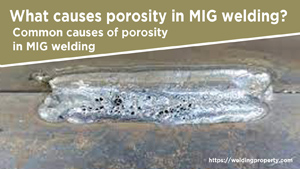
Looks like little holes in the weld. Almost always caused by dirty metal, wind, or bad gas. Fix: Clean better, move the work inside or use a windscreen, check for leaks in hoses and regulator.
Excessive Spatter
Wrong voltage/wire speed combination or bad gas. Increase voltage slightly or try 90/10 argon/CO2 mix for less spatter on mild steel.
Burn-Through
Too much heat on thin metal. Drop voltage and wire speed, increase travel speed, or switch to 0.025″ wire.
Lack of Fusion
Travel speed too fast or voltage too low. Slow down slightly and make sure you’re getting good tie-in on the toes.
Bird Nesting
Wire feeding issue. Check for kinks in the liner, wrong drive roll tension, or worn contact tip.
MIG Welding Different Materials
Mild Steel
Easiest. 75/25 or 90/10 gas works great. ER70S-6 wire is the go-to for most shop work because it handles slight rust better than ER70S-3.
Stainless Steel
Use tri-mix (90% helium, 7.5% argon, 2.5% CO2) for best results. ER308L or ER316L wire depending on the grade. Keep heat lower than mild steel to avoid warping and carbide precipitation.
Aluminum
Requires pure argon and a spool gun or push-pull feeder. Clean the oxide layer immediately before welding. Use 4043 wire for most general work, 5356 for higher strength. Expect to run hotter and faster.
Is MIG Right for Your Situation?
For most garage fabricators and small shops doing repair and light-to-medium fabrication, the pros of MIG welding far outweigh the cons. The speed and ease let you get more done in less time, which matters when you’re balancing a day job and weekend projects.
Professional production environments love it for the same reasons, especially when parts are clean and the work stays indoors.
If you do a lot of field work, heavy structural welding, or work with very rusty/dirty material, you’ll still need stick or flux-cored in your arsenal.
Final Thoughts
After thousands of hours running MIG machines—from cheap 110V units to industrial 350-amp beasts—I can tell you this: MIG is the most practical all-around process for the majority of welders in the United States today. It won’t replace every other process, but it will handle 70-80% of common jobs faster and cleaner than anything else.
The key is understanding when to use it and when to reach for something different. Once you get comfortable dialing in settings and respecting its limitations, MIG becomes one of the most satisfying tools in your welding arsenal.
When in doubt, turn the voltage up a couple of points and slow your travel speed slightly. Most beginners run settings too cold, resulting in cold laps and lack of fusion. A slightly hotter arc with good technique almost always looks and performs better.
FAQ
Is MIG welding good for beginners?
Yes, it’s one of the easiest processes to start with. The continuous wire feed removes a lot of the coordination required in stick or TIG. Focus on getting clean metal and basic settings right, and you’ll be making solid welds within a few practice sessions.
Can you MIG weld outside?
Not reliably. Even light wind can ruin the gas shield. For occasional outdoor work, you can use a windscreen or try self-shielded flux-cored wire instead. For serious field welding, stick or gasless flux-cored is usually the better choice.
What’s the best gas for MIG welding mild steel?
75% argon / 25% CO2 is the most common and versatile mix in the US. It gives good penetration, smooth arc, and acceptable spatter levels. For even less spatter on thin material, try 90/10. Pure CO2 is cheapest but produces more spatter and a harsher arc.
How thick of metal can MIG weld?
A typical 200-250 amp machine handles up to about 3/8″ in a single pass comfortably. Thicker material is possible with multiple passes, but at that point many welders switch to flux-cored or stick for efficiency and better penetration.
Do I need a spool gun for aluminum?
For anything over very short runs, yes. Regular MIG guns have too much friction for soft aluminum wire, leading to bird nests and feeding problems. A spool gun puts the wire right at the gun and makes aluminum MIG welding much more reliable.