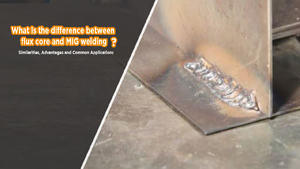
Looking to start welding but worried about the hassle and expense of gas cylinders? Flux core welding offers a practical solution that eliminates the need for external gas supplies while delivering strong, reliable welds.
This gasless welding process has become increasingly popular among beginners and professionals alike, thanks to its portability, versatility, and effectiveness in outdoor conditions.

Image by mig-welding.co
Flux core welding combines simplicity with powerful performance, making it an ideal starting point for anyone entering the world of welding.
This guide breaks down everything you need to know about flux core welding. From essential equipment and proper techniques to troubleshooting common issues, you’ll learn how to achieve professional-quality welds without the complexity of traditional gas-shielded processes.
Flux Core Welding Basics
Flux core arc welding (FCAW-S) represents a significant advancement in welding technology, combining the simplicity of stick welding with the efficiency of wire-fed systems.
First introduced in the 1950s, this innovative process has revolutionized the welding industry by offering a practical solution for both indoor and outdoor applications.
What is FCAW-S welding
FCAW-S, or self-shielded flux core arc welding, operates like a “stick electrode turned inside out.” This unique process uses a tubular wire filled with special flux compounds that create their own shielding protection when heated.
Unlike traditional welding methods, FCAW-S doesn’t require external gas tanks, making it incredibly portable and practical for field work.
How flux core wire works
The magic of flux core welding lies in its specialized wire construction. The wire consists of a metal sheath filled with flux and other crucial compounds. When the arc strikes, these internal components perform multiple vital functions:
- Deoxidize and denitrify the molten metal
- Form protective slag that shapes and shields the bead
- Add alloying elements for desired mechanical properties
- Create shielding gas through chemical reactions
The flux creates a protective barrier around the weld pool, effectively shielding it from atmospheric contamination. This self-shielding capability makes the process particularly effective in outdoor conditions where wind might disrupt traditional gas-shielded methods.
Advantages over traditional MIG welding
Superior Outdoor Performance: Unlike MIG welding, flux core welding excels in outdoor environments where wind can disrupt gas coverage. The self-generated shielding makes it ideal for construction sites and field repairs.
Enhanced Penetration: For the same amperage, flux core welding typically achieves better penetration than MIG welding, making it particularly effective on thicker materials.
Contamination Tolerance: One of the most significant advantages is its ability to handle less-than-ideal conditions. Flux core welding can effectively work through:
- Surface rust
- Mill scale
- Light contamination
- Various material thicknesses
The process also offers higher deposition rates than traditional MIG welding, leading to increased productivity and faster completion times. This efficiency, combined with its portability and versatility, makes flux core welding an increasingly popular choice for both professional welders and enthusiasts.
Essential Equipment and Setup
Success in flux core welding starts with selecting the right equipment and setting it up correctly. Let’s explore the essential components you’ll need to get started with this versatile welding process.
Choosing the right flux core wire
Selecting the appropriate wire is crucial for achieving strong, clean welds. The most common wire diameters range from 0.8mm to 2.0mm, with 0.030-inch (.8mm) being an excellent all-around choice for beginners.
For general-purpose steel welding, the E71T-GS wire offers excellent versatility and performance across various thicknesses.
Key considerations for wire selection:
- Match wire strength to base metal requirements
- Consider material thickness when choosing wire diameter
- Select wire type based on intended application
- Ensure proper storage in clean, dry conditions
Welder settings and polarity
One of the most critical aspects of flux core welding setup is proper polarity configuration. Unlike MIG welding, most self-shielded flux core welding requires DCEN (Direct Current Electrode Negative) or straight polarity. Incorrect polarity settings can result in inconsistent arcs, excessive spatter, and poor penetration.
Your welding machine should be a constant voltage (CV) type, which helps maintain consistent arc length through self-adjustment. Most modern welders include reference charts for setting correct:
- Voltage levels
- Wire feed speeds
- Amperage ranges
Required safety gear and tools
Safety should never be compromised when flux core welding. The process produces intense UV radiation and significant heat, requiring comprehensive protection. Essential safety equipment includes:
- Head and Face Protection
- Welding helmet (shade 10-14)
- Safety glasses
- Fire-resistant skull cap
- Body Protection
- Flame-resistant jacket
- Welding gloves
- Steel-toed boots
- Coveralls
Beyond personal protective equipment, you’ll need several essential tools:
- Wire brush for cleaning
- Chipping hammer for slag removal
- MIG pliers for maintenance
- Angle grinder or metal file
- Welding clamps for securing workpieces
To maintain your equipment regularly and store flux core wire in its original packaging until ready for use. This helps prevent moisture contamination and ensures consistent weld quality.
Mastering Proper Welding Technique
Mastering the proper technique is what separates good welds from great ones in flux core welding. With expert guidance from Miller® technician Joel Ort and proven industry practices, let’s dive into the essential techniques that will elevate your welding game.
Correct gun angle and movement
The key to successful flux core welding lies in the drag technique – where you point the gun back at the weld pool and pull it away from the completed weld.
This simple rule: “If there’s slag, you drag.” This method ensures better penetration and reduces spatter, particularly crucial when working with thicker metals.
Your travel angle should be maintained between 10-15 degrees for optimal results. Exceeding 20 degrees can lead to excessive spatter and unstable arcs. The work angle varies depending on your welding position:
- Flat position butt welds: 90-degree work angle
- T-joints: 45-degree work angle
- Horizontal welds: 0-15 degrees with slight upward angle
- Vertical welds: Requires 5-15 degree drop from perpendicular
Wire stick-out length
Wire stick-out – the distance between the contact tip and the work surface – plays a crucial role in achieving consistent welds. For flux core welding, maintain a stick-out of 3/4 to 1 inch, but never exceed the 1-inch mark. This specific length serves multiple purposes:
- Creates electrical resistance heating
- Preheats the wire effectively
- Helps drive out moisture and oxygen
- Initiates the production of shielding gasses
Speed and pattern control
Maintaining proper travel speed is critical for preventing common defects in flux core welding. Moving too slowly allows the weld puddle to get ahead of the arc, leading to slag inclusions. Conversely, excessive speed can result in lack of penetration.
For optimal speed control:
- Watch the weld puddle formation
- Maintain steady movement
- Allow proper filling of base metal
- Keep the arc on the trailing edge of the puddle
When working with thicker materials or bridging gaps, a slight weaving motion can help achieve better coverage. To pause briefly at each side of the weave to prevent undercutting and ensure proper tie-in with the base metal.
The combination of proper gun angle, stick-out length, and speed control directly impacts weld strength and appearance.
While these techniques may take time to master, consistent practice with these fundamentals will significantly improve your flux core welding results.
Common Applications and Materials
From industrial construction to DIY home repairs, flux core welding’s versatility makes it a go-to choice for countless applications. Let’s explore the materials and projects where this welding process truly shines.
Best materials for flux core welding
Flux core welding demonstrates exceptional performance across a range of metals, particularly excelling with:
- Carbon and structural steel
- Iron alloys
- Nickel-based alloys
- Stainless steel
- Duplex steels
What makes flux core welding particularly valuable is its ability to handle thicker materials with superior penetration. While it can work with materials as thin as 18 gage, it really shows its strength when working with metals 1/8 inch and thicker.
Outdoor welding projects
The self-shielding nature of flux core welding makes it perfect for outdoor projects where wind would typically disrupt traditional welding methods. Popular applications include:
| Project Type | Common Examples |
|---|---|
| Automotive | Exhaust systems, panel repairs |
| Garden/Yard | Fire pits, metal planters, trellises |
| Structural | Gates, fences, metal furniture |
| Repairs | Farm equipment, mower decks |
One significant advantage is that flux core welding can handle less-than-pristine materials. While you’ll still need to remove paint, oil, and moisture, the process can effectively work through light rust and mill scale – a common scenario in outdoor repairs.
Structural vs non-structural applications
Understanding the distinction between structural and non-structural applications is crucial for safety and compliance. For structural applications requiring high integrity:
Structural Applications:
- Use E71T-8 wire for critical welds requiring excellent toughness
- Suitable for bridge and skyscraper construction
- No thickness restrictions
- Follows strict AWS D1.8/D1.8M code requirements
Non-Structural Applications:
- E71T-11 wire works well for general repairs and lighter projects
- Perfect for materials less than 1/2 inch thick
- Ideal for stitch welds and tack welds
- Great for DIY projects and home repairs
The high productivity rates and excellent weld penetration make flux core welding particularly valuable in manufacturing environments where fast turnaround times are essential.
If you’re a professional welder working on industrial projects or a hobbyist tackling home repairs, the process offers the versatility to handle virtually any steel welding task.
Troubleshooting Common Issues
Even the most experienced welders encounter challenges with flux core welding. Understanding how to identify, prevent, and fix common issues can save you hours of frustration and ensure consistently high-quality welds.
Preventing porosity and slag inclusion
Porosity and slag inclusions are two of the most common defects that can compromise weld integrity.
Porosity appears as small holes or pockets in the weld, while slag inclusions occur when flux particles become trapped within the weld metal.
To prevent these issues, follow this comprehensive checklist:
- Clean base metal thoroughly, removing rust, paint, oil, and moisture
- Maintain proper stick-out length (3/4 to 1-1/4 inch maximum)
- Use correct polarity (typically DCEN for self-shielded wire)
- Adjust voltage settings according to manufacturer specifications
- Keep travel speed steady and consistent
For multi-pass welds, thorough cleaning between passes is crucial. Use a wire brush followed by a grinder to remove all slag before laying the next bead. If you think you’ve cleaned enough, clean it again.
Fixing wire feed problems
Wire feed issues can quickly halt your welding progress. Two primary problems you might encounter are birdnesting (wire tangling in the drive rolls) and burnback (wire melting back into the contact tip).
| Problem | Cause | Solution |
|---|---|---|
| Birdnesting | Incorrect drive rolls or tension | Use knurled V- or U-groove drive rolls, adjust tension gradually |
| Burnback | Too slow wire feed or incorrect stick-out | Increase wire feed speed, maintain proper distance |
| Wire flattening | Excessive drive roll pressure | Reduce tension, test feed into welding glove |
For optimal wire feeding, ensure your setup includes:
- Properly sized liner for your wire diameter
- Correct contact tip size
- Clean, unobstructed wire feed path
- Regular maintenance and inspection of components
Addressing weld appearance issues
Weld appearance problems often indicate underlying technical issues. Worm tracking – elongated holes along the weld surface – typically results from excessive voltage. To correct this, reduce voltage in half-volt increments until the problem resolves.
Conclusion
Flux core welding stands as a powerful, versatile solution for both beginners and seasoned professionals. Armed with proper equipment, correct techniques, and troubleshooting knowledge, you’ll master this efficient welding process that eliminates the need for external gas supplies.
Success depends on attention to detail – maintaining proper gun angles, managing wire stick-out length, and keeping consistent travel speeds. Regular practice with these fundamentals builds the muscle memory needed for professional-quality welds.
Each weld presents a learning opportunity. Start with simple projects, gradually tackle more complex applications, and always prioritize safety.
If you’re crafting garden furniture or handling industrial repairs, flux core welding delivers reliable results across diverse materials and conditions.
The path to welding mastery starts with understanding basics and grows through hands-on experience. Take time to practice proper techniques, learn from common mistakes, and build confidence in your abilities. Soon enough, you’ll produce strong, clean welds that stand the test of time.