I’ve watched a lot of beginners struggle with MIG welding, and nine times out of ten the problem isn’t the machine—it’s how they’re holding the gun. I remember helping a buddy who swore his welder was “spitting and acting crazy,” but the moment I adjusted his grip and angle, the bead smoothed out like magic.
Holding a MIG gun looks simple, but the way you position your hand, wrist, and nozzle can make the difference between a clean, controlled weld and a smoky mess of spatter.
Welding everything from thin sheet metal to heavy brackets, I’ve learned the little habits that keep the arc stable: steady hand placement, proper contact tip angles, and how to move without fighting the gun. When you get the grip right, the weld puddle becomes easier to read and your confidence shoots up fast.
If your welds feel inconsistent or you just want a more comfortable, controlled technique, let me walk you through the way I hold a MIG welding gun for smooth, predictable results every time.
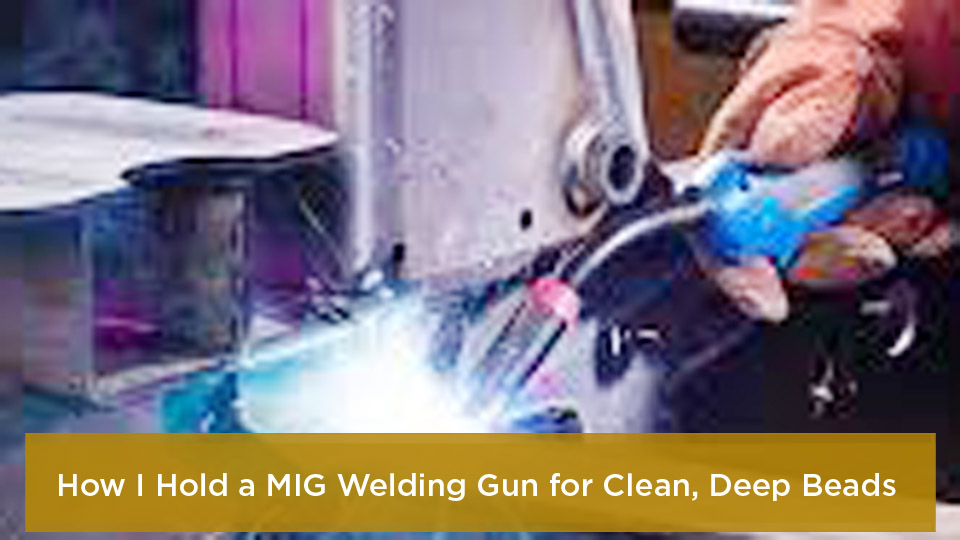
Image by binzel-abicor
Why Your MIG Gun Grip Actually Matters More Than Your Settings
Most beginners obsess over voltage and wire speed (and yeah, those matter), but I’ve watched guys with $4,000 machines make garbage welds because they were holding the gun like a garden hose. A steady, correct grip controls travel angle, work angle, stick-out, and travel speed – the four things that actually determine penetration, bead profile, and burn-through.
Hold it wrong and you’ll fight porosity, undercut, ropey beads, or cold lap all day. Hold it right and even a cheap 110-volt box starts laying down pretty welds. I’ve passed ASME bend tests on 6G pipe with a $200 Lincoln welders simply because I didn’t let the gun flop around.
The Basic MIG Gun Grip That 90% of Pros Use
Wrap your dominant hand around the handle exactly like you’re shaking hands with somebody you respect – firm but relaxed. Your trigger finger sits naturally on the switch, middle finger and ring finger hook under the barrel for support, pinky curls loosely, and your thumb rests on top of the handle or lightly along the side of the nozzle for extra steering control.
Keep your wrist straight, not bent up or down. I see new guys death-grip the handle until their knuckles turn white – that’s how you get the shakes after ten minutes. Relax. The gun only weighs a couple pounds.
Forehand vs Backhand – Which Push or Pull Is Actually Right
This argument has been going on since the 1980s, but here’s the no-BS field answer.
Push (forehand) – gun angled 5-15° in the direction of travel):
- Gives a prettier, flatter bead
- Better for thin metal and sheet
- Washes the weld out wider with less penetration
- Easier to see the puddle
Pull (backhand – gun angled 5-15° back toward the finished weld):
- Deeper penetration
- Narrower, taller bead (great for filling gaps)
- Less spatter on most ER70S-6 wire
- My personal default on anything over 3/16″
I push on auto body panels and aluminum, pull on structural steel and pipe. Most fab shops I’ve worked in run drag angle 90% of the time because the weld has to pass UT or X-ray, not a beauty contest.
The Perfect Stick-Out (Electrical Stick-Out) and Why It Drives Weld Quality
Stick-out is the distance from the end of the contact tip to the work – and almost nobody talks about it, yet it’s the fastest way to fix burn-back or a ropey bead. For .035 wire I keep 3/8″ to 1/2″ on steel, 1/2″ to 3/4″ on aluminum. Any longer and you lose penetration and get unstable arc. Any shorter and the tip overheats and you’ll burn back into it. I actually mark my nozzle with a Sharpie at 1/2″ so new helpers can eyeball it quick.
Stance and Body Position – Stop Welding Like You’re Afraid of It
Stand like you’re ready to fight – feet shoulder-width, weight balanced, knees slightly bent. Keep the gun in your strong hand and rest your other hand on your hip, knee, or the work itself for stability. When I’m running long horizontal fillets on a beam, I’ll sit on the flange or lean my off-hand forearm on the web. The goal is to lock your shoulder and elbow so the only thing moving is your wrist and forearm. If your shoulder is dancing, your bead is dancing.
Travel Angle and Work Angle Explained with Real Numbers
Travel angle = push or pull angle we already talked about (5-15°).
Work angle = how the gun is tilted side-to-side relative to the joint.
- Flat or horizontal fillet: 45° work angle
- Vertical up: point the gun slightly upward 5-10° and 45° work angle
- Overhead: 0-10° push, keep it almost perpendicular so the puddle doesn’t fall on your hood
- Lap joint: favor the bottom plate by 10° so you don’t burn through the top sheet
I keep a cheap plastic angle finder in my box just to show new guys what 45° actually looks like – most guess 60-70°.
Common MIG Gun Holding Mistakes I Still See Every Week
- “Death grip” that causes hand fatigue and shaky lines
- Bending the wrist like they’re pouring beer – keeps the arc length inconsistent
- Holding the nozzle instead of the handle – melts gloves and screws up angle
- Letting the cable drag on the floor and pull the gun sideways
- Resting the nozzle on the work (unless you’re hard-wire weaving on heavy plate)
Fix any one of these and your welds instantly look twice as good.
How to Practice Holding the Gun Without Wasting Wire or Gas
Run “dry beads” with the machine off. Put on your hood, gloves, get in position, and just pull the trigger while moving the gun exactly how you would if it was hot. Do it for five minutes a day and your muscle memory locks in faster than burning $50 worth of wire. I made my son do this for two weeks before he ever struck an arc – first time he touched a MIG.
Gun Angle and Settings Cheat Sheet I Keep Taped in Every Booth
| Material Thickness | Wire | Volts | WFS | Angle | Stick-out |
|---|---|---|---|---|---|
| 16 ga – 1/8″ | .030 | 17-19 | 180-250 | Push 10° | 3/8″ |
| 3/16 – 3/8″ | .035 | 21-24 | 300-400 | Drag 10° | 1/2″ |
| 1/2″ + single pass | .045 | 26-30 | 350-450 | Drag 15° | 5/8-3/4″ |
| Aluminum 1/8-1/4″ | .035 5356 | 22-25 | 400-500 | Push 5-10° | 5/8″ |
These are Lincoln Power MIG 210MP numbers – adjust ±2 volts for other machines.
Welding Vertical Up – The Grip Trick That Changed Everything for Me
When I was a kid on pipeline tie-ins, an old welder showed me to choke up on the gun so my trigger finger is almost touching the nozzle, then rest the side of the nozzle on the lower plate like a fulcrum. Lets you steer a perfect zigzag or weave without the gun tipping. Still use that trick on every vertical-up root pass.
Overhead Welding Without Burning Your Sleeve Off
Keep the gun almost straight down (0-5° push), short stick-out, and travel fast. I wear a leather sleeve on my gun arm and keep my off-hand on my helmet brim to steady everything. The key is keeping the cable over your shoulder so it doesn’t pull the gun sideways. Takes practice, but once you lock that body position you can run overhead beads prettier than flat.
How Hand Size and Gloves Affect Your MIG Grip
Big hands? You might need to slide your hand a little farther back on the handle. Small hands? Choke up a bit. I can’t stand thick winter gloves for MIG – they kill feel. I run Tillman 50L or Caiman 1812 – thin enough to feel the trigger but still rated for the spatter.
When to Use the “Pencil Grip” on Thin Stuff
On 18-gauge and thinner (patch panels, HVAC duct), I ditch the handshake grip and hold the gun barrel like a pencil between thumb and two fingers, pinky braced on the sheet. Gives insane control and keeps heat down. Looks weird, but it works.
Final Pro Tip That Separates Hobbyists from Guys Who Get Paid
Lock your elbow against your side or a bench whenever possible. Your forearm becomes a precision slider instead of a wobbly lever. I’ve watched guys struggle for weeks until I made them weld with their elbow glued to their ribs – suddenly their beads look machined.
You now know exactly how to hold that MIG gun like someone who’s done this for rent money. Next time you pull the trigger, relax your hand, set your feet, keep that 10° drag angle, 1/2″ stick-out, and watch the puddle stack perfect little shelves.
FAQs
What’s the best angle to hold a MIG gun?
For most steel fabrication and structural work, 10-15° drag (backhand) with a 45° work angle gives the best penetration and cleanest bead. Switch to a slight push on thin metal or aluminum.
Why does my MIG bead look ropey and tall?
You’re probably dragging too steep (20°+), stick-out too long, or voltage too low, or travel speed too slow. Drop the angle to 10°, shorten stick-out to 1/2″, bump volts 1-2 clicks.
Should I push or pull MIG on stainless?
Push almost every time on stainless and especially 304/316. Gives better argon coverage, less oxidation color, and a flatter bead.
How do I stop the MIG gun from shaking?
Support your gun arm – elbow on your side, off-hand on the work or your knee, and relax your grip. A steady rest beats arm strength every time.
Can I rest the MIG nozzle on the metal?
Only on heavy plate when you’re weaving a fat bead and using .045 or bigger wire. On anything thinner you’ll short the nozzle, burn the tip, and get arc marks. Keep it floating 1/8″ off on sheet and medium stuff.