Setting up a MIG welder with a gas cylinder can feel tricky if you’ve never done it before. Twist the regulator the wrong way, tighten the hoses too loosely, and suddenly you’ve got a leak—or worse, a sputtering weld that ruins your project. I learned through trial and error that hooking up your shielding gas correctly isn’t just about avoiding mistakes—it’s about getting clean, strong welds and staying safe in the shop.
I’ve figured out the exact steps that make gas setup quick, reliable, and worry-free. In this guide, I’ll show you how to connect your MIG welder gas so it flows perfectly every time, without leaks or frustration.
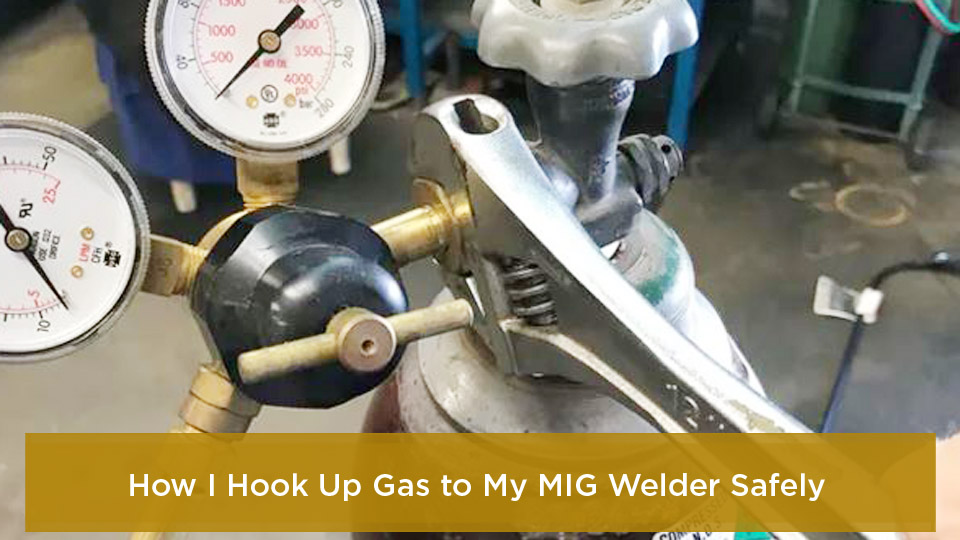
Image by hotrod
Why Gas Even Matters in MIG Welding
MIG (Metal Inert Gas) isn’t called “inert” for nothing. The shielding gas literally shields your puddle from oxygen and nitrogen in the air. Without good gas coverage you get wormholes, porosity, and welds that snap like a pretzel the first time you stress them.
I’ve seen brand-new trailers fail inspection because the shop tried to run 0.035 wire with no gas to “save money.” Don’t be that shop. Proper gas flow keeps your welds ductile, pretty, and code-approved whether you’re welding mild steel, stainless, or aluminum.
Common Shielding Gases and When I Reach for Each One
Straight CO2 – Cheap, deep penetration, lots of spatter. Great for heavy plate and structural work when cosmetics don’t matter.
75/25 (75% Argon / 25% CO2) – My everyday go-to for mild steel. Smooth arc, minimal spatter, nice bead profile. This is what 90% of American fab shops run.
92/8 or 90/10 mixes – A touch more penetration than 75/25 with almost no spatter loss. I use this on thin auto body panels.
Tri-mix (helium/argon/CO2) – Strictly for stainless. Gives a fluid puddle and great sidewall fusion.
100% Argon – Aluminum only. Anything else and you’ll get a black sooty mess.
Pure helium or helium-heavy mixes – Thick aluminum when you need to blast heat in.
Tools and Parts You Actually Need Before You Start
- Full shielding gas cylinder (rent or buy – I own mine now because I got sick of bottle rent)
- Two-stage regulator with flowgauge (single-stage works but drifts all day)
- ⅝-18 right-hand male fitting on the regulator (standard in the USA)
- Gas hose – ¼” ID, argon-rated, with 5/8-18 female on the machine side and usually a 9/16-18 or quick-connect on the regulator side
- Teflon tape (white or yellow gas-rated) or never red
- Adjustable wrench and maybe a 15/16 for the big cylinder nut
- Leak detector solution or soapy water in a spray bottle
Step-by-Step: Hooking Up the Tank and Regulator
- Put the cylinder in your cart or chain it to the wall. Never trust a tank standing bottle.
- Crack the valve for half a second to blow out grit. Stand to the side – that blast can take an eyebrow off.
- Thread the regulator onto the tank hand-tight, then snug with a wrench. Don’t crank it like a lug nut – brass is soft.
- Attach your gas hose to the regulator outlet. Hand-tight plus a quarter turn.
- Connect the other end to the back of your MIG machine. Most modern machines (Lincoln, Miller, Hobart, ESAB) use a 5/8-18 male stud with an O-ring – just push and hand-tighten the collar.
- Slowly open the cylinder valve all the way, then back it off half a turn so you can shut it fast in an emergency.
- Set the regulator to about 20-25 CFH for most mild-steel work. I usually start at 20 and creep up if I’m getting porosity hunting.
Setting Proper Flow Rate – This Is Where Most Guys Mess Up
Too little flow = air gets sucked in, porosity city.
Too much flow = turbulence, more porosity and you waste money.
Rule of thumb I’ve used for years:
- Indoors, no wind: 20-25 CFH
- Slight draft or fan: 30-35 CFH
- Outside or big roll-up door open: 35-50 CFH (and pray)
- 0.030 wire or smaller: stay under 30 CFH or you’ll get a wild arc
- Big 1/16 wire on thick stuff: 40 CFH is fine
Watch the little ball in the flowgauge, not the pressure gauge on top. Pressure and flow are different animals.
Common Gas Setup Mistakes I See Every Week
Running the hose under the wire feeder drive rolls – gets pinched and you lose flow mid-weld.
Forgetting to remove the plastic shipping cap on a new tank – you’ll spin that regulator forever and wonder why nothing comes out.
Using plumbing Teflon tape instead of gas-rated tape – contaminates the argon and makes the arc dance.
Leaving the cylinder valve only cracked – starves the regulator and flow drops when the bottle cools.
Mounting the flowgauge sideways – the ball sticks and lies to you.
MIG Welder Back Panel Connections – Brand Differences
Lincoln Power MIGs and Miller Millermatics: brass stud with O-ring and twist collar – dead simple.
Hobart Handler and older IronMans: 5/8-18 female thread – you need the hose with the male end.
ESAB Rebel: push-to-connect quick disconnect – slick but make sure it clicks twice.
Everlast, Eastwood, YesWelder: usually copy Miller or Lincoln pattern, but check your manual.
How to Leak-Test Like a Pro
Spray every connection with soapy water. If you see bubbles growing, you’ve got a leak. Tighten or re-tape. I once chased porosity for two hours before finding a pinhole in the hose where the wire feeder door had rubbed it raw.
Short Burst vs Continuous Flow Machines
Some cheap 110V machines (like the Harbor Freight Titanium) use a solenoid that only opens when you pull the trigger – saves gas but can give you a pop of air at the start of the weld. If you have one of those, always do a 1-2 second purge before you strike the arc.
Running Flux-Core Instead – When You Might Skip Gas Altogether
If you’re outside on a windy day or welding on a rusty barge in the Gulf, flip the polarity and run self-shielded flux-core. No bottle, no regulator, no headaches. Downside is uglier beads and more cleanup, but it works when gas just won’t stay put.
Pro tip I learned the hard way: even if you run flux-core 90% of the time, keep one bottle of 75/25 on the cart. You’ll thank me the day the customer wants pretty welds for a showroom piece.
Gas Cylinder Safety That Actually Matters
Chain it. Always. I watched a 300 cu ft argon bottle fall over in a shop in Oklahoma and punch straight through a block wall like a torpedo.
Transport it with the cap on and laying down in the truck bed – valve pointed away from the cab.
Store it away from the grinder station – sparks + high-pressure tank = bad day.
If the bottle gets below 200 psi, swap it. Flow gets unreliable and you’ll fight porosity.
Quick Comparison Table: Gas vs No Gas
| Situation | 75/25 Argon Mix | 100% CO2 | Flux-Core No Gas |
|---|---|---|---|
| Spatter | Very low | High | Very high |
| Bead appearance | Excellent | Good | Fair |
| Penetration | Good | Deep | Deep |
| Cost per hour | Medium | Low | Lowest |
| Wind tolerance | Poor | Poor | Excellent |
| Thin metal performance | Excellent | Fair | Poor |
| Best for | Shop & fab work | Heavy structural | Field & dirty steel |
Final Checklist Before You Pull the Trigger
- Cylinder chained and valve open
- Regulator set and flowgauge reading steady
- Hose routed clear of pinch points
- Gun nozzle clean and diffuser tight
- Wire type matches gas (ER70S-6 with 75/25, ER308 with tri-mix, etc.)
- Polarity correct (DCEP for solid wire with gas)
If all six and you’ll get that satisfying “bacon fry” sound and a bead you’d proudly post on Instagram.
Conclusion and One Last Pro Tip
Getting your gas hooked up right is literally the difference between professional welds and backyard garbage. Spend the extra ten minutes doing it correctly and every weld you make for the rest of the day will be cleaner, stronger, and faster. You now know exactly what parts to buy, how to hook them up, how to set flow, and how to troubleshoot when something feels off.
Install an inline gas saver valve or a purge button on your machine doesn’t already have one. One click purges the hose when you’re done for the day and shuts flow instantly instead of bleeding 20 CFH for five minutes while you walk the bottle back to the cage.
Frequently Asked Questions
Do I need a flowmeter or a regular regulator?
You need a regulator/flowgauge combo made for MIG. A plain oxygen regulator won’t control flow accurately with argon mixes and you’ll either starve or waste gas.
Can I use the same tank for TIG and MIG?
Yes! Same 100% argon or 75/25 works for both, just swap the hose and regulator if your TIG machine uses a different fitting.
Why does my gas run out so fast all of a sudden?
99% chance you have a leak. Spray every joint. The other 1% is you left the cylinder valve open overnight.
Is it safe to lay the cylinder on its side?
Never for welding gases. The liquid pickup tube inside will suck liquid CO2 or argon and freeze your regulator solid.
How many cubic feet do I really need?
For hobby/DIY, a 80 cu ft (size “K”) lasts me 25-30 hours at 20 CFH. Full-time shop guys step up to 125 or 300 cu ft tanks.