Choosing between resistance spot welding and MIG welding is a process decision that directly affects joint strength, production speed, distortion control, and inspection acceptance.
In a Spot Welding vs MIG Welding comparison, the core difference is how the heat and filler are applied: spot welding fuses overlapping sheets using electrical resistance and pressure, while MIG creates a continuous fused joint using an arc and consumable wire.
In real fabrication and automotive work, selecting the wrong method can cause weak joints, excessive heat distortion, slow cycle times, or unnecessary filler use that raises production cost.
Spot welding is typically preferred for high-speed sheet-metal assembly and consistent factory joins, whereas MIG is used when seams must be continuous, gaps must be filled, or structural penetration is required.
Understanding where each process performs best helps welders and shop managers choose the method that maintains structural reliability, minimizes rework, and matches the actual load and production demands of the job.

Image by zintilon
Fundamentals of Spot Welding
Spot welding operates as a resistance welding technique, generating heat through electrical resistance at the interface of two metal pieces. Copper alloy electrodes clamp the workpieces, and a high current passes through them, melting the metal at the contact point.
As the current ceases, pressure from the electrodes forges the molten nugget into a solid joint. No filler material or shielding gas is involved, making the process straightforward for high-volume tasks.
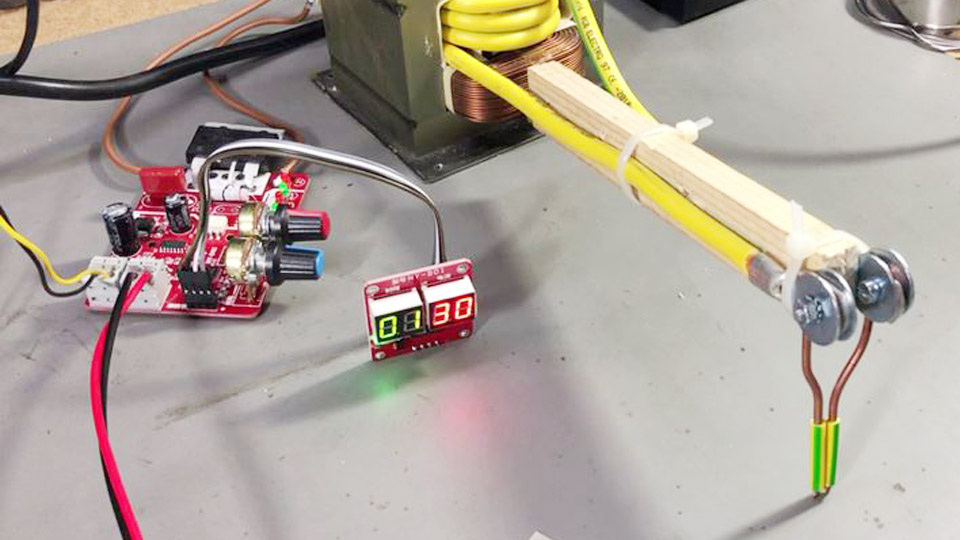
Equipment typically includes a spot welder with transformer, electrodes (often truncated cone or dome-shaped, 5-8mm diameter for thin sheets), and controls for current, time, and force. Portable units suit shop use, while robotic arms handle industrial automation.
Key parameters for thin mild steel sheets (0.5-1.5mm) include electrode force of 1.8-3.5 kN to ensure contact without excessive deformation, weld current ranging from 6,000-12,000 A for sufficient heat generation, and weld time of 5-15 cycles (approximately 0.08-0.25 seconds at 60 Hz) to control nugget size.
Hold time post-current allows cooling under pressure, typically 2-5 cycles, preventing cracks from rapid solidification. Electrode diameter influences heat concentration; 6mm is standard for 1mm sheets to achieve a nugget diameter of about 5√t (where t is thickness in mm), ensuring shear strength comparable to base metal.
Material compatibility focuses on conductive metals like low-carbon steel, stainless steel, and aluminum, but thickness is limited to under 3mm per sheet to avoid heat dissipation issues.
Joint preparation requires clean, oxide-free surfaces for low resistance and consistent fusion. Travel speed isn’t applicable since it’s a stationary process, but cycle times enable rates up to 60 welds per minute in automation.
Common failure causes stem from insufficient force leading to expulsion (molten metal ejection) or high resistance from contaminants causing weak nuggets. Penetration is shallow, typically 20-50% of sheet thickness, prioritizing speed over deep fusion.
Fundamentals of MIG Welding
MIG welding, or gas metal arc welding (GMAW), uses a continuous wire electrode fed through a gun, where an arc melts the wire and base metal. Shielding gas—often 75% argon/25% CO2 for steel—protects the weld pool from oxidation, resulting in a continuous bead as the pool solidifies.
Equipment comprises a power source (constant voltage), wire feeder, gun with nozzle for gas delivery, and gas regulator. Wire diameters range from 0.023-0.045 inches, selected based on amperage needs.
For mild steel, parameters vary by thickness. On 1/8-inch (3.2mm) plate, use 0.035-inch wire at 18-22 volts, 125-150 amps, and wire feed speed of 250-320 ipm for balanced penetration and minimal spatter. Gas flow rates of 10-15 CFH indoors prevent porosity without waste.
Polarity is typically DCEP (direct current electrode positive) for deeper penetration. Deposition rates reach 5-10 lbs/hour, influenced by wire speed and travel rate of 10-20 ipm for fillet welds.
Compatible with steels, aluminum, and stainless, MIG handles thicknesses from 0.5mm upward, with no upper limit beyond equipment capacity. Joint preparation involves beveling for thicker sections to ensure full penetration, and travel speed affects bead profile—slower speeds increase deposition but risk burn-through on thin stock.
Arc characteristics include short-circuit transfer for thin materials (low voltage, 14-18V) to reduce heat input, or spray transfer (24V+) for thicker plates with higher deposition.
Slag is minimal with solid wire, but flux-cored variants produce some for outdoor use. Failures often arise from improper gas coverage causing porosity or excessive amperage leading to undercut.
Key Process and Equipment Differences
Spot and MIG welding diverge fundamentally in heat application and joint formation. Spot welding is discrete, creating isolated nuggets without filler, ideal for lap joints on thin sheets. MIG forms continuous welds with added material, suited for butt, fillet, or groove joints.
| Aspect | Spot Welding | MIG Welding |
|---|---|---|
| Heat Source | Electrical resistance | Electric arc |
| Filler Material | None | Consumable wire |
| Shielding | Not required | Inert gas (e.g., Ar/CO2) |
| Joint Type | Primarily lap/spot | Continuous seams |
| Equipment Cost | Lower initial ($500-5,000 for basic units) | Higher ($1,000-10,000 including gas system) |
| Automation Ease | High (robotic spot guns) | Moderate (semi-automatic) |
Equipment for spot welding is simpler and less consumable-dependent, reducing ongoing costs but limiting versatility. MIG setups demand gas cylinders and wire spools, increasing complexity but enabling broader applications. Spot welders apply force mechanically, while MIG relies on operator technique for arc stability.
Material Compatibility and Applications
Spot welding thrives on thin, conductive sheets like 0.5-3mm mild steel or aluminum, where rapid heat localization prevents warping. It’s incompatible with thick or non-conductive materials due to poor resistance heating.
Common applications include automotive body panels (up to 10,000 spots per vehicle), appliance enclosures, and electronics housings for its speed in mass production.
MIG welding accommodates a wider range: mild steel from 0.5mm to over 25mm, stainless, and aluminum with appropriate wire (e.g., ER70S-6 for steel). It excels in structural work like frames, pipelines, and repairs where continuous strength is needed. Position usability favors MIG for overhead or vertical welds, as spot requires accessible clamping.
In hybrid scenarios, spot welding secures panels initially, followed by MIG for reinforcements, balancing speed and durability.
Performance Metrics: Strength, Speed, and Quality
Strength comparisons depend on application. For thin sheets (<3mm), spot welds can match MIG in shear strength, often exceeding 80% of base metal tensile via proper nugget sizing.
However, MIG generally provides superior tensile and fatigue resistance in thicker materials due to deeper penetration (up to 100% joint thickness) and continuous bonding. Spot welds are prone to peel failure under bending loads, while MIG offers better ductility.
Speed favors spot welding at 10-60 welds/minute for automation, versus MIG’s 5-15 inches/minute travel rate. Deposition isn’t comparable, as spot adds no material, but MIG achieves 3-8 kg/hour.
Quality metrics show spot welding with minimal distortion (heat-affected zone <5mm) and no spatter, but potential for internal voids if parameters drift.
MIG can produce spatter if voltage is off, but yields cleaner beads with proper settings, though heat input risks warping thin stock. Arc stability in MIG allows precise control, reducing defects like lack of fusion.
Cost and Practical Considerations
Initial costs for spot welding equipment are lower, with no recurring gas or wire expenses, making it economical for high-volume thin-sheet work—operational costs around $0.01-0.05 per weld. MIG involves higher setup ($0.10-0.50 per foot) due to consumables, but its versatility offsets this in mixed tasks.
Maintenance for spot includes electrode dressing to prevent sticking, while MIG requires nozzle cleaning and liner replacement. Skill level: Spot is operator-independent in automation, but MIG demands technique for arc control.
Safety focuses on electrical hazards in spot (high currents) and UV exposure in MIG, with both requiring ventilation for fumes.
Decision Framework for Selection
Evaluate based on thickness: Choose spot for sheets under 3mm needing quick laps; opt for MIG on thicker or continuous joints. For strength-critical applications, MIG’s penetration wins; for efficiency in assembly, spot dominates.
Consider production scale—automated spot for volume, manual MIG for custom. Test welds on samples: Measure nugget pull-out for spot (target >4√t mm diameter) and bend tests for MIG to confirm integrity.
In U.S. shops, comply with AWS standards; spot suits OEM repairs, MIG for fabrication.
Conclusion
Spot welding and MIG welding serve distinct roles in metal joining, with spot providing rapid, cost-effective bonds for thin assemblies and MIG delivering robust, versatile welds for diverse demands.
The choice hinges on balancing speed against strength requirements, where spot minimizes distortion in high-throughput scenarios, and MIG ensures durability in load-bearing structures.
Ultimately, integrating both processes in a workflow maximizes efficiency—use spot for initial tacking and MIG for final reinforcement. For advanced optimization, monitor electrode wear in spot welding to maintain consistent current density, preserving nugget integrity across production runs.
FAQ’s
Is spot welding suitable for thick steel plates?
No, spot welding is limited to thin sheets under 3mm due to heat dissipation; thicker plates require MIG for adequate fusion and strength.
Which process produces less distortion on thin metal?
Spot welding, with its localized heat input, causes less warping than MIG’s broader arc zone, especially on gauges below 18.
Can MIG welding replicate spot welds?
Yes, via plug welding (drilling holes for filler), but it’s slower and may introduce more heat; true spot is preferable for factory-like finishes on panels.
What gas mixture is best for MIG on mild steel?
A 75% argon/25% CO2 blend offers good arc stability and penetration; pure CO2 increases spatter but deepens weld pool.
How do I adjust parameters for aluminum in each process?
For spot, increase current 20-50% and use specialized electrodes to combat oxide; MIG requires pure argon gas, AC polarity for some units, and ER4043 wire for clean breaks.