
A tiny hole or cracked seam in an exhaust pipe can turn a quiet ride into an annoying rattle within minutes. The challenge is that exhaust tubing is usually thin, often rusty, and easy to burn through if your heat settings or technique aren’t right. That’s what makes learning how to weld exhaust pipes so valuable before striking your first arc.
Exhaust repairs demand more precision than many people expect. A weld that looks decent on the outside can still leak gases or crack again after a few heat cycles if the joint isn’t prepared and welded properly.
I’ve found that taking a little extra time to clean the metal, fit the pieces correctly, and control heat makes a huge difference in the final result.
Whether you’re repairing a small leak or replacing a section of pipe, the right approach can save you the cost of a new exhaust system and give you a repair that lasts.
I’ll walk you through the tools, welding methods, and practical techniques that help create strong, leak-free exhaust welds while avoiding the common mistakes that ruin thin tubing.
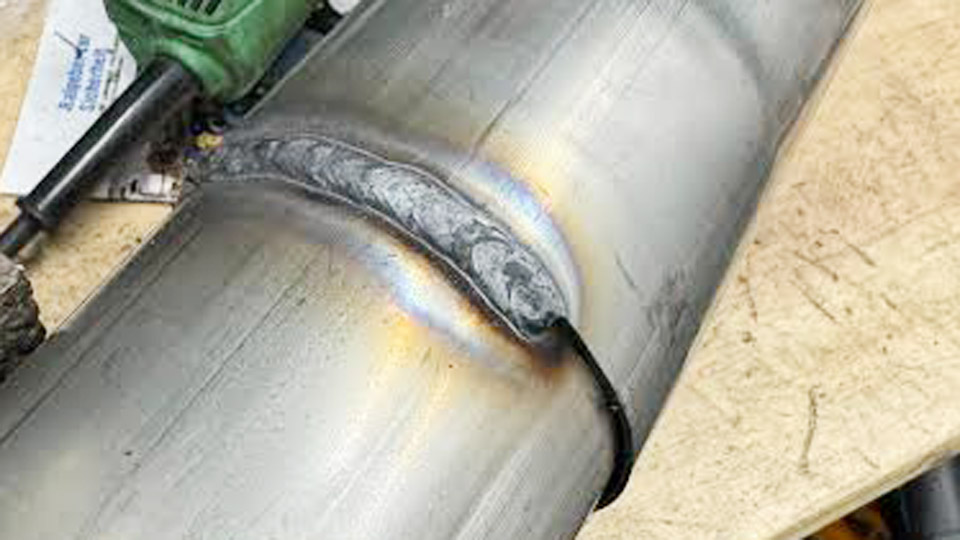
Image by r/Welding
Why Exhaust Pipe Welding Demands Special Attention
Exhaust pipes are usually 14- to 18-gauge mild steel or stainless—thin stuff that heats up fast and distorts easily. The weld has to be strong enough to handle vibration and thermal expansion but not so heavy that it creates stress points or looks like a lumpy mess once the system is installed.
Safety is non-negotiable. You’re often working under a vehicle with limited space, dealing with flammable undercoating or fuel lines nearby. Plus, welding produces fumes that you don’t want lingering in a confined garage. Proper ventilation, fire watch, and PPE aren’t optional here.
Cost matters too. Rework on a full system eats time and filler metal quickly. A clean first-time weld means less grinding, better flow, and a professional-looking result that lasts.
Choosing the Right Welding Process for Exhaust Pipes
The best process depends on the material, your shop setup, and how much time you have.
MIG Welding (GMAW) for Exhaust Work
MIG is the go-to for most fabricators and DIYers because it’s fast, forgiving on thin metal when dialed in, and produces solid results with minimal cleanup. For mild steel exhaust, 0.030″ ER70S-6 wire with 75/25 argon/CO2 works great. On stainless, switch to 308L or 309L wire and tri-mix gas if you have it.
I run short bursts—tack, move, tack—to control heat. On 16-gauge tubing, aim for 90-140 amps depending on your machine and joint. Voltage around 18-20V, wire speed moderate so you get good penetration without blowing holes. Test on scrap every time; every welder and gas setup behaves a little differently.
TIG Welding (GTAW) for Premium Results
When I want the cleanest, strongest welds—especially on stainless or visible custom work—TIG is king. It gives precise heat control and beautiful beads that need almost no post-weld cleanup. Use 1/16″ or 3/32″ 2% thoriated or lanthanated tungsten, 0.030″-0.035″ filler rod (308L for 304 stainless), and back-purge with argon to prevent sugaring inside the pipe.
Settings: 35-60 amps for thin tubing. Foot pedal control is your friend—start low, ramp up, and taper off to avoid cracking. A #16 gas lens cup with 25-30 CFH flow helps shield the puddle nicely.
Stick Welding (SMAW) in a Pinch
Stick works for quick roadside repairs or when your MIG/TIG machine isn’t available. Use small-diameter rods like 1/16″ or 3/32″ 6013 on DC- at 30-60 amps. It’s not pretty, and slag cleanup takes time, but it gets the job done on mild steel. Avoid it on stainless if corrosion resistance matters.
When to Choose Each
- Production or quick repairs: MIG
- Show-quality or stainless: TIG
- Field fix with basic gear: Stick
Pros of MIG: Speed, ease on thin metal. Cons: More spatter potential, less precision. TIG pros: Control, appearance. Cons: Slower, requires more skill. Stick pros: Portable. Cons: Messy, harder on thin stuff.
Material Compatibility and Filler Metal Choices
Most factory exhausts are aluminized mild steel or 409 stainless. Custom systems often use 304 or 321 stainless for better heat and corrosion resistance.
For mild steel to mild steel: ER70S-6 or similar. Mild to stainless: 309L filler bridges the gap decently, though the weld area may still rust over time. Stainless to stainless: 308L or 316L.
Always match your filler as closely as possible to the base metal for corrosion performance. Clean the material thoroughly—rust, oil, or scale will ruin your weld.
Joint Preparation: The Foundation of a Good Weld
Bad prep is the number one reason welds fail on exhaust. Cut pipes square with a good chop saw or bandsaw. Deburr inside and out. For butt joints, a slight gap (about 1/32″) helps penetration. Lap joints or slip fits are more forgiving for beginners.
Use a grinder with a flap disc or wire wheel to remove coatings and shine up the metal 1/2″ back from the joint. Acetone wipe for final cleaning. On stainless, avoid carbon steel contamination—dedicated brushes and wheels are worth it.
For flanges or hangers, fit everything dry first. Use V-blocks or magnetic clamps to hold alignment. Tack every 90 degrees, then check fit before committing to a full weld.
Step-by-Step: How to MIG Weld Exhaust Pipes
- Safety First: Park on level ground, chock wheels, disconnect battery if near electronics. Wear flame-resistant jacket, gloves, helmet with proper shade (10-12 for MIG), and respirator if ventilation is poor.
- Fit-Up: Align pipes. For slip joints, expand one end slightly for a snug fit.
- Tack It: Set machine low. Run quick tacks at clock positions. Let cool between tacks.
- Weld: Use short 1-2″ stitches, alternating sides to control heat. Push or pull technique—experiment for your setup. Keep travel speed steady; too slow burns through, too fast lacks penetration.
- Cool and Inspect: Let it cool naturally. Tap with a hammer to check for cracks. Pressure test if possible for leaks.
- Finish: Grind flush if needed, apply high-temp paint or wrap for protection.
TIG Technique for Exhaust Pipes
TIG demands more practice but rewards you with control. Back-purge the inside with argon to keep the root clean. Start with a small puddle, add filler as needed, and move smoothly. For lap joints, focus heat more on the thicker overlapping section.
Common TIG mistake: Too much amperage or holding too long causes distortion or burn-through. Pulse settings (if your machine has them) help a lot on thin material.
Controlling Distortion and Burn-Through
Thin tubing warps easily from concentrated heat. Key strategies:
- Short welds, skip around the pipe.
- Clamp securely and leave clamped while cooling.
- Use heat sinks like copper bars or wet rags (carefully) on nearby areas.
- Weld opposite sides alternately.
Beginners often run too cold and pile up metal, or too hot and blow holes. Practice on scrap tubing of the same thickness. “Hot and fast” tacks often give better penetration with less overall heat input.
Machine Settings for Common US Welders
For a typical 120/240V MIG like many Lincoln, Miller, or Hobart units:
- 16-gauge mild steel: 90-120 amps, 18-20V, 0.030″ wire.
- Adjust based on joint—flanges need a bit more.
TIG: 40-60 amps base, foot control for modulation.
Stick: 40-70 amps with small rods. Always test and listen to the arc—smooth crackle means good settings.
Common Mistakes and How to Avoid Them
- Burn-through: Too much heat, slow travel, poor fit-up. Fix: Lower settings, faster movement, better tacks.
- Lack of penetration: Cold settings or dirty metal. Fix: Clean better, increase amps slightly, ensure good ground.
- Warping: Continuous seams. Fix: Stitch weld, alternate positions.
- Porosity or sugaring on stainless: Poor shielding or no back-purge. Fix: Increase gas flow, purge inside.
- Weak joints: No filler on gaps or mismatched materials. Fix: Use proper rod, fill gaps appropriately.
I’ve seen pros rush and skip cleaning—then wonder why the weld looks sugar-coated or cracks later.
Safety Considerations Every Welder Should Know
Work in a well-ventilated area or use exhaust extraction. Exhaust fumes contain carbon monoxide and other nasties. Keep a fire extinguisher handy—sparks travel far. Wear proper leathers; thin exhaust work still throws hot metal. Ground your workpiece securely. Never weld on a pressurized system or near fuel.
Post-Weld Treatment and Longevity
After welding, let the system cool slowly. Clean the weld area and apply high-temperature ceramic coating or paint. For stainless, passivation helps restore corrosion resistance. Check hangers and flex sections—weld stress can affect them.
Real-World Examples from the Shop
On a recent 409 stainless cat-back system, I used TIG with back-purge for the visible sections and MIG for the undercarriage hangers. The customer is still running strong two years later with zero leaks. Another time, a quick MIG repair on an old truck’s rusted flange saved a tow and lasted through another harsh winter.
Building Your Skills Over Time
Start with scrap pieces. Practice different joint types: butt, lap, flange. Record your settings and results. Over time, you’ll develop a feel for how the puddle behaves on different materials and thicknesses.
Comparison Table: Processes for Exhaust Welding
| Process | Best For | Speed | Skill Level | Appearance | Cost |
|---|---|---|---|---|---|
| MIG | Mild steel, repairs | Fast | Beginner-Intermediate | Good | Low |
| TIG | Stainless, custom | Medium | Advanced | Excellent | Higher |
| Stick | Field fixes | Medium | Intermediate | Fair | Lowest |
Final Thoughts from the Weld Booth
After years of doing this, the biggest lesson is that preparation and heat control trump fancy equipment every time. Understand your material, dial in settings on test pieces, tack thoroughly, weld smart, and inspect your work. You’ll end up with systems that look good, perform well, and last.
The one pro-level tip I’d give any welder tackling exhaust: Always leave yourself a little extra material for fitment adjustments. A perfect cut is rare under the car—having room to trim and tweak prevents headaches and weak joints.
FAQ
Can I weld stainless exhaust with mild steel wire?
Yes, in a pinch for mild-to-stainless transitions, but the weld zone will rust faster. Use 309L when possible for better compatibility.
What’s the best way to avoid burning through thin exhaust pipe?
Tack frequently, use short stitch welds, keep settings conservative, and move quickly. Practice on similar scrap first.
Do I need to back-purge for TIG on exhaust?
Highly recommended for stainless to prevent oxidation inside the pipe, which weakens the root and looks bad. Argon flow on the inside makes a huge difference.
How do I weld exhaust pipes in tight spaces under the car?
MIG with a small torch or spool gun helps. Use mirrors or cameras for visibility. Work in sections and take breaks to avoid fatigue and poor welds.
What amperage should I use for 16-gauge exhaust tubing?
MIG: 90-130 amps range. TIG: 40-60 amps. Always adjust based on your specific machine, wire/rod, and joint after testing.


