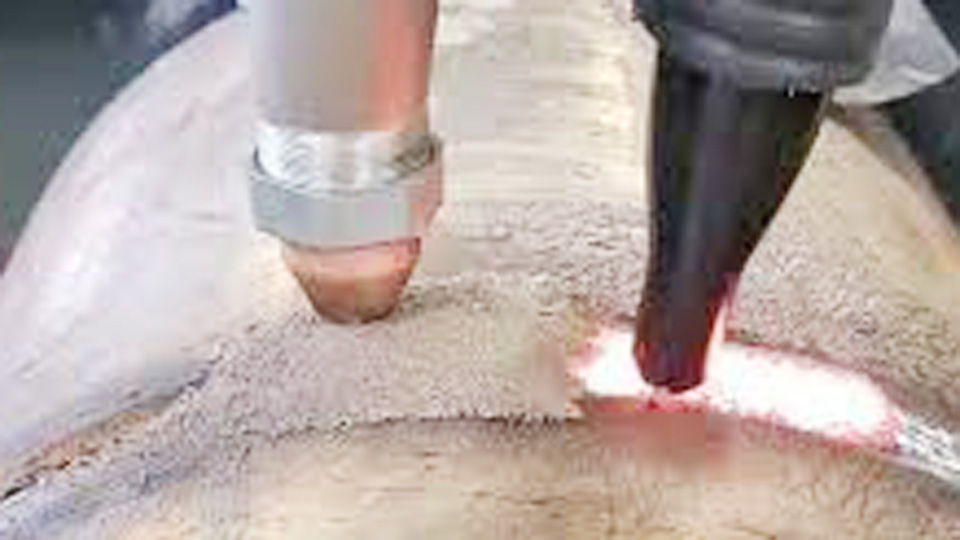
When thick carbon steel plates in structural fabrication demand deep, consistent penetration without spatter or excessive cleanup, conventional processes like MIG or SMAW fall short on speed and repeatability.
What Is Submerged Arc Welding? It is an automated or mechanized arc welding process that forms the arc between a continuously fed consumable wire electrode and the workpiece, completely submerged beneath a blanket of granular flux.
The flux melts to generate shielding gases and a protective slag layer, isolating the molten pool from atmospheric contamination while adding alloying elements.
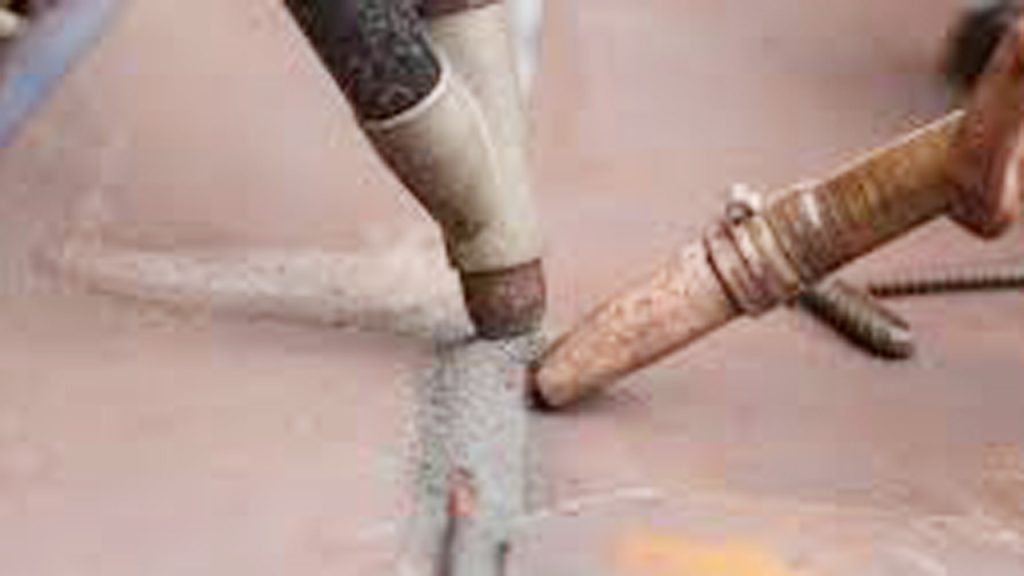
Image by theengineeringchoice
How Submerged Arc Welding Works
The Flux Shielding Principle
Granular flux poured ahead of the welding head creates a 25–50 mm deep blanket that completely covers the arc zone. As current flows, the flux layer melts into a conductive slag that conducts the arc current while releasing gases (primarily CO₂, H₂, and CO) to displace oxygen and nitrogen.
This self-generated shield eliminates the need for external gas, producing zero visible arc flash and virtually no spatter. Unused flux is vacuum-recovered at rates of 50–90 %, reducing consumable costs significantly.
The slag solidifies behind the weld pool, shaping the bead and protecting the cooling metal. After cooling, it peels away cleanly, leaving a smooth, uniform bead with minimal post-weld grinding.
Arc Initiation and Weld Pool Dynamics
The process begins with the wire electrode (typically 1.6–6 mm diameter) contacting the workpiece or flux to strike the arc. Once established, constant-voltage (CV) or constant-current (CC) power maintains the arc length automatically through wire feed speed adjustment.
The arc energy concentrates beneath the flux, achieving penetration depths up to 20 mm in a single pass on carbon steel at 600–900 A.
Molten droplets from the wire transfer across the arc into the pool, where the flux refines the deposit by removing impurities and adding manganese or silicon. Travel speed controls bead width and heat input: slower speeds increase penetration but risk rollover; faster speeds (up to 80 cm/min) narrow the bead while preserving fusion.
Equipment Setup for Reliable SAW Operation
Power Source Selection – DC vs AC
DC electrode positive (DCEP) is standard for single-wire welding because it concentrates heat at the workpiece for maximum penetration. Typical output ranges from 300–1,000 A at 100 % duty cycle using transformer-rectifier or inverter sources. DC electrode negative (DCEN) increases deposition by 20–25 % but reduces penetration, suiting cladding or surfacing.
AC power, especially square-wave AC, balances penetration and deposition while minimizing arc blow in long seams or magnetized plates. For twin-wire setups, combine DCEP on the leading wire with AC on the trailing wire to spread the pool without interaction.
Wire Feed and Contact Tip Management
Mechanized heads or tractors maintain precise electrode extension (stickout) of 25–40 mm. Longer stickout preheats the wire via I²R resistance, boosting deposition without raising amperage — ideal for high-productivity cladding. Shorter stickout (under 20 mm) maximizes penetration but risks arc instability.
Contact tips must remain flush or slightly proud of the flux layer to prevent arcing inside the nozzle. Wire feed speeds of 78–393 in/min directly set current draw in CV mode.
Flux Hoppers and Recovery Systems
Gravity or pressurized hoppers deliver flux 10–20 mm ahead of the arc. Integrated vacuum recovery systems collect unused granules while separating slag particles, maintaining flux chemistry. Dry storage below 0.2 % moisture prevents hydrogen-induced porosity.
Wire and Flux Selection Strategies
Electrode Wire Options and Diameters
Solid wires dominate for carbon and low-alloy steels (EL12, EM12K, EH12K classifications). Diameters of 3.2 mm run 300–750 A, 4.0 mm handle 400–800 A, and 5.0 mm reach 450–1,150 A. Tubular cored wires increase deposition 20–30 % at the same amperage due to higher current density and allow alloy modifications for stainless or nickel alloys.
Cored wires also tolerate longer stickout without burn-back.
Matching Flux to Base Material
Flux basicity index determines weld metal properties: acid fluxes (<0.9) are forgiving and add Mn/Si for deoxidation; semi-basic (2–2.5) improve toughness; fully-basic (≥3.0) deliver the highest impact values for critical joints. Agglomerated fluxes permit custom alloy additions; fused fluxes resist moisture better.
For stainless steel, chromium-compensating fluxes offset element loss. Always match flux-wire combinations per AWS A5.17 classifications to achieve required tensile strength (60–95 ksi) and CVN toughness.
Mastering SAW Welding Parameters
Current, Voltage, and Travel Speed Interactions
Current controls deposition and penetration: each 100 A increase adds roughly 1–2 kg/hour deposition and deeper fusion. Voltage primarily affects arc length and bead width — 28 V produces narrow, deep beads; 40 V widens the bead but flattens penetration. Travel speed governs heat input (kJ/mm) and bead volume.
Here is a practical starting table for mild steel butt joints (single wire, DCEP, 25 mm stickout):
| Plate Thickness (mm) | Wire Diameter (mm) | Amperage (A) | Voltage (V) | Travel Speed (cm/min) | Approx. Deposition (kg/hr) |
|---|---|---|---|---|---|
| 6–8 | 3.0–3.2 | 400–550 | 30–32 | 50–70 | 5–7 |
| 10–12 | 4.0 | 500–650 | 30–33 | 50–60 | 7–9 |
| 14–20 | 4.0–5.0 | 650–850 | 32–35 | 40–55 | 9–12 |
| 25+ (multi-pass) | 5.0 | 800–1,000 | 34–38 | 30–45 | 12–15 |
Adjust ±10 % based on joint fit-up and flux type. Higher travel speeds reduce distortion on thin sections.
Electrode Extension and Its Impact on Deposition
Increasing stickout from 25 mm to 50 mm raises deposition 30–40 % at fixed amperage by resistive preheating, but reduces penetration by up to 25 %. Use longer extension for cladding; keep it short for root passes requiring full fusion.
Material Thicknesses and Joint Preparations for SAW
Optimal Thickness Range
SAW excels on material 6 mm and thicker; below 5 mm, heat input causes burn-through or excessive distortion. Single-pass capability reaches 20 mm on square-butt joints with proper backing. Multi-pass welding handles unlimited thickness.
Joint Designs for Single and Multi-Pass
Square-butt joints with 0–2 mm gap work for plates under 12 mm. Double-V or U preparations (60–70° included angle) minimize filler for thicker sections. For one-sided welding, copper backing bars or flux backing prevent drop-through. Tack welds use E7018 electrodes to avoid slag contamination.
Where Submerged Arc Welding Outperforms Other Processes
SAW deposits metal 4–10 times faster than SMAW and 2–3 times faster than FCAW on thick sections while producing cleaner beads with zero spatter. Deep penetration eliminates many back-gouging steps required in MIG or TIG. Automation reduces operator fatigue and skill dependency compared with manual processes.
Deposition rates exceed 15 kg/hr in twin-wire tandem mode versus 6–8 kg/hr for single-wire MIG at similar currents. Weld metal toughness and radiographic quality consistently surpass open-arc methods on carbon and low-alloy steels.
Limitations and When to Avoid SAW
The process is restricted to flat (1G) or horizontal (2G) positions — vertical or overhead welding is impractical. Complex geometries or short welds under 300 mm favor MIG or FCAW. Very thin material (<5 mm), aluminum, or copper alloys require alternative processes due to flux chemistry and heat input. Flux handling and slag removal add time on small jobs.
Common Applications in Professional Welding
Shipbuilding uses SAW for longitudinal hull seams and deck plating at high travel speeds. Pressure vessel fabricators rely on it for circumferential seams on 25–100 mm thick shells. Pipeline mills apply tandem SAW for longitudinal seams in API 5L pipe.
Structural steel shops weld I-beams and box columns; wind-tower manufacturers join thick conical sections. Rail and heavy equipment industries employ it for hardfacing and structural joins.
Troubleshooting SAW Weld Defects
Porosity Prevention
Moisture in flux or base metal causes hydrogen porosity. Dry flux at 250–300 °C for 2 hours and store in sealed hoppers. Remove mill scale, rust, oil, or paint from joint edges. Excessive voltage or contaminated recovery flux also introduces gases — maintain flux depth at 30–40 mm.
Fusion and Penetration Problems
Lack of fusion results from low current, excessive travel speed, or poor joint fit-up. Increase amperage 50–100 A or slow travel by 10 %. Incomplete penetration on root passes signals short stickout or insufficient flux coverage — verify 25–30 mm extension and full arc submersion.
Slag Inclusions and Undercut
Slag entrapment occurs when travel speed is too slow or voltage too high, causing rollover. Reduce voltage 2–3 V or increase speed. Undercut appears at high voltage or excessive current — lower voltage and adjust torch angle to 90° perpendicular.
Boosting Productivity with Multi-Wire SAW Configurations
Twin-wire parallel setups (wires 8–12 mm apart) share current and raise deposition 30–40 % without proportional heat-input increase. Tandem setups (20 mm separation) use DCEP leading wire for penetration and AC trailing wire for bead shaping, cutting arc interaction and porosity.
Three- or four-wire systems achieve 25–30 kg/hr on heavy plate, common in pipe mills. These configurations maintain CVN toughness above 27 J at –40 °C while doubling travel speeds.
Wrapping Up
Submerged Arc Welding delivers unmatched productivity and weld quality on thick, flat steel joints when parameters and equipment match the application. For fabricators facing high-volume thick-plate work, switching to SAW with optimized single- or twin-wire setups cuts labor hours and consumable costs while producing radiographically sound welds that meet ASME or AWS codes.
The advanced insight: fully-basic fluxes paired with tandem twin-wire (DCEP lead + AC trail) at 800–1,200 A minimize dilution to under 15 % and arc blow, delivering weld metal with tensile strengths matching the base plate and impact values exceeding 50 J at low temperatures — the combination that separates high-output structural and pressure-vessel shops from the rest.
Frequently Asked Questions About Submerged Arc Welding
What Thickness Range Makes Submerged Arc Welding Most Effective?
SAW performs best on material 6 mm and thicker, with single-pass capability up to 20 mm and multi-pass welding handling unlimited thickness. Below 5 mm, distortion and burn-through risks make MIG or FCAW preferable.
Can Submerged Arc Welding Handle Stainless Steel?
Yes, using chromium-compensating fluxes and appropriate solid or cored wires (e.g., 308L, 316L). Keep heat input moderate (under 2.5 kJ/mm) and use AC or DCEN to control penetration and minimize sensitization in thicknesses under 10 mm.
Why Does SAW Produce No Visible Arc or Spatter?
The granular flux blanket completely submerges the arc, containing the molten pool and absorbing spatter energy. Shielding gases generated by the flux also suppress oxidation, resulting in clean, spatter-free beads.
What Are the Main Causes of Porosity in SAW Welds?
Moisture in flux or base metal, rust/oil contamination on joint surfaces, or excessive voltage that destabilizes the slag cover. Proper drying, joint cleaning, and voltage in the 28–35 V range eliminate most porosity issues.