Sparks were still popping off the joint when I noticed something didn’t look right. The bead looked decent on the surface, but something about the penetration felt off. Any welder who’s spent time in a shop knows that a weld can look solid yet still fail under pressure.
That’s exactly why understanding how to check welding strength is such an important skill—not just for professionals, but for anyone striking an arc in a garage or workshop.
I’ve seen welds crack during simple load tests, brackets bend where the joint should’ve held, and projects fail because the strength was never verified properly. A strong weld isn’t just about appearance—it’s about safety, durability, and confidence that your work will actually hold up when it matters.
The good news is you don’t need a fancy lab or expensive equipment to evaluate a weld. With a few practical checks and some simple testing methods, you can quickly spot weak welds before they become a serious problem.
I’ll walk through the practical ways I use in the shop to test weld strength—from visual inspection to simple real-world stress checks—so you can make sure your welds are as strong as they look.

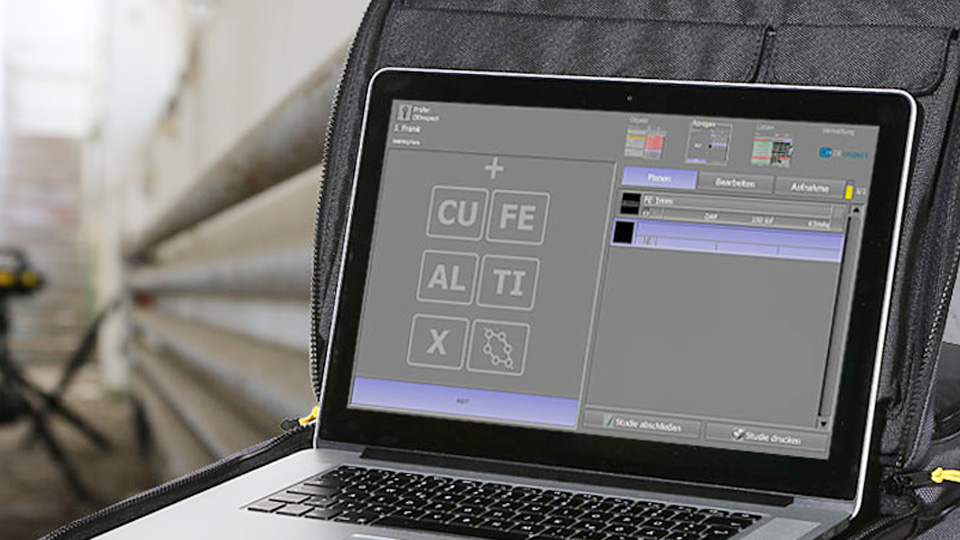
Image by ui.com.sa
What Is Welding Strength?
Welding strength refers to the ability of a welded joint to withstand forces without breaking or deforming. It’s the measure of how much load, stress, or pressure the weld can take before failure. The strength of a weld depends on factors like:
- Weld material
- Joint design
- Welding process
- Technique and skill
- Preparation and cleanliness
Testing welding strength is about more than just checking appearance. It’s about making sure the joint will perform under real-world conditions. For example, a weld on a bridge must hold up to years of vibration, weather, and heavy loads. In contrast, a weld on a decorative gate has different strength requirements.
Why Welding Strength Testing Matters
A weld that looks perfect on the surface can hide serious problems inside. Weak welds can cause:
- Structural failures (building collapses, broken machinery)
- Safety hazards (injury, death)
- Costly repairs
- Failed inspections
Sometimes, even experienced welders make mistakes. Testing removes guesswork and gives you confidence in your work. For industries, it’s a legal and insurance requirement. For DIYers, it’s peace of mind.
Types Of Welding Strength Tests
There are two main ways to check welding strength: destructive tests and non-destructive tests. Each has its own purpose, benefits, and limitations.
Destructive Tests
Destructive tests break the weld to measure its actual strength. These are done on sample pieces, not on the final product. The main types are:
- Tensile Test
- Bend Test
- Shear Test
- Impact Test (Charpy or Izod)
- Hardness Test
- Nick-Break Test
- Macro Etch Test
Non-destructive Tests
Non-destructive tests (NDT) check the weld without breaking it. These are used on finished parts and in the field. The main types are:
- Visual Inspection
- Ultrasonic Testing (UT)
- Radiographic Testing (X-ray)
- Magnetic Particle Testing (MT)
- Dye Penetrant Testing (PT)
- Eddy Current Testing
Let’s look at each test, how it works, and what it tells you.
Destructive Testing Methods
Destructive testing is the gold standard for measuring weld strength. It gives hard data but destroys the sample. These tests are usually done in a lab, but some can be performed in a workshop with simple tools.
Tensile Test
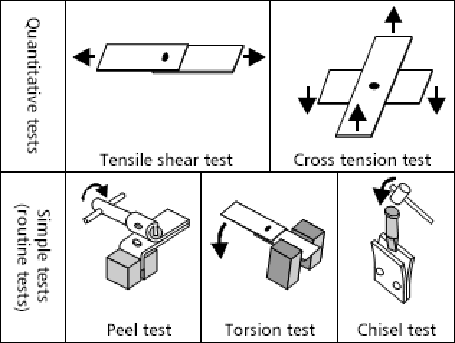
A tensile test measures how much pulling force (tension) the weld can take before breaking. The welded sample is clamped in a machine that pulls until it snaps. The result is the ultimate tensile strength (UTS), measured in pounds per square inch (psi) or megapascals (MPa).
Example: If a weld fails at 60,000 psi, that’s its tensile strength.
What it shows: The maximum load the weld can handle.
Non-obvious insight: Where the sample breaks tells you a lot. If the break is in the weld, the weld is weaker than the base metal. If it’s outside the weld, the joint is strong.
Bend Test
In a bend test, the weld is bent, usually 180°, to check ductility and soundness. The sample is placed on supports and a force is applied in the center until it bends.
What it shows: Whether the weld can bend without cracking. This simulates real-world forces like vibration and shock.
Common mistake: Not prepping the sample edges—sharp edges cause early failure, giving a false weak result.
Shear Test
A shear test checks the weld’s resistance to sliding forces. The welded piece is loaded until one part slides off the other.
What it shows: Shear strength of the weld, important for lap joints and fillet welds.
Impact Test (charpy Or Izod)
Impact tests measure how much energy the weld absorbs before breaking, especially at low temperatures. The sample is struck with a swinging pendulum.
What it shows: Toughness and resistance to sudden shocks. Important for structures in cold environments.
Data example: A typical Charpy impact test might show 27 Joules at -20°C for a good structural weld.
Hardness Test
This test presses a hard ball or diamond into the weld and measures the depth. It checks if the weld is too hard (brittle) or too soft (weak).
What it shows: The weld’s resistance to indentation. Too much hardness can mean cracks, while too little means weakness.
Nick-break Test
The weld is notched, then broken with a hammer. The break is inspected for internal flaws like slag, porosity, or lack of fusion.
What it shows: Internal weld quality, not just surface appearance.
Practical tip: This test is quick and can be done in most workshops.
Macro Etch Test
A section of the weld is polished and etched with acid. This reveals the weld structure under a microscope.
What it shows: Penetration, fusion, and possible defects.
Non-obvious insight: Macro etching can show if the heat affected zone (HAZ) is too large, which can weaken the weld.
Non-destructive Testing Methods
Non-destructive tests (NDT) allow you to check welding strength without breaking or damaging the part. These are essential for real-world jobs where the weld must stay intact.
Visual Inspection
The simplest and most common check. You look for surface defects like cracks, undercut, porosity, or incomplete fusion.
What it shows: Obvious flaws, bead shape, and size.
Limitations: Cannot see inside the weld.
Practical tip: Use a bright light, magnifier, and weld gauges for accurate checking.
Ultrasonic Testing (ut)
High-frequency sound waves are sent through the weld. Reflections from flaws are detected on a screen.
What it shows: Internal cracks, voids, or incomplete fusion.
Data example: UT can find flaws as small as 1mm inside a weld.
Non-obvious insight: Requires skill and calibration. Not all metals conduct sound waves equally.
Radiographic Testing (x-ray)
X-rays or gamma rays pass through the weld. A film or digital detector captures an image showing internal flaws.
What it shows: Porosity, inclusions, cracks, lack of fusion.
Advantages: Gives a permanent record; widely used for pipelines and pressure vessels.
Limitations: Expensive, requires safety precautions.
Magnetic Particle Testing (mt)
A magnetic field is applied to the weld. Iron particles are dusted on the surface. Flaws disrupt the field and attract particles, making cracks visible.
What it shows: Surface and near-surface cracks in ferromagnetic metals.
Common mistake: Using on non-magnetic metals like aluminum—it won’t work.
Dye Penetrant Testing (pt)
A colored dye is applied to the cleaned weld. After soaking, the surface is wiped and a developer is sprayed. The dye seeps out of cracks, making them visible.
What it shows: Surface-breaking defects in any metal.
Practical tip: Best for finding small surface cracks that are hard to see.
Eddy Current Testing
A coil produces changing magnetic fields, inducing currents in the weld. Defects change the flow, detected by a sensor.
What it shows: Surface and near-surface flaws, especially in conductive materials.
Limitations: Limited depth, best for thin materials.
Quick Comparison: Destructive Vs Non-destructive Tests
Here’s a direct comparison to help you choose the right method:
| Aspect | Destructive Tests | Non-Destructive Tests (NDT) |
|---|---|---|
| Purpose | Measures actual strength | Finds defects without damage |
| Sample status | Sample destroyed | Sample remains intact |
| Equipment cost | Medium to high | High (for advanced NDT) |
| When used | During qualification, R&D | Field inspections, production |
| Skill needed | Technical, but less than NDT | Requires trained technician |
Key Factors That Influence Welding Strength
Even the best test can only measure what’s there. To get strong welds, you need to control:
- Weld preparation: Clean surfaces and correct fit-up matter more than many realize. Rust, oil, or gaps weaken the weld.
- Proper welding parameters: Voltage, amperage, and speed must be right for the material and position.
- Filler metal selection: Use compatible filler for the base metal.
- Weld technique: Consistent travel speed, angle, and bead size.
- Heat input: Too much heat causes a wide HAZ and brittleness; too little causes lack of fusion.
- Post-weld treatment: Techniques like peening, stress-relief, or grinding can improve weld strength.
Non-obvious insight: Even small changes in joint design (like a tiny root gap) can reduce weld strength by 30% or more.
How To Perform Welding Strength Checks In The Field
Not every shop has access to expensive labs or machines. Here’s how to check welding strength practically:
1. Visual Inspection Steps
- Clean the weld area.
- Use a strong light and, if possible, a magnifying glass.
- Check for:
- Surface cracks
- Undercut (groove at toe of weld)
- Overlap (weld flows over base)
- Porosity (tiny holes)
- Incomplete fusion or penetration
Practical tip: Use a fillet weld gauge to measure the weld size. Compare with design requirements.
2. Hammer Test (for Practice Pieces)
- Strike the welded joint with a hammer.
- A good weld will not break or crack easily.
- Useful for simple T-joints or practice coupons.
Limitation: Not a substitute for real strength testing, but gives quick feedback.
3. Bend Test (diy Version)
- Clamp the welded coupon in a vice.
- Bend the joint slowly using a pipe or wrench.
- Watch for cracks or breaks in the weld area.
Practical tip: Try both face and root bends for more information.
4. Load Testing (simple Version)
- Apply a known weight or force to the welded piece.
- Increase gradually and observe for signs of failure.
- Compare with the expected load in real use.
Safety warning: Always wear eye protection and stand clear in case of sudden failure.
5. Dye Penetrant Kit
- Clean weld, apply dye, let sit, clean off, spray developer.
- Cracks will show as colored lines.
- Kits are cheap and easy to use.
Credit: www.jfe-tec.co.jp
How To Interpret Welding Test Results
Testing is only half the story. You need to know what the results mean.
Tensile Test Interpretation
- Break in base metal: Weld is stronger than parent material—good.
- Break in weld: Weld is weaker—improve technique or materials.
- Ductility: If the weld stretches before breaking, it’s tough. If it snaps suddenly, it’s brittle.
Bend Test Interpretation
- Crack-free bend: Good ductility and fusion.
- Cracks or breaks: Possible inclusions, poor fusion, or wrong technique.
Ndt Interpretation
- No indications: Good weld (but not a guarantee—some flaws are too small to detect).
- Indications present: Check standards to see if they’re acceptable. Some tiny flaws may be allowed, but not large cracks.
Non-obvious insight: Sometimes welds pass visual inspection but fail ultrasonic or X-ray testing. Never rely on appearance alone for critical work.
Codes And Standards For Welding Strength
Many industries require welds to meet specific codes and standards. These define how to test, what results are acceptable, and what must be rejected.
Key organizations include:
- American Welding Society (AWS)
- American Society of Mechanical Engineers (ASME)
- International Organization for Standardization (ISO)
- British Standards Institution (BSI)
Example: AWS D1.1 is the standard for structural steel welding in the US.
It’s important to check the code for your project. Codes specify:
- Test types and frequency
- Minimum strength values
- Acceptable defect sizes
- Reporting and documentation
Practical tip: Always keep records of test results for inspections and audits.
Common Mistakes When Checking Welding Strength
Even experienced welders and inspectors can make mistakes. Here are some to watch out for:
- Skipping surface cleaning: Dirt or paint can hide cracks.
- Using the wrong test for the material: For example, using MT on non-magnetic metals.
- Testing too few samples: One good weld doesn’t mean all are good.
- Ignoring environmental factors: Cold, humidity, or vibration during testing can affect results.
- Rushing interpretation: Take time to review all data and repeat tests if unsure.
Practical Examples And Case Studies
Example 1: Pipeline Weld Failure
A pipeline weld looked perfect but failed in service. NDT found a lack of root fusion not visible on the surface. After switching to X-ray inspection for every weld, failures dropped by 95%.
Example 2: Automotive Spot Welds
Automakers use peel and chisel tests to check spot weld strength. If a weld peels too easily, it’s rejected. Ultrasonic NDT is also used for quality control on production lines.
Example 3: Bridge Construction
Bridge welds are tested with both NDT and destructive bend tests during mock-ups. Any weld that cracks or breaks is reworked. This prevents catastrophic failures in service.
Comparing Testing Methods For Different Scenarios
Choosing the right test depends on your project:
| Scenario | Best Test | Why |
|---|---|---|
| Critical pipeline weld | Radiographic (X-ray) | Detects internal flaws, permanent record |
| Workshop practice coupon | Bend and nick-break | Quick, cheap, shows skill |
| Production line (sheet metal) | Ultrasonic or eddy current | Fast, non-destructive, suitable for thin materials |
| Steel structure in the field | Visual + magnetic particle | Portable, good for surface cracks |
Essential Equipment For Welding Strength Checks
Depending on your test method, you may need:
- Weld gauges
- Magnifiers
- Dye penetrant kits
- Magnetic particle kits
- Ultrasonic flaw detector
- X-ray equipment (for advanced NDT)
- Tensile/bend testing machine (for labs)
- Personal protective equipment (PPE)
Practical tip: You don’t need to own every tool. Many labs or inspection services offer testing at reasonable rates.
How To Choose The Right Test For Your Needs
Ask these questions to select the best method:
- Is the part critical for safety? Use NDT or lab destructive tests.
- Is the weld inaccessible after assembly? Test before final build.
- What does the code require? Always follow standards.
- What’s your budget? Simple tests cost less but may miss hidden flaws.
- Can you afford to destroy a sample? If not, use NDT.
Advanced Tips For Accurate Welding Strength Evaluation
- Calibrate your equipment regularly. Even small errors can give wrong results.
- Document all findings. Take photos, write notes, and keep test reports.
- Train staff on test methods. A poorly performed test is worse than none.
- Repeat tests if results are unclear. Consistency builds confidence.
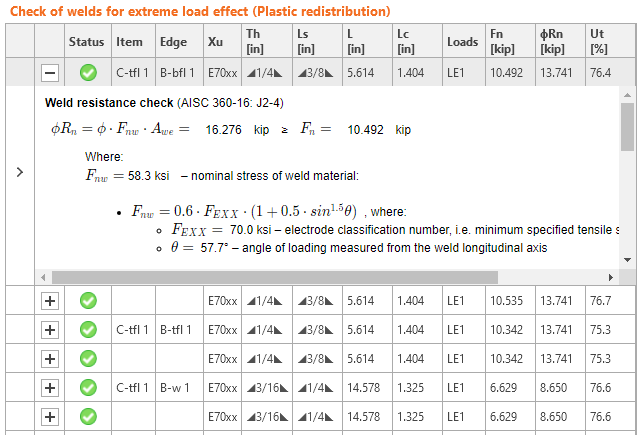
- Use multiple methods when possible. Combining visual, NDT, and destructive tests gives the best picture.
Credit: www.ideastatica.com
Where To Learn More
Welding inspection and testing is a deep field. For more details and advanced techniques, visit the Welding Inspection Wikipedia page.
Wrapping Up
Checking welding strength is a crucial skill for anyone working with metal structures. With the right methods and a careful approach, you’ll ensure your welds are not only strong but also safe and reliable for years to come.
Frequently Asked Questions
How Often Should Welding Strength Be Tested?
Testing frequency depends on the project’s code and safety requirements. For critical structures, every weld may be tested. For less critical work, random samples or only initial qualification may be enough.
Can Visual Inspection Alone Guarantee Weld Strength?
No. Visual inspection finds surface flaws but can miss internal defects. For critical joints, combine visual checks with NDT or destructive tests.
What Is The Minimum Strength Required For A Weld?
This depends on the application and code. For structural steel in buildings, a common minimum is 60,000 psi (about 414 MPa). Always check the relevant standard for your project.
Are All Non-destructive Tests Expensive?
Not always. Simple NDT methods like dye penetrant or magnetic particle testing are affordable and easy to use. Advanced NDT (ultrasonic, X-ray) costs more and needs skilled operators.
What Should I Do If A Weld Fails A Strength Test?
First, review the cause: poor technique, wrong materials, or preparation errors. Fix the problem, re-weld, and retest. Document the failure and corrective actions for quality control.