Ultrasonic seam welding is a precision solid-state joining process used when thin metals or thermoplastics must be bonded without excessive heat distortion or filler material. In Ultrasonic Seam Welding, high-frequency mechanical vibrations combined with controlled pressure create a continuous metallurgical or molecular bond along the joint line.
The method is especially valuable where conventional arc welding would introduce burn-through, surface oxidation, or dimensional distortion.
In real production environments—battery tabs, foil laminates, sealed housings, and thin sheet assemblies—poor seam quality can lead to leakage, electrical resistance problems, or premature joint failure that triggers inspection rejects and costly downtime.
Because the process operates below melting temperature, success depends on vibration amplitude, clamping force, surface cleanliness, and precise alignment rather than amperage or filler control.
Understanding how ultrasonic seam welding works helps fabricators and engineers determine when this low-heat, high-speed process provides stronger consistency, cleaner seams, and more reliable repeatability than traditional fusion welding methods.
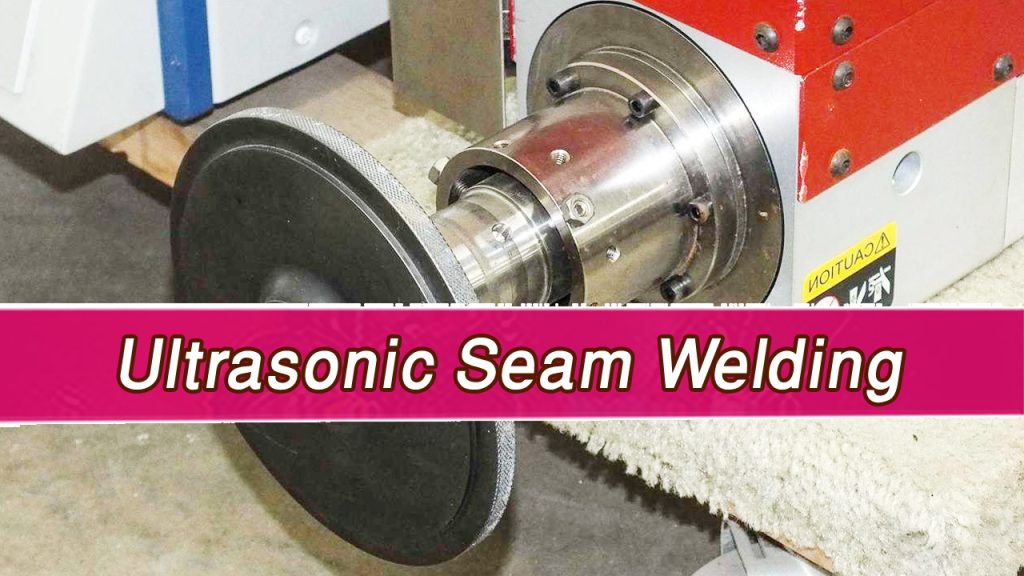
Image by recycledgoods
Principles of Ultrasonic Seam Welding
Ultrasonic seam welding operates on the principle of converting electrical energy into high-frequency mechanical oscillations that induce interfacial friction.
The process begins with a piezoelectric transducer generating vibrations at frequencies between 15 kHz and 70 kHz, most commonly 20-40 kHz for seam applications to balance energy input and material response.
These oscillations, with amplitudes ranging from 10-50 micrometers, are amplified and directed through a sonotrode to the workpiece.
In seam welding, unlike spot variants, the sonotrode or anvil incorporates a rotating wheel design, allowing continuous motion along the joint line at speeds up to 30 m/min.
Frictional heat softens thermoplastics to a viscoelastic state or disperses oxides in metals, forming a metallurgical bond under pressures of 0.1-1 MPa. Heat generation is localized, peaking at 100-300°C depending on material, preventing thermal degradation in adjacent zones.
For metals, bonding occurs via atomic diffusion without liquefaction, while plastics rely on molecular entanglement during cooling under sustained pressure.
This machine-focused approach minimizes energy loss, with typical power requirements of 500-3000 W per seam length, enabling integration into automated lines for high-throughput fabrication.
Key Components and Machine Setup
The core assembly in ultrasonic seam welding machines includes the ultrasonic stack: transducer, booster, and sonotrode. The transducer, often lead zirconate titanate (PZT) based, converts 50-60 Hz electrical input to ultrasonic vibrations with efficiencies exceeding 90%.
Boosters, machined from titanium or aluminum, adjust amplitude by factors of 0.5-3, ensuring resonance at the target frequency.
The sonotrode, typically titanium for durability, features a profiled tip or wheel with diameters of 50-150 mm for seam continuity. Anvils provide counterforce, often patterned with knurls to enhance grip on materials like nonwoven textiles. Pressure systems, pneumatic or servo-electric, deliver forces up to 5000 N, calibrated via load cells for consistency.
Setup involves aligning the stack to resonate precisely, verified by impedance analyzers to maintain quality factors above 1000.
Machines like those from Herrmann Ultrasonics or Dukane incorporate digital generators with amplitude modulation up to 100% and weld time controls from 0.1-5 seconds. For U.S. shop integration, ensure compliance with ANSI standards for vibration isolation to mitigate operator exposure.
Calibration routines include setting dwell time—post-vibration pressure hold of 0.2-1 second—to allow solidification, critical for seam tensile strengths exceeding 80% of base material.
Process Parameters and Optimization
Optimizing ultrasonic seam welding requires precise control of interdependent parameters to achieve defect-free joints. Frequency selection impacts penetration: lower 15-20 kHz suits thicker metals (up to 0.5 mm aluminum), while 35-40 kHz excels for delicate textiles.
Amplitude directly correlates with heat input; for polypropylene seams, 20-30 μm yields optimal fusion without flash.
Pressure influences contact area: excessive values above 0.8 MPa cause thinning in foils, while insufficient below 0.2 MPa leads to incomplete bonding.
Weld time, typically 0.5-2 seconds for intermittent seams or continuous at 5-20 m/min, affects energy delivery—measured in joules per mm of seam. Power levels scale with material thickness; 1000 W suffices for 0.1 mm copper foils, escalating to 2000 W for reinforced composites.
| Parameter | Typical Range | Optimization Notes |
|---|---|---|
| Frequency | 15-70 kHz | Match to material resonance; 20 kHz for metals, 40 kHz for plastics |
| Amplitude | 10-50 μm | Increase for harder materials; monitor for overheating |
| Pressure | 0.1-1 MPa | Adjust based on joint geometry; use force sensors |
| Weld Speed | Up to 30 m/min | Slower for dissimilar joins to ensure diffusion |
| Power | 500-3000 W | Energy mode control for consistent input |
Advanced optimization employs closed-loop systems monitoring acoustic impedance, adjusting parameters in real-time to compensate for material variations, enhancing seam peel strength by 15-20%.
Material Compatibility and Joint Design
Ultrasonic seam welding excels with amorphous and semi-crystalline thermoplastics exhibiting low melt viscosities.
Compatible polymers include polypropylene (PP) with melt temperatures around 160°C, polyethylene (PE) at 120-140°C, polyvinyl chloride (PVC), polyethylene terephthalate (PET), and acrylonitrile butadiene styrene (ABS).
Fillers like glass fibers up to 30% volume fraction are tolerable but reduce weldability by 10-20% due to energy scattering.
For metals, thin foils (0.05-0.3 mm) of aluminum, copper, nickel, and their alloys bond effectively, with shear strengths reaching 20-50 MPa. Dissimilar joins, such as aluminum to copper, leverage oxide dispersion for electrical conductivity in battery applications.
Textiles, particularly synthetics like polyester nonwovens, achieve waterproof seams via melting at 200-250°C interfaces.
Joint design mandates overlap widths of 2-10 mm, with energy directors—triangular ridges 0.2-0.5 mm high—concentrating vibrations. For seams, bevel edges at 45° to minimize stress concentrations, ensuring uniform pressure distribution.
Compatibility testing via lap shear per ASTM D3163 quantifies bond integrity, targeting failures in parent material over interface.
Applications in Industry
In automotive fabrication, ultrasonic seam welding secures air filters and fluid reservoirs using PP and PE, delivering hermetic seals resistant to 100 kPa pressure differentials. Medical sector applications include sterile gowns and masks from nonwovens, where seams withstand 50 wash cycles without delamination.
Electronics benefit from foil welding in lithium-ion batteries, joining aluminum tabs at 20 kHz for resistances below 1 mΩ. Packaging employs continuous seams for blister packs and cartons, processing films at 15 m/min with leak rates under 10^-6 mbar l/s.
Aerospace utilizes it for carbon-fiber composites with thermoplastic matrices, achieving interlaminar shear strengths of 30 MPa. U.S.-based technicians often integrate it for HVAC duct linings, fusing PET films to metal substrates for thermal insulation.
Advantages and Limitations
Advantages stem from its solid-state nature: no fillers reduce costs by 20-30%, while cycle times under 1 second boost throughput. Energy efficiency—0.5-2 kJ per meter seam—lowers operational expenses compared to resistance welding. Bonds exhibit high fatigue resistance, with metal seams enduring 10^6 cycles at 50% yield stress.
Limitations include thickness constraints; materials over 0.5 mm demand excessive power, risking sonotrode wear. Material mismatches, like high-damping rubbers, absorb vibrations inefficiently.
Initial equipment costs of $20,000-100,000 necessitate volume justification, and parameter sensitivity requires skilled setup to avoid under-welds.
Troubleshooting Common Issues
Incomplete fusion often arises from insufficient amplitude; increase by 10-20% while monitoring temperature via infrared sensors to stay below 300°C. Excessive flash in plastics indicates over-pressure—reduce to 0.3-0.5 MPa and refine energy directors.
For metals, oxide contamination causes weak bonds; pre-clean with 5% nitric acid etch. Vibration damping from loose fixtures leads to inconsistent seams; torque stack components to 50 Nm. Seam porosity in textiles signals moisture absorption—dry materials at 80°C for 2 hours pre-weld.
Real-time diagnostics using power curves identify anomalies, with peak shifts over 5% warranting recalibration.
Conclusion
Ultrasonic seam welding delivers precise, efficient bonding for thin materials, with optimized parameters ensuring seam strengths that rival base properties in high-stakes fabrication.
Its integration into automated systems underscores performance in speed and reliability, particularly for U.S. shops prioritizing defect-free output. By quantifying inputs like 20 kHz frequency and 0.5 MPa pressure, technicians achieve consistent results across runs.
As an advanced insight, incorporating adaptive feedback loops in generators can dynamically adjust amplitude based on acoustic response, potentially increasing joint ductility by 25% in dissimilar metal seams, enhancing long-term durability in cyclic loading environments.
FAQ’s
What frequency range is optimal for ultrasonic seam welding of aluminum foils?
For aluminum foils up to 0.2 mm thick, frequencies of 20-30 kHz provide effective oxide dispersion and bonding, with amplitudes of 25-40 μm under 0.4 MPa pressure to achieve shear strengths above 40 MPa.
How does joint design affect weld quality in textiles?
Energy directors or textured anvils concentrate vibrations, requiring overlap of 5-8 mm; improper design leads to uneven melting, reducing seam burst pressure by 30-50%.
What power levels are required for continuous plastic film seams?
Continuous seams on PE films at 10 m/min typically demand 1500-2500 W, calibrated to deliver 1-2 J/mm energy for hermetic bonds without perforation.
Can ultrasonic seam welding join dissimilar metals like copper and nickel?
Yes, with parameters like 20 kHz and 30 μm amplitude, it forms diffusion bonds with electrical resistances under 2 mΩ, provided surface cleanliness exceeds 95% oxide-free.
What maintenance is essential for sonotrode longevity in high-volume runs?
Inspect for wear every 10,000 cycles, resurface titanium wheels to maintain 0.1 mm profile accuracy, and lubricate bearings to prevent frequency drift beyond 0.5%.