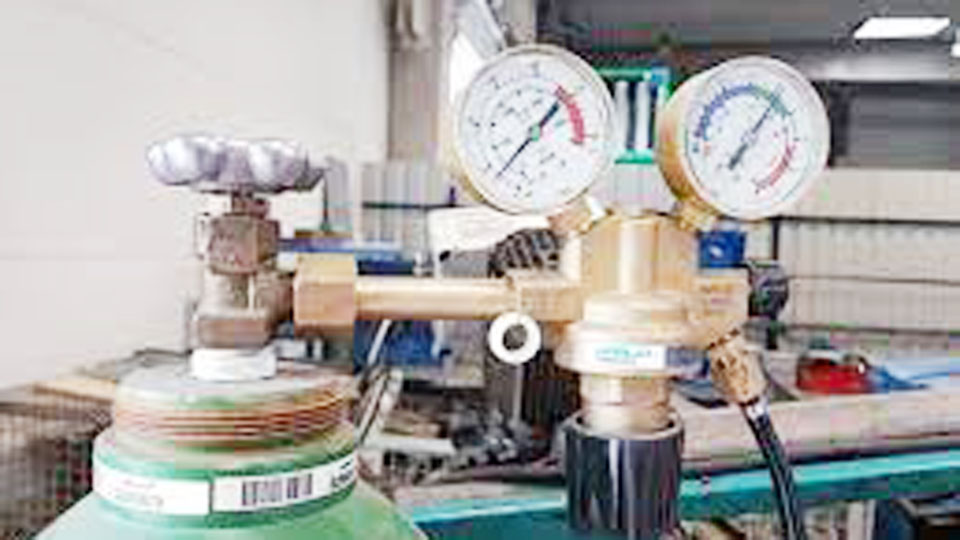
Yes, you can MIG weld with 100% Argon gas. This gas provides excellent shielding properties. MIG welding with 100% Argon is suitable for welding non-ferrous metals like aluminum and magnesium.
The use of pure Argon gas helps prevent atmospheric contamination during the welding process. It creates a stable arc and produces clean welds with minimal spatter.

Image by weld com
When welding steel, a mixture of Argon and CO2 is more commonly used for better penetration and productivity.
100% Argon gas is a versatile option for various welding applications, offering good results and ease of use for MIG welding projects.
About Mig Welding
MIG welding, or Metal Inert Gas welding, is a popular method for joining metals.
Basics Of Mig Welding
MIG welding uses a wire electrode to create an electrical arc that melts and fuses metal pieces together.
Shielding Gases
Shielding gases protect the weld from atmospheric contaminants, ensuring a clean and strong weld.
In MIG welding, 100% Argon gas can be used as a shielding gas, especially for welding non-ferrous metals like aluminum.
Characteristics Of Argon Gas
Argon gas is commonly used for MIG welding due to its stable arc characteristics. Welding with 100% argon can result in better penetration and reduced spatter, ideal for welding non-ferrous metals like aluminum. It provides excellent shielding properties, making it a popular choice for various welding applications.
Properties Of Argon
Argon is an inert gas with excellent stability and low reactivity. It is colorless, odorless, and tasteless.
Why Argon Is Common In Welding
Argon is commonly used in welding due to its ability to shield the weld area from atmospheric contamination. Characteristics of Argon Gas: Argon gas has unique properties that make it ideal for welding applications.
It provides excellent protection for the weld pool, preventing oxidation and contamination. The stable nature of argon ensures a clean and strong weld, making it a popular choice among welders.
Combining Mig Welding With Argon
Discover the versatility of MIG welding with 100% argon gas. Achieve cleaner welds with reduced spatter and enhanced arc stability. Ideal for welding non-ferrous metals like aluminum, ensuring high-quality results.
Feasibility Of 100% Argon In Mig Welding
MIG welding is an efficient and versatile welding process that uses a consumable wire electrode and a shielding gas to join two metal pieces. Argon gas is commonly used as a shielding gas in MIG welding to protect the weld from atmospheric contamination.
Using 100% argon gas in MIG welding is not always feasible as it can lead to several issues. One of the main issues is that argon gas is not as effective in preventing oxidation as compared to other gases like CO2 or a mix of argon and CO2.
This can result in poor weld quality and reduced penetration. Pure argon gas requires higher voltage and current to achieve the same weld penetration as compared to other gases.
Potential Challenges
Using 100% argon in MIG welding can also lead to other challenges such as increased spatter, reduced travel speeds, and difficulty in maintaining a stable arc. The increased spatter can lead to a rough weld surface and can also cause damage to the welding equipment.
The reduced travel speeds can lead to longer welding times, which can increase the overall cost of the welding project. To overcome these challenges, it is recommended to use a mix of argon and CO2 gases in MIG welding.
The CO2 gas provides better penetration and reduces spatter, while the argon gas helps to stabilize the arc and improve weld quality. The most commonly used mix is 75% argon and 25% CO2.
While using 100% argon gas in MIG welding is possible, it can lead to several challenges and may not be the most effective option.
Using a mix of argon and CO2 gases can help to overcome these challenges and provide better weld quality and efficiency.
Comparing Shielding Gases
Argon Vs. Mixed Gases
When it comes to MIG welding, the choice of shielding gas plays a crucial role in determining the quality of the weld.
Argon, a noble gas, and mixed gases, a combination of argon and carbon dioxide, are the two primary options available for MIG welding. Let’s compare the two.
Impact On Weld Quality
The choice between argon and mixed gases can have a significant impact on the quality of the weld. While argon provides better stability and a more controlled arc, mixed gases offer deeper penetration and higher productivity.
Technical Considerations
When it comes to MIG welding with 100% Argon gas, there are several technical considerations to keep in mind. Understanding the adjustments needed and equipment compatibility is crucial for achieving optimal welding results.
Adjustments For Using 100% Argon
When using 100% Argon for MIG welding, it’s important to make specific adjustments to the welding setup. Since Argon has different properties than the commonly used mixtures, the following adjustments are necessary:
- Higher Voltage Settings: Increase the voltage to compensate for the lower heat conductivity of Argon.
- Increased Flow Rate: Adjust the gas flow rate to ensure proper shielding and arc stability.
- Wire Type and Size: Consider using a smaller wire size for better control and penetration.
Equipment Compatibility
Not all MIG welding equipment is compatible with 100% Argon gas. It’s essential to ensure that the welding machine, gun, and consumables are suitable for use with pure Argon. Compatibility considerations include:
Gas Regulator: Check if the regulator is designed to handle 100% Argon and adjust the settings accordingly.
Nozzle and Contact Tip: Verify that the nozzle and contact tip are compatible with Argon to prevent issues during welding.
Welding Wire: Choose welding wire specifically recommended for use with 100% Argon to avoid potential feeding and deposition problems.
Material Specifics
Yes, you can MIG weld with 100% argon, but it’s best for non-ferrous metals like aluminum. For steel, a mix of argon and CO2 is more suitable. The pure argon shielding gas can lead to poor penetration and weak welds on steel.
Suitable Metals For 100% Argon Mig Welding
When using 100% argon for MIG welding, certain metals are more suitable for this process due to their compatibility with pure argon gas.
Stainless Steel: 100% argon MIG welding is well-suited for stainless steel due to its ability to provide good penetration and minimize spatter.
Aluminum: While not as common as using a mixed gas for aluminum welding, 100% argon can be used for thinner aluminum materials.
Copper: This metal can also be welded using 100% argon, particularly for applications where aesthetics are important.
Limitations For Certain Metals
Despite its benefits, 100% argon MIG welding also has limitations when it comes to certain metals.
| Metal | Limitation |
|---|---|
| Carbon Steel | Not ideal for thicker carbon steel due to the lack of oxide cleaning action provided by CO2 or other mixed gases. |
| Aluminum | Not suitable for thicker aluminum materials as it may result in insufficient penetration and lack of cleaning action. |
Practical Applications
When it comes to MIG welding with 100% argon, understanding its practical applications is crucial for achieving optimal results.
Let’s explore the practical uses of 100% argon in MIG welding, from industry examples to specific scenarios where this shielding gas is most effective.
When To Use 100% Argon
Understanding the specific conditions and materials suitable for 100% argon in MIG welding is essential for achieving high-quality welds. Here are some instances when using 100% argon is advantageous:
- Welding non-ferrous metals such as aluminum and copper
- Thin gauge materials where a lower heat input is required
- Applications requiring minimal spatter and excellent bead appearance
Industry Examples
Various industries leverage the benefits of using 100% argon in MIG welding to achieve superior results. Some notable industry examples include:
| Industry | Application |
|---|---|
| Automotive | Welding aluminum components with precision |
| Aerospace | Joining thin gauge aluminum panels for aircraft structures |
| Electronics | Creating clean welds on copper components |
Expert Opinions
Expert opinions suggest that using 100% Argon for MIG welding may not be ideal. The high cost and potential porosity issues are reasons to avoid it. A mix of Argon and CO2 is recommended for better results and cost efficiency.
Mig welding is a popular welding process that uses a consumable wire electrode to join two metal pieces. Argon gas is often used as a shielding gas in mig welding to prevent oxidation and contamination of the weld pool. But can you mig weld with 100% argon? Let’s hear what the experts have to say.
Professional Recommendations
According to professional welders, mig welding with 100% argon is not recommended. While argon provides excellent shielding, it does not have the same oxidizing properties as other gases like CO2.
This can lead to poor penetration and weak welds. Instead, a mixture of argon and CO2, such as 75/25 or 90/10, is recommended for mig welding. These mixtures provide better penetration and stronger welds.
Alternative Solutions
If you don’t have access to a mixture of argon and CO2, there are alternative solutions you can try. One option is to use a flux-cored wire instead of solid wire.
Flux-cored wire contains a flux compound that produces a shielding gas when heated, eliminating the need for an external gas.
Another option is to use a different welding process, such as TIG welding, which uses pure argon gas for shielding. In conclusion, while it may be tempting to use 100% argon for mig welding, it is not recommended by professionals.
Instead, use a mixture of argon and CO2 or try an alternative solution like flux-cored wire or TIG welding. By following these recommendations, you can ensure strong, quality welds every time.
Conclusion
Using 100% argon for MIG welding can be effective for certain applications, particularly when working with non-ferrous metals.
However, it’s crucial to consider the specific requirements of your project and consult with welding experts to determine the most suitable gas mixture for optimal results. Experimentation and professional guidance are key to achieving successful MIG welding outcomes.